1994–95 Gillingham F.C. season
During the 1994–95 English football season, Gillingham F.C. competed in the Football League Third Division, the fourth tier of the English football league system. It was the 63rd season in which Gillingham competed in the Football League, and the 45th since the club was voted back into the league in 1950. In January 1995, after several seasons spent near the bottom of the Football League and nearly a decade of financial difficulties, the club was declared insolvent and placed in administrative receivership. Mike Flanagan was made redundant as the club's manager and replaced by experienced player Neil Smillie for the remainder of the season. Gillingham finished the season 19th in the Third Division, but the club's continued existence remained in doubt. In June, however, the club was saved from going out of business when it was purchased by businessman Paul Scally.
| 1994–95 season | |||
|---|---|---|---|
| Chairman | Bernard Baker (until 30 March)[1] | ||
| Manager | Mike Flanagan (until 28 February) Neil Smillie (from 28 February) | ||
| Third Division | 19th | ||
| FA Cup | Third round | ||
| League Cup | First round | ||
| League Trophy | Second round | ||
| Top goalscorer | League: Chris Pike (13) All: Chris Pike (18) | ||
| Highest home attendance | 10,425 vs Sheffield Wednesday (7 January 1995) | ||
| Lowest home attendance | 963 vs Brighton & Hove Albion (27 September 1994) | ||
|
| |||



Gillingham also competed in three knock-out competitions. The team were eliminated at the earliest stage of both the Football League Cup and the Football League Trophy but reached the third round of the FA Cup, at which stage they lost to Sheffield Wednesday of the FA Premier League. The team played a total of 50 competitive matches, winning 12, drawing 12, and losing 26. Chris Pike was the team's leading goalscorer with 18 goals. Paul Watson made the most appearances for the team, playing 47 times. The highest attendance recorded at the club's home ground, Priestfield Stadium, was 10,425, for the FA Cup game against Sheffield Wednesday. The lowest attendance was 963, for a Football League Trophy game against Brighton & Hove Albion, which was the smallest crowd recorded for a competitive match at Priestfield for more than 20 years.
Background and preseason
The 1994–95 season was Gillingham's 63rd season playing in the Football League and the 45th since the club was elected back into the League in 1950 after being voted out in 1938. It was the club's sixth consecutive season in the fourth tier of the English football league system, which had been named the Football League Third Division since 1992. Since being relegated to the fourth tier in 1989, Gillingham had only once finished in the top half of the league table, with a low point in the 1992–93 season when the team finished 21st out of 22 teams and narrowly avoided being relegated into non-League football. In the 1993–94 season, Gillingham had finished 16th.
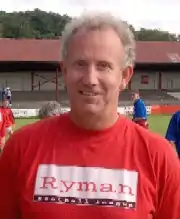
At the start of the 1994–95 season, Mike Flanagan was the club's manager, a position he had held since the summer of 1993. He was assisted by Neil Smillie, who held the position of player-coach.[2] Adrian Foster, a forward, was the only new player to join the club before the start of the season, arriving from Torquay United for a transfer fee of £60,000 (equivalent to £120,000 in 2020).[3] Gillingham lost their top goalscorer of the previous season, however, as Nicky Forster rejected the offer of a new contract and left to join Brentford of the Second Division, for which Gillingham received a fee of £320,000 (equivalent to £650,000 in 2020).[4]
The club retained the previous season's kit, which had been designed to mark the club's centenary and added panels of black and white stripes to the usual blue shirts, which were worn with white shorts and socks;[5] the club's original shirts when it was founded in 1893 featured black and white stripes.[6] The second-choice kit, to be worn in the event of a clash of colours with the opposition, was all red with similar black and white panels on the shirts.[5] The team prepared for the new season with a number of friendly matches, including a testimonial match for Ron Hillyard, who played for the club from 1974 until 1990, and a delayed match to mark the club's centenary. Arsenal of the FA Premier League provided the opposition for the centenary match; the same club, then known as Woolwich Arsenal, had been the opposition in the first match contested by Gillingham, then known as New Brompton, in 1893.
Third Division
August–December
.jpg.webp)
Gillingham's first match was at home to Hartlepool United and resulted in a goalless draw. Foster made his debut, but had to be substituted after injuring his ankle. Although he was able to continue playing for two weeks, the injury then recurred and kept him out of the team until November.[3] He scored his first goal for the team in the second league match of the season, a 3–0 victory away to Wigan Athletic; this was Gillingham' biggest win away from home for more than three years.[7] The team extended their unbeaten run from the start of the season to three games with a 1–1 draw at home to Rochdale but then lost away games against Scunthorpe United and Exeter City. In Foster's absence, Andy Arnott was brought into the starting line-up against Scunthorpe for the first time since the opening game of the season,[8] but neither he nor fellow forward Paul Baker was able to score in either game, with both finishing 3–0 to Gillingham's opponents.[9] In response to the lack of goals, Flanagan signed Scottish forward Paul Ritchie on loan from Dundee.[10] It was the second loan spell at Priestfield Stadium for Ritchie, who had played six Third Division games for Gillingham in 1993.[10] He scored on his second debut for Gillingham to help the team to a 3–1 win at home to Scarborough on 10 September.[9]
Following the victory over Scarborough, Gillingham began a run of consecutive defeats, losing at home to Preston North End and away to Hartlepool and Walsall. With Foster still out of action and Ritchie due to return to Dundee, Flanagan signed experienced Welsh forward Chris Pike from Hereford United for £15,000 (equivalent to £30,000 in 2020);[11] he made his debut on 1 October at home to Mansfield Town.[8] The match resulted in a fourth consecutive league defeat, leaving Gillingham 20th in the table, only two places off the bottom of the entire Football League.[12][13] A week later, Pike scored his first goal at home to Torquay United as Gillingham won 1–0 to end the run of defeats. He scored four more goals in the next four games, which resulted in two defeats, one win, and one draw, after which Gillingham had risen to 17th in the table.
Gillingham extended their unbeaten league run to four games with two more draws in the last two games of November, but then began December with consecutive defeats at home to Wigan Athletic and away to Rochdale; in the latter game Foster scored his first goal since August. The team ended the year by playing three games in six days. On Boxing Day the team won 4–1 at home to Fulham, the first time Gillingham had scored four goals in a game for nearly two years. The attendance of 4,737 was the largest of the season for a Third Division game at Priestfield.[12] The following day Gillingham lost 1–0 away to Barnet, beginning a run of three consecutive defeats. The team's final match of 1994 was at home to Carlisle United on New Year's Eve; Carlisle won 1–0 meaning that Gillingham finished the year 18th in the table.[12][14] Although the team had only lost 3 of 10 league games at Priestfield up to this point in the season, their league position suffered from the fact that they had only won once and drawn twice in 11 games on their opponents' grounds, the worst away record in the division.
January–May
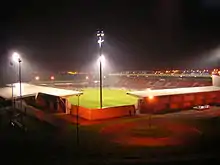
On 9 January, the club was declared insolvent and placed in administrative receivership; after nearly a decade of financial difficulties, the club's debts were estimated at approximately £2 million (equivalent to £3.9 million in 2020). Administrators from accountants Kidsons Impey took over the day-to-day running of the club while searching for a buyer.[15][16] The first game after this announcement was away to Northampton Town and resulted in a 2–0 defeat for Gillingham, the team's third consecutive league defeat. The next game, which did not take place until 4 February due to the postponement of several scheduled matches, was a goalless draw at home to Lincoln City, the fourth consecutive league game in which the team had failed to score; the result meant that Gillingham had again slipped to 20th in the table. The team ended the goalless run with a 2–1 victory away to Doncaster Rovers in the first game of February, Pike scoring twice.[12] It was the first time Gillingham had won away from home in the Third Division since August.[12] The team's form away from home remained largely poor, however; they played three further away matches during February, against Chesterfield, Darlington and Mansfield Town, and lost all three without scoring a goal.
On 28 February, three days after the defeat away to Mansfield, the administrators took the decision to make Flanagan redundant; Smillie was appointed player-manager for the remainder of the season.[17] His first game in charge resulted in a 3–1 defeat at home to Walsall.[12] Following this game, however, Gillingham did not lose for five games, their longest unbeaten run of the season.
Gillingham finished 19th in the 22-team Third Division.[18]
Match details
- Key
|
|
- Results[12]
| Date | Opponents | Result | Goalscorers | Attendance |
|---|---|---|---|---|
| 13 August 1994 | Hartlepool United (H) | 0–0 | 2959 | |
| 20 August 1994 | Wigan Athletic (A) | 3–0 | Foster, Reinelt, Watson | 1514 |
| 27 August 1994 | Rochdale (H) | 1–1 | Butler | 3009 |
| 30 August 1994 | Scunthorpe United (A) | 0–3 | 2098 | |
| 3 September 1994 | Exeter City (A) | 0–3 | 2241 | |
| 10 September 1994 | Scarborough (H) | 3–1 | Palmer, Ritchie, Baker | 2438 |
| 13 September 1994 | Preston North End (H) | 2–3 | Smith, Baker | 2653 |
| 17 September 1994 | Hartlepool United (A) | 0–2 | 1756 | |
| 24 September 1994 | Walsall (A) | 1–2 | Micklewhite | 3654 |
| 1 October 1994 | Mansfield Town (H) | 0–2 | 2569 | |
| 8 October 1994 | Torquay United (H) | 1–0 | Pike | 2450 |
| 15 October 1994 | Hereford United (A) | 1–2 | Arnott | 2470 |
| 22 October 1994 | Bury (A) | 2–3 | Pike (2, 1 pen.) | 2976 |
| 29 October 1994 | Darlington (H) | 2–1 | Pike, Smillie | 2841 |
| 5 November 1994 | Colchester United (A) | 2–2 | Reinelt, Pike | 3817 |
| 19 November 1994 | Chesterfield (H) | 1–1 | Reinelt | 2730 |
| 26 November 1994 | Lincoln City (A) | 1–1 | Arnott | 2919 |
| 10 December 1994 | Wigan Athletic (H) | 0–1 | 2257 | |
| 17 December 1994 | Rochdale (A) | 1–2 | Foster | 1665 |
| 26 December 1994 | Fulham (H) | 4–1 | Reinelt, Micklewhite, Foster (2) | 4737 |
| 27 December 1994 | Barnet (A) | 0–1 | 2074 | |
| 31 December 1994 | Carlisle United (H) | 0–1 | 3709 | |
| 14 January 1995 | Northampton Town (A) | 0–2 | 5529 | |
| 4 February 1995 | Lincoln City (H) | 0–0 | 4191 | |
| 7 February 1995 | Doncaster Rovers (A) | 2–1 | Pike (2) | 1740 |
| 11 February 1995 | Chesterfield (A) | 0–2 | 3070 | |
| 18 February 1995 | Northampton Town (H) | 3–1 | Ramage, Green, Foster | 4072 |
| 21 February 1995 | Darlington (A) | 0–2 | 1548 | |
| 25 February 1995 | Mansfield Town (A) | 0–4 | 3182 | |
| 4 March 1995 | Walsall (H) | 1–3 | Foster | 3757 |
| 11 March 1995 | Scarborough (A) | 0–0 | 1949 | |
| 18 March 1995 | Scunthorpe United (H) | 2–2 | Foster, Pike | 2501 |
| 25 March 1995 | Exeter City (H) | 3–0 | Foster, Pike (pen.), Butler | 3364 |
| 1 April 1995 | Preston North End (A) | 1–1 | Dunne | 9095 |
| 4 April 1995 | Bury (H) | 1–1 | Brown | 2957 |
| 8 April 1995 | Carlisle United (A) | 0–2 | 6786 | |
| 11 April 1995 | Colchester United (H) | 1–3 | Watson | 3404 |
| 15 April 1995 | Barnet (H) | 2–1 | Brown, Pike | 3457 |
| 17 April 1995 | Fulham (A) | 0–1 | 3612 | |
| 22 April 1995 | Doncaster Rovers (H) | 4–2 | o.g., Pike (3) | 3069 |
| 29 April 1995 | Hereford United (H) | 0–0 | 4200 | |
| 6 May 1995 | Torquay United (A) | 1–3 | o.g. | 2638 |
Cup matches
FA Cup
As a Third Division team, Gillingham entered the 1994–95 FA Cup in the first round and were paired with Heybridge Swifts of the Isthmian League First Division, three levels lower in the English football league system. Gillingham defeated their semi-professional opponents 2–0. In the second round, they played fellow Third Division team Fulham at Priestfield; the initial match finished 1–1, necessitating a replay at Fulham's Craven Cottage stadium. The replay also finished 1–1 but the rules of the competition meant that on this occasion extra time was played; Robbie Reinelt scored the winning goal during the extra period. In the third round, Gillingham played Sheffield Wednesday of the FA Premier League; the match drew a crowd of 10,425, the largest attendance recorded at Priestfield since 1987. Wednesday took a 2–0 lead in the first half and, despite having their starting goalkeeper, Kevin Pressman, sent off and Pike scoring from a penalty kick, the Premier League team held on for a 2–0 victory.
Football League Cup
As a Third Division team, Gillingham entered the 1994–95 Football League Cup in the first round and were paired with Reading of the Football League First Division, the second tier of English football. Gillingham lost the first leg of the two-legged tie 1–0 and the second 3–0 and were eliminated from the competition by an aggregate score of 4–0.
Football League Trophy
The 1994–95 Football League Trophy, a tournament exclusively for Second and Third Division teams, began with a preliminary round in which the teams were drawn into groups of three, contested on a round-robin basis. Gillingham were grouped with Brentford and Brighton & Hove Albion, both of the Second Division. Gillingham's first match was at home to Brighton and resulted in a 1–1 draw;[19] the game drew an attendance of only 963, the lowest crowd for a competitive match at Priestfield since 1973.[20]
Player details
During the course of the season, 31 players played for Gillingham in competitive matches. Paul Watson made the most appearances, playing in 47 of the team's 50 games. He missed three Third Division matches but played in every game in the FA Cup, League Cup, and League Trophy. Four other players made over 40 appearances: Richard Green (44), Steve Banks and Gary Micklewhite (both 43), and Tony Butler (40). In contrast, both Jon Hooker and Abdul Kamara played only in one League Trophy match; in both cases it was the only appearance the player ever made for Gillingham.
Seventeen players scored at least one goal for Gillingham during the season. Pike was the top scorer with 13 goals in the Third Division and 18 in total. Foster was the only other player to reach double figures, scoring 10 times in total.
| Player | Position | Third Division | FA Cup | League Cup | League Trophy | Total | |||||
|---|---|---|---|---|---|---|---|---|---|---|---|
| Apps | Goals | Apps | Goals | Apps | Goals | Apps | Goals | Apps | Goals | ||
| Andy Arnott | 28 | 2 | 4 | 0 | 2 | 0 | 2 | 0 | 36 | 2 | |
| Paul Baker | 8 | 2 | 0 | 0 | 2 | 0 | 0 | 0 | 10 | 2 | |
| Steve Banks | 38 | 0 | 4 | 0 | 0 | 0 | 1 | 0 | 43 | 0 | |
| Scott Barrett | 4 | 0 | 0 | 0 | 2 | 0 | 2 | 0 | 8 | 0 | |
| Mick Bodley | 7 | 0 | 0 | 0 | 0 | 0 | 1 | 0 | 8 | 0 | |
| Steve Brown | 8 | 2 | 0 | 0 | 0 | 0 | 0 | 0 | 8 | 2 | |
| Tony Butler | 33 | 2 | 3 | 0 | 2 | 0 | 2 | 0 | 40 | 2 | |
| Richard Carpenter | 29 | 0 | 4 | 0 | 0 | 0 | 2 | 1 | 35 | 1 | |
| Joe Dunne | 35 | 1 | 1 | 0 | 2 | 0 | 1 | 0 | 39 | 1 | |
| Adrian Foster | 29 | 8 | 3 | 0 | 2 | 0 | 1 | 2 | 35 | 10 | |
| Darren Freeman | 2 | 0 | 0 | 0 | 0 | 0 | 0 | 0 | 2 | 0 | |
| Richard Green | 37 | 1 | 4 | 0 | 2 | 0 | 1 | 0 | 44 | 1 | |
| Jon Hooker | 0 | 0 | 0 | 0 | 0 | 0 | 1 | 0 | 1 | 0 | |
| Ian Hutchinson | 5 | 0 | 0 | 0 | 0 | 0 | 2 | 0 | 7 | 0 | |
| Abdul Kamara | 0 | 0 | 0 | 0 | 0 | 0 | 1 | 0 | 1 | 0 | |
| Andy Kennedy | 2 | 0 | 0 | 0 | 0 | 0 | 0 | 0 | 2 | 0 | |
| Gareth Knott | 5 | 0 | 0 | 0 | 0 | 0 | 0 | 0 | 5 | 0 | |
| Scott Lindsey | 12 | 0 | 0 | 0 | 0 | 0 | 1 | 0 | 13 | 0 | |
| Eliot Martin | 7 | 0 | 0 | 0 | 0 | 0 | 0 | 0 | 7 | 0 | |
| Gary Micklewhite | 35 | 2 | 4 | 0 | 2 | 0 | 2 | 0 | 43 | 2 | |
| Lee Palmer | 10 | 1 | 0 | 0 | 2 | 0 | 2 | 0 | 14 | 1 | |
| Chris Pike | 27 | 13 | 4 | 4 | 0 | 0 | 2 | 1 | 33 | 18 | |
| Andy Ramage | 13 | 1 | 0 | 0 | 0 | 0 | 2 | 0 | 15 | 1 | |
| Robbie Reinelt | 27 | 4 | 4 | 2 | 2 | 0 | 3 | 0 | 36 | 6 | |
| Paul Ritchie | 5 | 1 | 0 | 0 | 0 | 0 | 1 | 0 | 6 | 1 | |
| Neil Smillie | 15 | 1 | 3 | 0 | 0 | 0 | 1 | 0 | 19 | 1 | |
| Neil Smith | 33 | 1 | 3 | 0 | 2 | 0 | 1 | 0 | 39 | 1 | |
| Robin Trott | 9 | 0 | 0 | 0 | 0 | 0 | 1 | 0 | 10 | 0 | |
| Paul Watson | 39 | 2 | 4 | 0 | 2 | 0 | 2 | 0 | 47 | 2 | |
| Grant Watts | 3 | 0 | 0 | 0 | 0 | 0 | 1 | 0 | 4 | 0 | |
| Paul Wilson | 2 | 0 | 0 | 0 | 0 | 0 | 0 | 0 | 2 | 0 | |
Aftermath
At the end of the 1994–95 season, with no rescue deal finalised, fans were unsure whether the club would still be in existence to start the next season;[21] one takeover bid had already collapsed when the leader of the consortium resigned after adverse publicity surrounding his financial status.[22][23] In early June, however, shareholders and creditors voted overwhelmingly to accept a takeover bid from Sevenoaks-based businessman Paul Scally, who paid a nominal fee to purchase the club.[24][25] The deal was finalised at the end of the month, one day before a deadline imposed on the club by the Football League to be out of receivership or face expulsion, and Scally was officially named as the club's new chairman.[26][27] Having signed many new players, Gillingham began the 1995–96 season strongly and remained in the top three positions in the Third Division for the entire season, finishing in second place. The club thus gained promotion to the Second Division seven years after being relegated from the third tier.
References
- Rollin 1995, p. 23.
- Triggs 2001, p. 299.
- Triggs 2001, p. 123.
- Triggs 2001, p. 122.
- Rollin 1995, p. 167.
- Triggs 1999, p. 12.
- Brown 2003, pp. 101–104.
- Rollin 1995, p. 169.
- Rollin 1995, pp. 168–169.
- Triggs 2001, p. 276.
- Triggs 2001, p. 255.
- Rollin 1995, p. 168.
- "League Division 3 table after close of play on 01 October 1995". 11v11. AFS Enterprises. Retrieved 14 December 2021.
- "League Division 3 table after close of play on 31 December 1995". 11v11. AFS Enterprises. Retrieved 14 December 2021.
- Elligate 2009, p. 14.
- Moore, Glenn (27 March 1995). "Football Commentary : Little pity for the poor relations". The Independent. Retrieved 9 August 2021.
- Elligate 2009, p. 43.
- Brown 2003, p. 104.
- Rollin 1995, p. 596.
- Brown 2003, pp. 84–104.
- Elligate 2009, p. 81.
- Redding, Mark (3 April 1995). "Soccer: Kendall shock at 'ruthless' dismissal". The Guardian. Retrieved 14 July 2021 – via Gale.
- Hodgson, Guy (2 April 1995). "United in row over injections". The Independent. Retrieved 14 July 2021.
- Elligate 2009, p. 105.
- Kelso, Paul (15 February 2002). "Scally's rocky road to Highbury". The Guardian. Archived from the original on 26 January 2008. Retrieved 26 May 2011.
- Elligate 2009, p. 109.
- Farrell, John (13 August 1995). "Football: Inglorious for Wigan". The Observer. Retrieved 21 July 2021 – via Gale.
Works cited
- Brown, Tony (2003). The Definitive Gillingham F.C.: A Complete Record. Nottingham: Soccerdata. ISBN 1-899468-20-X.
- Elligate, David (2009). Gillingham FC On This Day. Durrington: Pitch Publishing. ISBN 978-1-9054-1145-0.
- Rollin, Glenda; Rollin, Jack, eds. (1996). Rothmans Football Yearbook 1995–96. London: Headline Publishing Group. ISBN 978-0-74727-823-8.
- Triggs, Roger (1999). Images of England: Gillingham Football Club. Stroud: Tempus Publishing Ltd. ISBN 0-7524-1567-0.
- Triggs, Roger (2001). The Men Who Made Gillingham Football Club. Stroud: Tempus Publishing Ltd. ISBN 0-7524-2243-X.
{{1994–95 in English football}}