2023 Turkish general election
General elections are scheduled to occur on or before 18 June 2023[1] in Turkey. Voters will elect a new president, as well as 600 members of the Grand National Assembly of Turkey, each for a term of five years.
 | ||||||||||||||||||||||||||
| Opinion polls | ||||||||||||||||||||||||||
| ||||||||||||||||||||||||||
| ||||||||||||||||||||||||||
Background
Elections of 2018
The previous Turkish general election took place on 24 June 2018. The election marked the country's transition from a parliamentary system to a presidential one, as narrowly endorsed by voters in the controversial 2017 constitutional referendum. That election resulted in a victory for incumbent president Recep Tayyip Erdoğan, who had held the position since 2014. Meanwhile, the ruling Justice and Development Party (AKP) lost its absolute majority in the Grand National Assembly of Turkey for the first time since June 2015, forcing it to rely on its ally, the Nationalist Movement Party (MHP) of Devlet Bahçeli, to pass legislation. The office of the Prime Minister of Turkey was abolished on 12 July 2018, and its last holder, Binali Yıldırım, took office as the Speaker of the Grand National Assembly.
Although there were speculations about a snap election that was supposed to be held in 2023, Bahceli ruled them out. In a written statement, he said that elections would not be held before 2023. He also confirmed that the current coalition between AKP and MHP will remain intact and Erdogan will be their joint nominee for President.[2]
Electoral system
The President of Turkey, who serves as the country's head of state and government, is directly elected through the two-round system, under which a candidate must obtain an absolute majority of votes in order to be elected. If no candidate secures an overall majority outright, a runoff is held between the two most voted-for candidates from the first round, the winner of which is then declared elected. This electoral system was first introduced for the 2014 presidential elections, when it replaced a system of indirect elections under which the president was elected by parliament. The president is subject to term limits, and may serve two times at five-year terms. Some jurists and opposition politicians said that since Erdoğan was already elected two times, if the Turkish parliament doesn't decide to call a snap election, he cannot be a candidate again.[3] The rule for the president to serve a maximum limit of two terms was introduced in the 2007 constitutional referendum, but this rule wasn't changed in the 2017 constitutional referendum.[4] With the 2017 constitutional referendum, the right to decide snap election were given to the president and 3/5 of the total number of MPs on Turkish parliament (at least 360 MPs). According to constitution if the parliament decides for snap elections in the second term of the president, the president will be a candidate again. However, it has been speculated that incumbent president Recep Tayyip Erdoğan could be eligible to seek a third term in 2023, since the current executive presidential system was only fully implemented after the conclusion of his first term in office, meaning that his period in power from 2014 to 2018 would not count towards his two-term limit according to some jurists.[5]
In order to participate in a presidential election, a candidate must have received the nomination of a political party that either obtained 5% of the vote in the most recent parliamentary election, or that holds at least 20 seats in parliament. Other prospective candidates may still obtain ballot access if they are able to collect signatures from 100,000 eligible voters.[6]
The Grand National Assembly of Turkey is composed of 600 members, who serve five-year terms adjacent to those of the president. These representatives are elected through a form of party-list proportional representation from 87 electoral districts, by the D'Hondt method. The electoral districts largely correspond to the provinces of Turkey, though provinces with larger populations are divided into multiple districts. Specifically, Istanbul and Ankara are each divided into three districts, while Izmir and Bursa are divided in two. Political parties must be officially organised in at least half of the country's provinces (41 or more) and in at least a third of districts in those provinces, and must nominate two candidates in 41 or more provinces, in order to be entitled to seats. Since the introduction of the Constitution of 1982, political parties are also required to pass an electoral threshold of 10% in order to qualify for seats in parliament. Parties that fail to cross the threshold are disregarded for seat allocation purposes.
Electoral districts
|
|
|
|
|
|
|
| |||||||||||||||||||||||||||||||||||||||||||||||||||||||||||||||||||||||||||||||||||||||||||||||||||||||||||||||||||||||||||||||||||||||||||||||||||||||||||||||||||||||||||||||||||||||||||||||||||||||||||||||||||||||||||||||||||||||||||||||||||||||||||||||||||||||||||||||||||||||||||||||||||||||
Candidates
Potential
- Recep Tayyip Erdoğan, incumbent president[7]
- Kemal Kılıçdaroğlu, chairman of the Republican People's Party, leader of the opposition[8]
Publicly expressed interest
- Cem Uzan, former leader of the Young Party (GP)[9]
- Muharrem İnce, leader of the Homeland Party, 2018 presidential candidate[10]
Declined to be candidates
- Meral Akşener, leader of the İYİ Party, 2018 presidential candidate[11]
Candidates and parties
Presidential candidates
 |
|
|
|
|
| to be determined | to be determined | to be determined | to be determined | to be determined |
| AKP | CHP | HDP | MHP | İYİ |
Contesting parties
| Justice and Development Party | Republican People's Party | Peoples' Democratic Party | Nationalist Movement Party | İyi Party |
|---|---|---|---|---|
295 / 600 |
146 / 600 |
67 / 600 |
49 / 600 |
43 / 600 |
Other parties also wish to contest the election, but the Interior Ministry has not yet registered them all.[12]
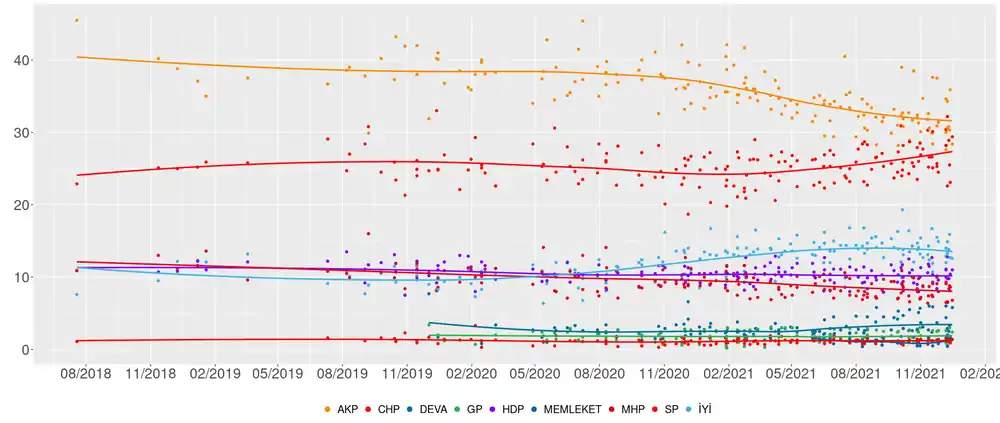
Opinion polls
Parliamentary election
References
- "Cumhurbaşkanının Üçüncü Defa Seçilmesi". www.sen.av.tr (in Turkish). 26 February 2021. Retrieved 21 June 2021.
- "General elections to be held in 2023, early polls out of question, MHP's Bahçeli says | Daily Sabah". General elections to be held in 2023, early polls out of question, MHP’s Bahçeli says. Sep 7, 2020. Retrieved Dec 23, 2020.
- "Anayasa hukukçuları cevapladı: Erdoğan'ın yeniden aday olup olamayacağına Cumhur İttifakı'nın değiştirmek istediği Anayasa Mahkemesi mi karar verecek?". Independent Turkish (in Turkish). 3 October 2020. Retrieved 19 June 2021.
- "82 Anayasası'nda yapılan değişiklikler". Cumhuriyet (in Turkish). 30 March 2010. Retrieved 19 June 2021.
- "Turkey election: Erdogan wins re-election as president". BBC News. 25 June 2018. Retrieved 4 July 2018.
- "VP leader Perinçek reaches 100,000 signatures to run in elections". Hürriyet Daily News. 9 May 2018. Retrieved 4 July 2018.
- "Bahçeli: 2023'te adayımız Recep Tayyip Erdoğan'dır". www.sozcu.com.tr (in Turkish). Retrieved 2021-10-27.
- Welle (www.dw.com), Deutsche. "Kılıçdaroğlu aday olacak mı? | DW | 07.07.2021". DW.COM (in Turkish). Retrieved 2021-10-27.
- "Cem Uzan'dan adaylık açıklaması". www.cumhuriyet.com.tr. Retrieved Dec 23, 2020.
- Gazetesi, Dünya (2021-09-18). "Muharrem İnce: Açıklıyorum aday adayıyım". www.dunya.com (in Turkish). Retrieved 2021-09-20.
- "İYİ Party's Akşener says she will run for prime minister not president - Turkey News". Hürriyet Daily News. Retrieved 2021-10-27.
- Karageldi, Zeynep (2021-06-06). "Q & A with The Turkish Green Party". Global Green News. Retrieved 2021-10-18.
| Presidential elections | |
|---|---|
| Parliamentary elections | |
| Local elections | |
| Senate elections | |
| Referendums | |
| By-elections | |
See also: Elections in the Ottoman Empire | |