6.5×53mmR
The 6.5×53mmR, originally and more correctly produced as the 6.5x53.5mmR, and in the early Imperial (English) nomenclature also known as the .256 Mannlicher, is a late 19th-century rimmed centerfire military rifle cartridge similar to other early smokeless powder designs.
| 6.5×53mmR (6.5x53.5mmR) | ||||||||
|---|---|---|---|---|---|---|---|---|
 Military cartridge | ||||||||
| Type | Military rifle cartridge[1] | |||||||
| Place of origin | Austria-Hungary[1] | |||||||
| Service history | ||||||||
| In service | 1893-1945 | |||||||
| Used by | Netherlands[2] Romania[3] Kingdom of Portugal[4] | |||||||
| Wars | Aceh War World War I[3] World War II[2] | |||||||
| Production history | ||||||||
| Designer | Steyr Mannlicher, Ferdinand Mannlicher | |||||||
| Designed | 1892[3] | |||||||
| Specifications | ||||||||
| Case type | Rimmed, bottleneck[5] | |||||||
| Bullet diameter | 6.65 mm (0.262 in) | |||||||
| Neck diameter | 7.55 mm (0.297 in) | |||||||
| Shoulder diameter | 10.75 mm (0.423 in) | |||||||
| Base diameter | 11.48 mm (0.452 in) | |||||||
| Rim diameter | 13.4 mm (0.53 in) | |||||||
| Rim thickness | 1.25 mm (0.049 in) | |||||||
| Case length | 53.5 mm (2.11 in) | |||||||
| Overall length | 77.47 mm (3.050 in) | |||||||
| Primer type | Berdan | |||||||
| Ballistic performance | ||||||||
| ||||||||
| Source(s): Rifles and Machine Guns[5] .256 Mannlicher / 6.5x53R Reloading Data[6] | ||||||||
History and description
Mannlicher's Model 1891 Rifle was adopted by Romania in 1892 as the Mannlicher M1893 and the Netherlands in 1895. They used the first of a series of 6.5-millimetre (0.26 in) Mannlicher cartridges[1] which became the standard service rifle cartridge for the Romanian Mannlicher M1893 from 1893 to 1938,[3] and the Dutch Geweer M. 95 from 1895 to 1945.[2] Dutch ammunition with cartridge cases made of brass (pre-occupation) or steel (under German occupation) may be encountered on the American surplus market. In both instances, the primer pocket is Berdan-style, of an unusual type (Roth-patent), and features a central flash hole running through the center of the integral Berdan anvil. When examining fired cases from the inside with a flashlight, this design gives the false impression of a Boxer primed cartridge case.
Portugal's Navy adopted this cartridge for the Mannlicher Model 1896, officially known as “Espingarda Portuguesa Mod. 1896”.[7] It was also used by artillery and cavalry units of the Esercito. It was used only shortly until the adoption of the Mauser-Vergueiro, and most were then sent to the colonies. The AE (Arsenal do Esercito) made "M96" 6,5x53R ammo well into the 1930s.[8]
This is the original rimmed or "flanged" cartridge designed by Steyr-Mannlicher for the Romanian and the Dutch military. In the family of Mannlicher cartridges, it is directly related to and the precursor of the later Greek 6.5×54mm Mannlicher–Schönauer rimless cartridge with which it is ballistically identical.[9]
In the military service rifles, these cartridges are loaded primarily by using the Mannlicher designed en-bloc clip as used in the German Gewehr 1888 "Commission" rifle. These pre-date and are similar in concept to the clip used later by the US Army's M1 Garand. With the Ferdinand Mannlicher designed trigger guard / magazine housing assembly, when the bolt is open and fully retracted to the rear the full en-bloc clip is loaded into the magazine from the top through the open receiver. The empty clip will fall out through a hole in the base of the magazine housing when out of cartridges, enabling quick reloading of the rifles during combat. Also when the bolt is fully open, full clips can be vigorously ejected upwards from the magazine housing by means of a spring loaded latch at the rear of the magazine, operated by a recessed button in the front of the trigger guard portion of the assembly. The clips were essentially disposable as ammunition would be issued already loaded into clips from the factory.
The .256 Mannlicher cartridge also saw use as a sporting round. The elephant hunter W. D. M. Bell was fond of a Mannlicher M1893 rifle in .256 Mannlicher, (from renowned English gunmaker George Gibbs), that he used to hunt for meat in Africa.[10]
Additional case dimensions
Based on direct measurement of Dutch and German unfired ammunition averaged and compared to published original sources:[11][12]
| 6.5x53R (.256 Dutch-Mannlicher) | Imperial (in.) | Metric (mm) |
| Shoulder Angle | 25 deg | |
| Length to Shoulder | 1.59 | 40.32 |
| Length to Neck | 1.77 | 45.00 |
Due to very close dimensional relationships, boxer-primed cartridge cases can be made by resizing and trimming .303 British[13] or .30-40 Krag (.30-40 US)[14] brass, and Fire forming the resulting altered brass cases in the 6.5x53R chamber
Gallery
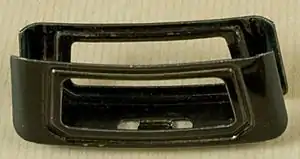 Empty Dutch Mannlicher en-bloc clip
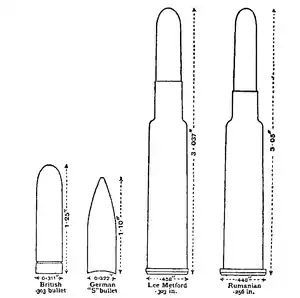 Comparison of .303 British with .256 Mannlicher
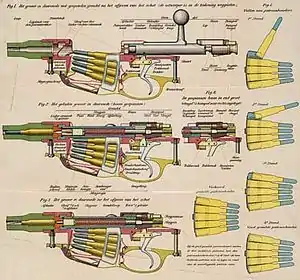 Function diagram of the 6.5x53.5mmR and en-bloc clip
 Romanian Mannlicher M1893
 Dutch Mannlicher M1895
See also
References
- "A Mannlicher Introduction". Mannlicher Collectors Association. Archived from the original on 3 December 2013. Retrieved 29 November 2013.
- Reynolds, Dan. "Reissued Rifles of "The East Asia Co-Prosperity Sphere"". Retrieved 29 November 2013.
- Reynolds, Dan. "The Rifles of Romania 1878-1948". Carbines for Collectors. Retrieved 29 November 2013.
- Philip Peterson (20 July 2011). Standard Catalog of Military Firearms: The Collector's Price and Reference Guide. Gun Digest Books. p. 283. ISBN 978-1-4402-1451-6.
- Johnson, Melvin M., Jr. (1944). Rifles and Machine Guns. New York: William Morrow & Company. p. 384.
- ".256 Mannlicher / 6.5x53R Reloading Data". Load Data. Archived from the original on 2013-12-03. Retrieved 29 November 2013.
- "The Portuguese Mod. 1904 Mauser Vergueiro: With the 98 Mauser just introduced, would you have gone back to the split-bridge receiver of the Gew 88? Portugal did, and the Mod. 1904 served for decades. - Free Online Library".
- Major-General Renato Fernando Marques Pinto, "As Indústrias Militares e as Armas de Fogo Portáteis no Exército Português" Revista Militar 28 May 2010
- https://municion.org/producto/65-x-535-r-dutch-mannlicher-m-1895/
- Bell, WDM. "Chapter One". Karamojo Safari. Safari Press.
- https://loaddata.com/Cartridge/65x53R/811
- https://prehistoire-xixeme.forumactif.org/t1602-rechargement-modification-d-etuis-courant-pour-calibres-obsoletes
- https://bobp.cip-bobp.org/uploads/tdcc/tab-ii/tabiical-en-page74.pdf
- https://bobp.cip-bobp.org/uploads/tdcc/tab-ii/30-40-krag-en.pdf