1068
Year 1068 (MLXVIII) was a leap year starting on Tuesday (link will display the full calendar) of the Julian calendar.
| Millennium: | 2nd millennium |
|---|---|
| Centuries: | |
| Decades: | |
| Years: |
| 1068 by topic |
|---|
| Leaders |
|
| Birth and death categories |
| Births – Deaths |
| Establishments and disestablishments categories |
| Establishments – Disestablishments |
| Gregorian calendar | 1068 MLXVIII |
| Ab urbe condita | 1821 |
| Armenian calendar | 517 ԹՎ ՇԺԷ |
| Assyrian calendar | 5818 |
| Balinese saka calendar | 989–990 |
| Bengali calendar | 475 |
| Berber calendar | 2018 |
| English Regnal year | 2 Will. 1 – 3 Will. 1 |
| Buddhist calendar | 1612 |
| Burmese calendar | 430 |
| Byzantine calendar | 6576–6577 |
| Chinese calendar | 丁未年 (Fire Goat) 3764 or 3704 — to — 戊申年 (Earth Monkey) 3765 or 3705 |
| Coptic calendar | 784–785 |
| Discordian calendar | 2234 |
| Ethiopian calendar | 1060–1061 |
| Hebrew calendar | 4828–4829 |
| Hindu calendars | |
| - Vikram Samvat | 1124–1125 |
| - Shaka Samvat | 989–990 |
| - Kali Yuga | 4168–4169 |
| Holocene calendar | 11068 |
| Igbo calendar | 68–69 |
| Iranian calendar | 446–447 |
| Islamic calendar | 460–461 |
| Japanese calendar | Jiryaku 4 (治暦4年) |
| Javanese calendar | 972–973 |
| Julian calendar | 1068 MLXVIII |
| Korean calendar | 3401 |
| Minguo calendar | 844 before ROC 民前844年 |
| Nanakshahi calendar | −400 |
| Seleucid era | 1379/1380 AG |
| Thai solar calendar | 1610–1611 |
| Tibetan calendar | 阴火羊年 (female Fire-Goat) 1194 or 813 or 41 — to — 阳土猴年 (male Earth-Monkey) 1195 or 814 or 42 |
Events
Byzantine Empire
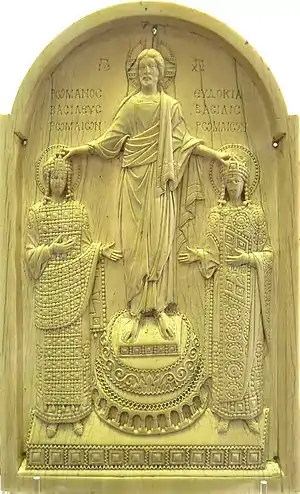
- January 1 – Empress Eudokia Makrembolitissa, wife of the late Emperor Constantine X, marries General Romanos Diogenes (a member of a prominent Cappadocian family) – who is proclaimed co-emperor as Romanos IV of the Byzantine Empire.[1]
- Autumn – Romanos IV begins a campaign against the Seljuk Turks, leading a Byzantine expeditionary force (which is in poor condition). He is successful in recapturing the fortress city of Hieropolis (modern-day Manbij) near Aleppo in northern Syria.[2]
- Winter – Romanos IV leaves a portion of his army as a rearguard at Melitene. The Byzantine garrison fails to check a Seljuk raid that manages to sack Amorium (penetrating deep in Byzantine territory). Romanos winters near Aleppo before returning to Constantinople.[3]
Europe
- Norman conquest of southern Italy: Norman forces under Robert Guiscard (duke of Apulia and Calabria) lay siege to the Byzantine city of Bari.
- Battle of the Alta River: The Cumans defeat the Kievan Rus' forces of Grand Prince Iziaslav I, and his brothers Sviatoslav II and Vsevolod I.
- Kiev Uprising: The city of Kiev rebels against Iziaslav I, in the aftermath of the Kievan Rus' defeat against the Cumans.
England
- Siege of Exeter: Norman forces under King William I (the Conqueror) take the city of Exeter after a siege of 18-days.
- William I begins a campaign in the East Midlands to put down the rebellions at Nottingham, Stafford, Lincoln and York.
- Edgar the Ætheling takes refuge with King Malcolm III of Scotland along with Edgar's sister Margaret, who marries King Malcolm.
- May 11 – William I brings his wife Matilda of Flanders to England. She is crowned queen in Westminster Abbey.
Africa
- September – Zaynab an-Nafzawiyyah marries Abu Bakr ibn Umar, leader of the Almoravids, and becomes his queen and co-regent.
Asia
- Spring – Emperor Yi Zong of the Western Xia (or Xi Xia) dies after a 19-year reign. He is succeeded by his 7-year-old son Hui Zong, who assumes the throne (until 1086).
- May 22 – Emperor Go-Reizei dies after a 23-year reign, leaving no direct heirs to the throne. He is succeeded by his brother Go-Sanjō as the 71st emperor of Japan.
Geology
- March 18 – An earthquake affects the Near East, with a maximum Mercalli intensity of IX (Violent). The shock has a magnitude greater than 7, and leaves about 20,000 people dead.
Births
- August 1 – Taizu (Aguda), emperor of the Jin Dynasty (d. 1123)
- Abu al-Salt, Moorish astronomer and polymath (approximate date)
- Ermengarde of Anjou, duchess of Aquitaine and Brittany (d. 1146)
- Haakon Magnusson (Toresfostre), king of Norway (d. 1095)
- Henry I, king of England (approximate date) (d. 1135)
- Peter I, king of Aragon (approximate date)
- Robert de Ferrers, 1st Earl Derby (d. 1139)
Deaths
- January 11 – Egbert I, margrave of Meissen
- May 22 – Go-Reizei, emperor of Japan (b. 1025)
- November 10 – Agnes of Burgundy, duchess of Aquitaine
- Abulchares, Byzantine general and catepan
- Ali ibn Yusuf al-Ilaqi, Persian physician
- Argyrus, Lombard nobleman and general
- Böritigin, ruler of Transoxiana (Kara-Khanid Khanate)
- Choe Chung, Korean Confucian scholar (b. 984)
- Eadnoth the Constable, English landowner
- Ephraim ibn al-Za'faran, Jewish physician
- Ralph the Staller, English nobleman
- William IV (or Guillem), French nobleman
- William of Montreuil, Italo-Norman duke
- Yi Zong, emperor of Western Xia (b. 1047)
- Vijayaditya VI, king of the Eastern Chalukyas (unconfirmed)
References
- John Julius Norwich (1991). Byzantium: The Apogee – The Choice of Emperor, p. 344. ISBN 0-394-53779-3.
- Brian Todd Carey (2012). Road to Manzikert – Byzantine and Islamic Warfare (527–1071), p. 133. ISBN 978-1-84884-215-1.
- George Finlay (1854). History of the Byzantine and Greek Empires from 1057–1453, p. 34. William Blackwood & Sons.
This article is issued from Wikipedia. The text is licensed under Creative Commons - Attribution - Sharealike. Additional terms may apply for the media files.