AEgIS experiment
AEgIS (Antimatter Experiment: gravity, Interferometry, Spectroscopy), AD-6, is an experiment at the Antiproton Decelerator facility at CERN, Geneva. The goal of AEgIS is to measure and understand the behavior of antimatter in Earth's gravitational field through different experimental techniques.[1]It was originally proposed in 2007.[2] Construction of the main apparatus was completed in 2012.[3]
| ELENA | Extra Low ENergy Antiproton ring-further decelerates antiprotons coming from AD |
|---|---|
| AD experiments | |
| ATHENA | AD-1 Antihydrogen production and precision experiments |
| ATRAP | AD-2 Cold antihydrogen for precise laser spectroscopy |
| ASACUSA | AD-3 Atomic spectroscopy and collisions with antiprotons |
| ACE | AD-4 Antiproton Cell Experiment |
| ALPHA | AD-5 Antihydrogen laser physics apparatus |
| AEgIS | AD-6 Antihydrogen experiment gravity interferometry spectroscopy |
| GBAR | AD-7 Gravitational Behaviour of Anti-Hydrogen at Rest |
| BASE | AD-8 Baryon Antibaryon Symmetry Experiment |
| PUMA | AD-9 antiProton Unstable Matter Annihilation |
AEgIS experimental setup and physics
.svg.png.webp)
AEgIS would attempt to determine if gravity affects antimatter in the same way it affects matter by testing its effect on an antihydrogen beam.[4][5]The experimental setup uses the moire deflectometer to measure the vertical displacement of the beam of cold antihydrogen atoms traveling in the earth’s gravitational field.
The first phase of the experiment creates antihydrogen: antiprotons from the Antiproton Decelerator are coupled with positrons, making a pulse of horizontally-travelling antihydrogen atoms.[2]
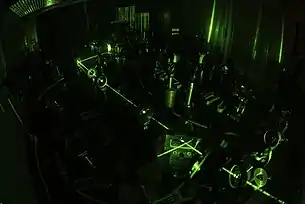
The antiprotons obtained from the antiproton decelerator and passed through a series of aluminum foils which acts as degrader and slows down the high energy antiprotons. They are cooled through the electron cooling process and stored inside the Malmberg-Penning trap. Radioactive Na-22 source is used to produce positrons, which are bunched in Surko-type accumulators. From these positrons, Positronium (Ps*) (see fig 1) is obtained and then excited to Rydberg states using laser pulses. Inside the Malmberg-Penning trap, the charge exchange process takes place, leading to the production of Rydberg antihydrogen atoms.[6]
[Charge exchange process][6]

The Rydberg antihydrogen atoms are stacked to form a beam, which then passes through a series of diffraction gratings, ultimately hitting a surface and thus annihilating. The points where the antihydrogen annihilates are measured with a precise detector.[4][6] Areas behind the gratings are shadowed, while those behind the slits are not.
The annihilation points reproduce a periodic pattern of light and shadowed areas. Using this pattern, it can be measured how many atoms of different velocities drop during horizontal flight. Therefore, the Earth's gravitational force on antihydrogen can be determined.[7]
AEgIS collaboration
The AEgIS collaboration comprises the following institutions:[8]
- University of Bergen, Norway
- University of Bern, Switzerland
- Istituto Nazionale di Fisica Nucleare, Italy
- ETH Zurich, Switzerland
- University College London, United Kingdom
- Max Planck Institute for Nuclear Physics, Germany
- University of Oslo, Norway
- Czech Technical University in Prague, Czech Republic
- Stefan Meyer Institute for subatomic physics, Austria
- Institute of Nuclear Research of The Russian Academy of Science, Russia
- Université de Lyon, France
- University of Paris-Sud, France
See also
References
- Doser, M. (2021). Status report for the AEgIS experiment for 2020. Status Report. CERN. Geneva. SPS and PS Experiments Committee, SPSC.
- Drobychev, G. Yu; Nédélec, P.; Sillou, D.; Gribakin, G.; Walters, H.; Ferrari, G.; Prevedelli, M.; Tino, G. M.; Doser, M. (2007). Proposal for the AEGIS experiment at the CERN antiproton decelerator (Antimatter Experiment: Gravity, Interferometry, Spectroscopy). CERN. Geneva. SPS Experiments Committee, SPSC.
- Khalidova, O; Aghion, S; Amsler, C; Antonello, M; Belov, A; Bonomi, G; Brusa, R S; Caccia, M; Camper, A; Caravita, R; Castelli, F (November 2019). "The AEgIS experiment: towards antimatter gravity measurements". Journal of Physics: Conference Series. 1390 (1): 012104. Bibcode:2019JPhCS1390a2104K. doi:10.1088/1742-6596/1390/1/012104. ISSN 1742-6588.
- Tietje, I C; Amsler, C; Antonello, M; Belov, A; Bonomi, G; Brusa, R S; Caccia, M; Camper, A; Caravita, R; Castelli, F; Cheinet, P (August 2020). "Protocol for pulsed antihydrogen production in the AE ḡ IS apparatus". Journal of Physics: Conference Series. 1612 (1): 012025. Bibcode:2020JPhCS1612a2025T. doi:10.1088/1742-6596/1612/1/012025. ISSN 1742-6588.
- Narita, Kanako (2019). The Study report in AEgIS experiment. CERN. Geneva. Department.
- Pagano, D.; Aghion, S.; Amsler, C.; Bonomi, G.; Brusa, R. S.; Caccia, M.; Caravita, R.; Castelli, F.; Cerchiari, G.; Comparat, D.; Consolati, G. (January 2020). "Gravity and antimatter: the AEgIS experiment at CERN". Journal of Physics: Conference Series. 1342 (1): 012016. Bibcode:2020JPhCS1342a2016P. doi:10.1088/1742-6596/1342/1/012016. ISSN 1742-6588.
- Aegis Collaboration (2014). "AEgIS Experiment". CERN. Retrieved 2017-06-20.
- "The AEgIS experiment at CERN: Probing antimatter gravity". Il Nuovo Cimento C. 42 (203): 1–4. 2019-09-20. doi:10.1393/ncc/i2019-19123-9.