ATM (computer)
ATM (ATM Turbo) is a ZX Spectrum clone, developed in Moscow, in 1991, by two firms, MicroArt and ATM. It offers enhanced characteristics, compared to the original Spectrum, such as a Z80 at 7 MHz, 1024 kB RAM, 128 kB ROM, AY-8910 (two ones in upgraded models), 8-bit DAC, 8-bit 8-channel ADC, RS-232, Centronics, Beta Disk Interface, IDE interface, AT/XT keyboard, text mode (80x25, 16 colours, 8x8 pattern), and new 3 graphics modes.
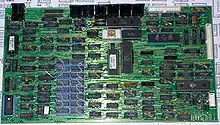 ATM Turbo 2+ motherboard | |
| Developer | MicroArt and ATM; NedoPC |
|---|---|
| Type | Home computer |
| Release date | 1991 |
| Operating system | ATM Turbo 1: Sinclair BASIC, TR-DOS, CP/M ATM Turbo 2+: iS-DOS/TASiS, DNA OS, Mr Gluk Reset Service |
| CPU | Zilog Z80 @ 3.5 and 7 MHz; 14 MHz (ZX Evolution) |
| Memory | 128 to 512 KB (ATM Turbo 1); 128 to 1024 KB (ATM Turbo 2+); 4MB RAM (ZX Evolution) |
| Storage | Floppy disk, IDE devices (ATM Turbo 2) |
| Removable storage | SD card (ZX Evolution) |
| Display | SECAM TV, EGA monitor, VGA monitor (ZX Evolution) |
| Graphics | 256x192, 320x200, 640x200 |
| Sound | one-bit speaker; AY-3-8910; Covox |
| Backward compatibility | Sinclair ZX Spectrum |
| Related articles | Pentagon (computer) |
History
ATM was developed in 1991 based on the Pentagon, a ZX Spectrum clone popular in Russia. In 1993 an upgraded model was introduced, named ATM Turbo 2. Up to 1994 the computer was produced ATM and MicroArt, then the firms separated and production ended.
In 2004 NedoPC (Moscow) resumed the production.[1] New versions called ATM Turbo 2+ and ZX Evolution were introduced.
Characteristics
Graphics modes
For compatibility purposes, the original 256 x 192 ZX Spectrum mode is available.
New graphics modes offer expanded abilities:
- 640 x 200 mode, with 2 out of 16 colors per 8x1 pixels. Difference from Profi (computer) is that the ATM can use the full 16 colour set for both ink and paper.
- 320 x 200 mode (16 colours) is ordinary raster mode, but not similar to EGA (it is two-pixel chunky, not planar like EGA). Two games for this mode were converted directly from PC: Prince of Persia and Goblins (computer game), and one from Sony PlayStation: Time Gal. Some other games for this mode exist, like Ball Quest (released in August, 2006).
Palette:
- 16 colors from a 64 color palette (6-bit RGB) can be set for all modes.
Operating systems
48 Sinclair BASIC, 128 Sinclair BASIC, TR-DOS, CP/M, iS-DOS, TASiS, DNA OS, Mr Gluk Reset Service.
Emulator
Unreal Speccy v0.27 and higher.
Models
Many models exist. Models before version 6.00 are called ATM 1, later models are called ATM 2(2+) or ATM Turbo 2(2+) or simply Turbo 2+. IDE is available since v6.00.JIO0UBH9BY8B9T7GVC6R The latest model is 7.18.[4]
ATM Turbo 1 specifications (1991)
- Processor : Zilog Z80 at 3.5 and 7 MHz (turbo mode)
- RAM : 128 to 512 KB
- ROM : 64 to 128 KB
- Memory manager: standard for ZX Spectrum 128 (memory over 64KB is addressed through a window in the upper 16KB of address space), with the ability to include a zero page of RAM in the lower 16KB of the address space
- Graphics video modes: Standard ZX Spectrum mode (256x192, 2 colors per block of 8x8 pixels from 16 colors), EGA-like mode 320x200, 16 colors per pixel; 640x200 high resolution mode, 2 out of 16 colors per 8x1 pixels
- Color palette : 64 colors, 16 can be used at the same time
- Firmware: BASIC48 / 128; TR-DOS; CP/M 2.2
- Supported external drives: tape recorder; drive
- Sound devices: standard one-bit speaker; AY-3-8910; Covox
- Additional devices: SECAM encoder for connection to color TV; Single-channel DAC; Modem; Centronics interface for connecting a printer; Stereo audio amplifier 2x1W
- Keyboard : mechanical matrix, standard for ZX Spectrum (40 keys, or extended, 64 keys)
ATM Turbo 2 (1993)
New features (relative to ATM Turbo 1):
- Memory manager: the ability to include any page of RAM or ROM in any of the quarters of the address space
- Text mode: 80x25 text video mode, characters are stored in the character generator ROM. It is possible to set any of 16 colors for the symbol and background
- Hardware vertical scrolling in EGA and 640x200 modes
- Supported external drives: controller for IDE devices (hard drives of any capacity, CD-ROM ); Digital PLL added to floppy controller
- Additional devices: eight-channel DAC
- Keyboard: XT keyboard support, on-chip RAM 537RU10
- Removed the following devices: SECAM encoder
ATM Turbo 2+
New features (comparing to ATM Turbo 2):
- RAM: 128 to 1024 KB
- Additional devices: RS-232 interface; Channel switch for DAC
- Keyboard: support for XT and AT keyboards, based on the 1816BE31 (i8031) microcontroller
- Removed the following devices: Modem
- The xBIOS ROM has been specially developed for ATM Turbo 2+ with support for virtual floppies. Also for ATM Turbo 2 (+) there is a ROM version of Mr Gluk Reset Service.
ZX Evolution
New features (comparing to ATM Turbo 2+):
- Turbo mode up to 14 MHz, switchable via menu and software
- 4MB RAM: both ATM Turbo 2 (+) and Pentagon 1024 Expanded Memory Supported
- 2 expansion slots according to the ZXBUS standard for connecting General Sound, etc.
- Flexible architecture based on FPGA (EP1K50) - third-party firmware available
- SD card with transparent BIOS support (EVO RESET SERVICE)
- Added VGA video output
- Non-volatile clock according to Mr Gluk standard, IDE interface according to Nemo standard, mouse according to Kempston Mouse standard
- Video scan rate from the Pentagon computer, with full support of all border and multicolor effects
References
- "Официальный сайт группы NedoPC!". www.nedopc.com.
- "Официальный сайт поддержки ATM-turbo 1,2,2+". atmturbo.nedopc.com.
- "Virtual TR-DOS". vtrd.in.
- "Google Tradutor". translate.google.pt.
- "Prince of Persia 1 ATM Turbo". www.popuw.com.
- ru:ATM Turbo
| Sinclair Research / Science of Cambridge |  | |
|---|---|---|
| Amstrad | ||
| Licenced systems | ||
| Timex Corporation | ||
| Cambridge Computer | ||
| Clones | ||
| Compatible or related systems | ||
| Sinclair Research peripherals | ||
| Timex peripherals |
| |
| People |
| |