A Bullet for the General
A Bullet for the General (Spanish: Quién sabe?; original title means "Who knows?", in the Spanish language), also known as El Chucho Quién Sabe?, is a 1966 Italian Spaghetti Western drama film directed by Damiano Damiani and starring Gian Maria Volonté, Lou Castel, Klaus Kinski and Martine Beswick. The film, a Zapata Western, tells the story of El Chuncho, a bandit, and Bill Tate (or El Niño/The Kid), a counter-revolutionary contract killer in Mexico. Chuncho soon learns that social revolution is more important than mere money.
| A Bullet for the General | |
|---|---|
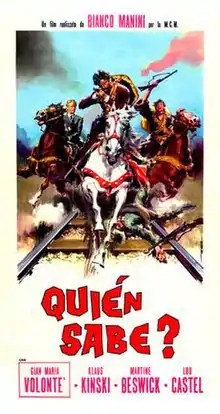 Italian film poster | |
| Directed by | Damiano Damiani |
| Screenplay by | Salvatore Laurani[1] |
| Story by | Salvatore Laurani[1] |
| Produced by | Bianco Manini[1] |
| Starring | |
| Cinematography | Antonio Secchi[1] |
| Edited by | Renato Cinquini[1] |
| Music by | Luis Bacalov[1] |
Production company | MCM[1] |
Release date |
|
| Country | Italy[1] |
| Box office | £687.1 million[2] |
Plot
During the Mexican Revolution, American adventurer Bill Tate lends unexpected assistance to El Chuncho Muños's gang of bandits in hijacking a government munitions train. Posing as a proponent of the revolution, Tate joins the gang and is quickly befriended by Chuncho, who nicknames him "Niño." After several heists, the gang rides to the town of San Miguel. El Chuncho executes the loyalist town leader and installs a poor, young scholar as his replacement. This proves a popular move, and the townspeople shower Chuncho with adoration -- so much so, that Chuncho intends to stay in the village and temporarily set aside the cause. But later, while missing the camaraderie of his gang, he decides otherwise.
After leaving San Miguel, Tate and Chuncho use a stolen machine gun to shoot down a contingent of Federales in a bloody desert battle. However, the encounter proves costly; except for Tate, no one from Chuncho's gang survives the battle. Even so, Tate is stricken with malaria. While searching through Tate's belongings for quinine to ease his symptoms, Chuncho comes across a bullet made of gold. Tate claims he carries it as a good-luck charm. Later, Chuncho and Tate arrive at a revolutionary general's encampment. Tate wanders off at one point, leaving Chuncho to sell their stolen weaponry and ammunition to the general for 5,000 pesos. After authorizing payment, the general informs Chuncho that San Miguel's inhabitants were wiped out by federal troops. He accuses the ex-gang leader of abandoning the village in its hour of need. He pronounces Chuncho a traitor and sentences him to death. But before the execution can be carried out, the general becomes victim to an assassin's bullet -- in fact, a bullet made of gold.
Cut to Ciudad Juarez. Tate has traveled there to collect a reward of 100,000 pesos from Mexican government representatives for the killing of the general. As he carries the loot back to his hotel, he is surprised by the appearance of Chuncho, to whom he turns over half of his reward. That evening, the two comrades celebrate their reunion with a night of revelry and carousing. The next day, as they prepare to board a train together for America, Chuncho pulls out a pistol and takes aim at Tate, who asks "Why?" Chuncho replies, "Quien sabe? (Who can say?)" and puts three bullets into Tate's chest.
Cast
- Gian Maria Volonté as El Chuncho Muños/Niños
- Klaus Kinski as El Santo
- Martine Beswick as Adelita
- Lou Castel as Bill "Niño" Tate/Taylor
- William Berger as Bill "Niño" Tate (voice, uncredited)
- Jaime Fernández as General Elías
- Andrea Checchi as Don Felipe
- Spartaco Conversi as Eufemio
- Joaquín Parra as Picaro
- Aldo Sambrell as Lieutenant Alvaro Ferreira
- José Manuel Martín as Raimundo
- Santiago Santos as Guapo
- Valentino Macchi as Train Engineer
- Guy Heron as Pepito (uncredited)
- Carla Gravina as Rosaria (uncredited)
- Rufino Inglés as Captain Enrique Sanchez Compoy (uncredited)
- Vicente Roca as Hotelier (uncredited)
- Antoñito Ruiz as Chico (uncredited)
- Sal Borgese as Bandit (uncredited)
- Damiano Damiani as Journalist with Elías (uncredited)
- Aysanoa Runachagua as Paymaster (uncredited)
- Richard McNamara as Opening Narrator (uncredited)
Production
The screenplay and story for A Bullet for the General is credited to Salvatore Laurani while Franco Solinas is credited with the adaptation and dialogue.[3] Film historian Howard Hughes noted that A Bullet for the General was the first Italian Western to seriously deal with the Mexican revolution and credited Solinas with the political aspects on the film.[3] Solinas was a Marxist writer best known in film for his screenplays for Salvatore Giuliano and The Battle of Algiers.[3][4]
A Bullet for the General was directed by Damiano Damiani and shot in Almería between July and August 1966.[3][5] Damiani had originally wanted to shoot the film in Mexico which proved to be impossible.[5]
Release
A Bullet for the General was released in Italy in December 1966.[6]
Reception
In a contemporary review, the Monthly Film Bulletin declared the film to be "a lively sortie into the Mexican Revolution with a good deal of boisterous action and a spirited performance from Gian Maria Volonte".[7] The review noted the running time cut from 135 minutes to 77 minutes, stating "substantial pruning unfortunately plays havoc with the continuity (a character who was clearly of some importance in the original is here reduced to a few marginal references)."[7]
Damiano's film has been called a "serious statement about the Mexican Revolution" and has been recognised as an accomplished blend of "tension, action, politics and history".[8]
References
Footnotes
- Hughes 2004, p. 94.
- Fisher 2014, p. 221.
- Hughes 2004, p. 95.
- Hughes 2004, p. 96.
- Hughes 2004, p. 97.
- Hughes 2004, p. 104.
- "Quien Sabe? (A Bullet for the General)". Monthly Film Bulletin. Vol. 36 no. 424. British Film Institute. June 1969. p. 128.
- Hughes 2010, p. 66.
Notes
Sources
- Fisher, Austin (2014). Radical Frontiers in the Spaghetti Western: Politics, Violence and Popular Italian Cinema. I.B.Tauris. ISBN 9781780767116.
- Hughes, Howard (2004). Once Upon a Time in the Italian West. I. B. Tauris. ISBN 1-85043-430-1.
- Hughes, Howard (2010). Spaghetti Westerns. Harpenden: Kamera Books. ISBN 978-1-84243-303-4.