Abdur Rahman bin Samara
Abdur Rahman ibn Samara (عبد الرحمن بن سمرة, died c. 670 in Basra)[1] was a general of the Umayyad Caliphate in the 7th century CE.
Abdur Rahman bin Samara عبد الرحمن بن سمرة | |
|---|---|
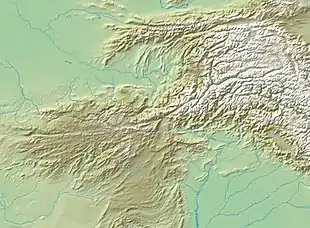   Abdur Rahman bin Samara invaded the territory of the Zunbils in Zamindawar, in the vicinity of Kandahar. | |
| Died | c. 670 Basra |
| Allegiance | Rashidun caliphate Umayyad Caliphate |
| Battles/wars | Umayyad campaign against the Zunbīls |


Biography
According to Ibn Manzur, Ibn Samara full lineage were a Qurayshite descended from Samara ibn Habib, son of Rabia ibn Abd Shams ibn Abd Manaf ibn Qusai ibn Kilab al Qurashi[2]
Ibn Samara participated in the Battle of Mu'tah, after Khalid ibn al-Walid managed to organize successful retreat from the battle, Khalid sent Ibn Samara in advance as messenger to Medina to report the battle result to Muhammad. Ibn Manzur recorded the narration from Ibn Samara, that when Ibn Samara has meet Muhammad, the latter has predicted the outcome of the battle that includes the death of Zayd ibn Harithah, Ja'far ibn Abi Talib, and Abdullah ibn Rawaha.[2]
By 652, he replaced Rabi ibn Ziyad al-Harithi as the governor of Sīstān.[3]
During the Muslim conquest of Sistan, Ibn Samara were sent by governor of Basra, Abdallah ibn Amir to Sistan, and then initiate the Muslim conquest of Khorasan, where he first securing peace in a place named "land of al-Dawar".[2]
In 653–4 CE, an army of around 6,000 Arabs were led by Ibn Samara to the territory of the Turkic Zunbils in Zabulistan, before continues to subdue the cities of Kabul and Zabulistan.[2] Sometimes later arrived to the shrine of Zoon in Zamindawar. It is reported that General Ibn Samara "broke off a hand of the idol and plucked out the rubies which were its eyes in order to persuade the Marzbān of Sīstān of the god's worthlessness."[4] The General explained to the Marzbān: "my intention was to show you that this idol can do neither any harm nor good."[5] It is then recorded by Abu Labid said that when the army were trying to get their hands on the spoils seized from Kabul Ibn Samara stands up and warned them by narrating a hadith he heard from Muhammad that the Prophet forbade the seizing of spoils of war before it is distributed first according to the Sharia rule. Then those who take the they returned what they had taken, He then distributed it among them.[6]
Then Ibn Samara sent the spoils of war from Kabul and Zabulistan to Abdullah ibn Amir.[2] Bust (Sīstān) and Kabulistan were occupied by a treaty of capitulation, also signed with the marzban of Kerman before the death of Caliph Uthman in 656.
Upon the caliph's death, he returned to Basra, where its governor Abdallah ibn Amir was dismissed by the new Caliph Ali. He joined Muawiyah I after the Battle of the Camel, and was sent as one of the envoys to Hasan ibn Ali in 661. Abdallah ibn Amir was reappointed as governor in Basra by Muawiyah, then he was sent along with Abd Allah ibn Khazim al-Sulami to restore Arab rule to eastern Khurasan and Sīstān. He introduced the office of ṣāḥeb al-šorṭa (chief of police) to Sīstān and built a mosque in Zaranj. The territories he had already conquered had to be reclaimed by force or by treaty, Kabul was occupied after a siege of a few months. He later launched an expedition to Arachosia and Zabulistan, recovering Bust and the other cities, Kabul then revolted but reoccupied after a month-long siege. He managed to convert 12,000 inhabitants of Kabul to Islam before abandoning the city. Muawiyah personally confirmed him as governor dependent from the caliph.
After Muawiyah deposed him from Sīstān in 665, he retired to Basra where the slaves he had brought from Kabul built a mosque in his house in the building style of Kabul. He died in Basra in 670.
References
- Ibn Hajar al-Asqalani. Tahdhib al-Tahdhib: Part 6. p. 190.
- Hawramani, Ikram (1311). "عبد الرحمن بن سمرة بن حبيب بن ربيعة" [Abdul Rahman bin Samra bin Habib bin Rabiah]. Hawramani.com. Ikram Hawramani's Website Search for: When autocomplete results are available use up and down arrows to review and enter to go to the desired page. Touch device users, explore by touch or with swipe gestures. Skip to content. Retrieved 5 December 2021.
Ibn Manẓūr (d. 1311 CE) - Mukhtaṣar Tārīkh Dimashq; Brief history of Damascus
- Marshak & Negmatov 1996, p. 450.
- Wink, André. Al-Hind, the Making of the Indo-Islamic World: Early Medieval India and the Expansion of Islam 7Th-11th Centuries. BRILL. p. 120. ISBN 978-0-391-04173-8.
- "Amir Kror and His Ancestry". Abdul Hai Habibi. alamahabibi.com. Retrieved August 14, 2012.
- al-Khattabi, Abd al-Karim. "Awn Ma'bud Sunan Abu Dawud Chapter on the prohibition of looting if there is a shortage of food in the enemy's land". Retrieved 5 December 2021.
Al- Khattabi said : Al- Nahbi is a noun based on an act of plundering, such as desiring out of desire. What is meant by looting is taking the money of the spoils without division
Abu Dawud, Sulaymān; Al-Albani, Nasiruddin. "Sunan Abu Dawud, book 15 Jihad (Kitab Al-Jihad) Chapter on the prohibition of looting if there is a shortage of food in the enemy's land". sunnahweb. Retrieved 5 December 2021.حَدَّثَنَا سُلَيْمَانُ بْنُ حَرْبٍ، قَالَ حَدَّثَنَا جَرِيرٌ، - يَعْنِي ابْنَ حَازِمٍ - عَنْ يَعْلَى بْنِ حَكِيمٍ، عَنْ أَبِي لُبَيْدٍ، قَالَ كُنَّا مَعَ عَبْدِ الرَّحْمَنِ بْنِ سَمُرَةَ بِكَابُلَ فَأَصَابَ النَّاسُ غَنِيمَةً فَانْتَهَبُوهَا فَقَامَ خَطِيبًا فَقَالَ سَمِعْتُ رَسُولَ اللَّهِ صلى الله عليه وسلم يَنْهَى عَنِ النُّهْبَى . فَرَدُّوا مَا أَخَذُوا فَقَسَمَهُ بَيْنَهُمْ . graded authentic by al-Albani
Sources
- Marshak, B.I.; Negmatov, N.N. (1996). "Sogdiana". In Litvinsky, B.A.; Guang-da, Zhang; R. Shabani, Samghabadi (eds.). History of Civilizations of Central Asia, Volume III: The Crossroads of Civilizations: A.D. 250 to 750. Paris: UNESCO Publishing. ISBN 92-3-103211-9.