Zunbils
Zunbil, also written as Zhunbil, or Rutbils of Zabulistan,[3] was a royal dynasty south of the Hindu Kush in present southern Afghanistan region. They ruled from circa 680 AD until the Saffarid conquest in 870 AD.[3][2] The Zunbil dynasty was founded by Rutbil (Turkic: Iltäbär), the elder brother of the Turk Shahi Tegin Shah, who ruled over a Khalaj Turk-Hephthalite kingdom from his capital in Kabul.[3][4][5][6] The Zunbils are described as having Turkish troops in their service by Arabic sources like Tarikh al-Tabari and Tarikh-i Sistan.[7]
Zunbils | |||||||||||
|---|---|---|---|---|---|---|---|---|---|---|---|
| 680–870[1][2] | |||||||||||
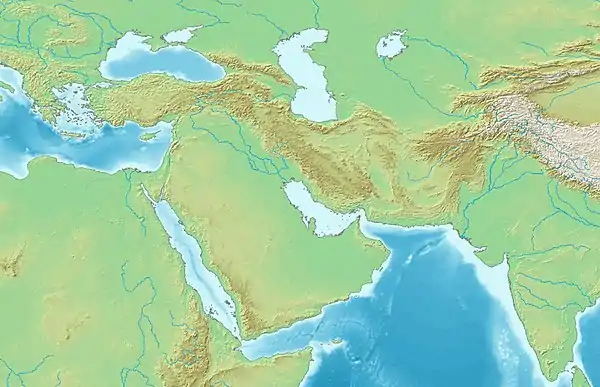 ZUNBILS Approximate location of the Zunbils | |||||||||||
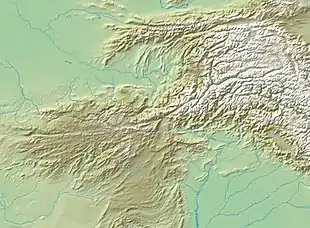 ZUNBILS Ghazni, the capital, and other important cities of the Zunbils (red dots). | |||||||||||
| Capital | Ghazni | ||||||||||
| Common languages | Bactrian | ||||||||||
| Religion | Hinduism Buddhism Zoroastrianism | ||||||||||
| Historical era | Early Middle Ages | ||||||||||
• Established | 680 | ||||||||||
• Disestablished | 870[1][2] | ||||||||||
| |||||||||||
| Today part of | Afghanistan | ||||||||||





The faith of this community has been little researched. According to the interpretation of Chinese sources by Marquarts and de Groots in 1915, the king of Ts'ao is said to have worn a crown with a golden fish head and was related to the Sogdians. The Temple of the Zun was recognizable by a large fish skeleton on display; this would indicate a related merchantry deity.[8] In addition to that Marquarts states the Zunbils to have worshipped a solar deity which might have been connected to Aditya (Surya). However, according to Shōshin Kuwayama there was a clear dichotomy between worshipers of the Hindu god Surya and followers of Zhun. This is exemplified by the conflict between Surya and Zhun followers, which lead to the followers of Zhun migrating southwards towards Zabulistan from Kapisa.[9] According to André Wink the followers of this god were primarily Hindu, though parallels have also been noted with pre-Buddhist religious and monarchy practices in Tibet and had Zoroastrian influence in its ritual.[10][11] Other scholars such as H. Schaeder and N. Sims-William have connected it with the Zoroastrian deity of time.[12]
Their territory included between what is now the city of Zaranj in southwestern Afghanistan and Kabulistan in the northeast, with Zamindawar and Ghazni serving as their capitals.[13] In the south their territory reached at times the cities of Rakhwad (al-Rukhkhaj) and Bost (near Kandahar).[3]
The title Zunbil can be traced back to the Middle-Persian original Zūn-dātbar, 'Zun the Justice-giver'. The geographical name Zamindawar would also reflect this, from Middle Persian 'Zamin-i dātbar' (Land of the Justice-giver).[14]
History
From 680 AD, the Tegin Shah was the king of the Turk Shahis, and ruled the area from Kabulistan to Gandhara as well as Zabulistan.[15][4] His title was "Khorasan Tegin Shah" (meaning "Tegin, King of the East"), and he was known in Chinese sources as Wusan teqin sa.[4] His grand title probably refers to his resistance to the peril of the Umayyad caliph from the west.[4]
The area of Zabulistan came to be ruled by Rutbil, also spelled Zibil or Jibul (from Turkic: Iltäbär "Commander"), his elder brother or nephew, who founded the dynasty of the Zunbils.[4][16] Their relationship was at times antagonistic, but they fought together against Arab incursions.[4] Rubtil issued coins derived from Sassanian prototypes, with a Bactrian script legend on the obverse, a Pahlavi script legend on the reverse, and a short Brahmi script legend in the name of Śrī Vākhudevaḥ ("His Highness the Majestic Lord"):
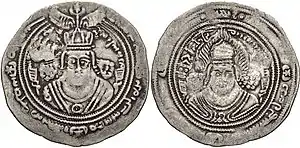
Obverse: yypwlh. wtyp’ / GDH / ’pzwt
PWN ŠMY yzt’ yypwl bgyh. wtyp’ wh. m’n’n mlt’n MLK’
King Jibul, [his] glory increased! In the name of god, Jibul, the Majestic Lord [is] King of brave men
Reverse: Śrī Vākhudevaḥ / pncdh. z’wlst’n / ’pl plm’n yzd’n
His Highness the Majestic Lord / [minted in his] 15th [regnal year in] Zavulistan, by the order of the gods.— Coin legend of Rutbil[16]
According to Anthony McNicoll, "the Zunbils ruled in the Kandahar area for nearly 250 years until the late 9th century AD".[17] Their main capital Zamindawar was located in the present-day Helmand Province of Afghanistan. The shrine of Zoon was located about three miles south of Musa Qala in Helmand, which may still be traced today. Some believe that the Sunagir temple mentioned by the famous Chinese traveler Xuanzang in 640 AD pertains to this exact house of worship.[18]
Vassalage to the Yabghus of Tokharistan
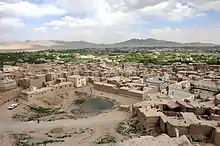
According to Chinese sources, in particular the chronicles of the Cefu Yuangui, The Turk in Kabul were vasals of the Yabghus of Tokharistan. When a young brother of the Yabghu Pantu Nili, named Puluo (僕羅 púluó in Chinese sources), visited the court of the Tang Dynasty in Xi'an in 718 AD, he gave an gave an account of the military forces in the Tokharistan region.[19] Puluo described the power of "the Kings of Tokharistan", explaining that "Two hundred and twelve kingdoms, governors and prefects" recognize the authority of the Yabghus, and that it has been so since the time of his grand-father, that is, probably since the time of the establishment of the Yabghus of Tokharistan.[20] This account also shows that the Yabghu of Tokharistan ruled a vast area circa 718 AD, formed of the territories north and south of the Hindu Kush, including the areas of Kabul and Zabul.[21] Finally, Puluo reaffirmed the loyalty of Yabghu Pantu Nili towards the Tang Dynasty.[20]
Part of the Chinese entry for this account by Puluo is:
On the Dingwei day of the eleventh month in the sixth year of the Kaiyuan era, Ashi Tegin Puluo writes to the emperor: Tokhara Yabghu, his elder brother, is controlling as his subordinates two hundred and twelve persons, such as the local kings of various states, dudu (Governors-General), and cishi (heads of regional governments). The king of Zabul rules two hundred thousand soldiers and horses, the king of Kabul two hundred thousand, each king of Khuttal, Chaghanian, Jiesu, Shughnan, Evdal, Kumedha Wa'khan, Guzganan, Bamiyan, Lteyuedejzan, and Badakhshan fifty thousand."
— Cefu Yuangui 3.5. Fanyan in Vol. 999 (Claims, Foreign Subjects), 718 AD.[22]
Early Arab incursions
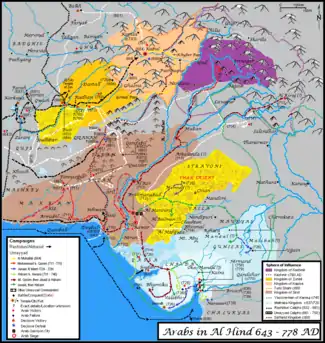
In 653-4 AD, an army of around 6,000 Arabs were led by General Abdur Rahman bin Samara of the Rashidun Caliphate, and they arrived to the shrine of Zoon in Zamindawar. It is reported that General Abdur Rahman "broke off a hand of the idol and plucked out the rubies which were its eyes in order to persuade the Marzbān of Sīstān of the god's worthlessness."[23] The General explained to the Marzbān: "my intention was to show you that this idol can do neither any harm nor good."[24]
In 698 Ubayd Allah ibn Abi Bakra of the Umayyad Caliphate lead an 'Army of Destruction' against the Zunbils, was defeated and was forced to offer a large tribute, give hostages including three of his sons and take an oath not to invade Zunbil again.[25] About 700 Ibn al-Ash'ath tried again with the 'Peacock Army' which led to a mutiny.[26]
Arabic sources recount that, after the Abbasids came to power in 750, the Zunbils made submissions to the third Abbasid Caliph al-Mahdi (r. 775–785), but these appear to have been nominal acts,[27] and the people of the region continued to resist Muslim rule.[28] The Muslim historian Ya'qubi (died 897/8) in his Ta'rikh ("History"), recounts that Al-Mahdi asked for, and apparently obtained, the submission of various Central Asian rulers, including that of the Zunbils.[29] The original account by Ya'qubi reads:
Al-Mahdī sent messengers to the kings, calling on them to submit, and most of them submitted to him. Among them were the king of Kābul Shāh, whose name was Ḥanḥal; the king of Ṭabaristān, the Iṣbahbadh; the king of Soghdia, the Ikhshīd; the king of Tukhāristān, Sharwin; the king of Bamiyan, the Shīr; the king of Farghana, ------ ; the king of Usrūshana, Afshīn; the king of the Kharlukhiyya, Jabghūya; the king of Sijistān, Zunbīl; the king of Turks, Tarkhan; the king of Tibet, Ḥ-h-w-r-n; the king of Sind, al-Rāy; the king of China, Baghbür; the king of India and Atrāḥ, Wahūfūr; and the king of the Tughuz-ghuz, Khāqān.
Saffarid and Zunbil struggles
C.E. Bosworth writes that:
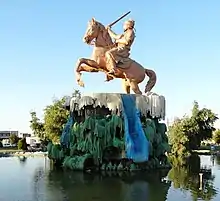
One of the most important aspects of early Saffarids policy of significance for the spread of Islam in Afghanistan and on the borders of India long after their empire had collapsed was that of expansion into east Afghanistan. The early Arab governors of Sistan had at times penetrated as far as Ghazna and Kabul, but these had been little more than slave and plunder raids. There was a fierce resistance from the local rulers of these regions, above all from the line of Zunbils who ruled in Zamindavar and Zabulistan and who were probably epigoni of the southern Hepthalite or Chionite kingdom of Zabul; on more than one occasion, these Zunbils inflicted sharp defeats on the Muslims. The Zunbils were linked with the Turk-Shahs of the Turk Shahi dynasty; the whole river valley was at this time culturally and religiously an outpost of the Indian world, as of course it had been in the earlier centuries during the heyday of the Buddhist Gandhara civilization.[32]
The Zunbils were finally defeated in 870 AD by Muslim conquerors. Yaqub bin Laith al-Saffar (r. 861–879 AD, founder of the Saffarid dynasty, vanquished the Zunbils and conquered the entire territory from his base in Sistan.[3]
Religion
._As_shown_in_the_exhibition_'Afghanistan_-_Rescued_Treasures_of_Buddhism'_at_N%C3%A1prstek_Museum_of_Asian%252C_African_and_American_Cultures%252C_Prague.jpg.webp)
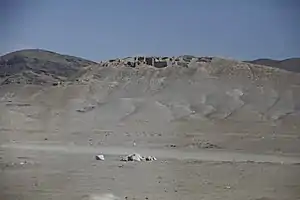
In his travel diaries, the Chinese monk Xuanzang reported in the early 700s that there were numerous Buddhist stupas in the area of Zabul, which may been built by Ashoka in the 3rd century BC. He also reported hundreds of Buddhist monasteries, and dozens of Hindu temples.[3] In addition the temple of the Hindu god Zun was in the region, drawing many pilgrims.[3]
Zhun
The Zunbils worshiped a deity called Zhūn (or Zūn), from whom they derived their name.[34] He is represented with flames radiating from his head on coins. Statues were adorned with gold and used rubies for eyes. Huen Tsang calls him "sunagir".[18]
The origin and nature of Zhun is disputed. M. Shenkar in his study comes to the conclusion that Zhun was possibly connected to the deity of the river Oxus, the modern river Amudarya. Furthermore he holds it most likely that Zhun was the greatest deity worshiped in Zabulistan.[12] F. Grenet believes that Zhun might have been connected with the Iranian solar deity Mithra.[12] Zhun has been linked with the Hindu god Aditya at Multan, pre-Buddhist religious and kingship practices of Tibet as well as Shaivism.[11] Some scholars have considered the cult to be neither Buddhist nor Zoroastrian, but primarily Hindu.[35] Scholars point out the connections between the Iranian god Zhun/Zun and the Hindu god Shiva, suggesting a syncretic mixture of the Iranian and Indian gods in the Indo-Iranian borderlands of ancient Bactria.[35]
His shrine lay on a sacred mountain in Zamindawar. Originally he appears to have been brought there by Hepthalites, displacing an earlier god on the same site. Parallels have been noted with the pre-Buddhist monarchy of Tibet, next to Zoroastrian influence on its ritual. Whatever his origins, he was certainly superimposed on a mountain and on a pre-existing mountain god while merging with Shaiva doctrines of worship.[10]
Zurvan hypothesis
Other scholars however have connected Zun with the Sassanid Zoroastrian deity Zurvān, the deity of time.
"Regarding origin of Žuna, Xuanzang had only mentioned that it was initially brought to Kapisa, later Begram from “far” and later moved to Zabul. There is no consensus as to who brought it and when. By identifying Žun with Sassanian Zurvān, the cult of Žun or *Zruvān can be viewed in a much wider context of Iranian history and religious developments. Žun, Like Zurvān, most likely represented the "god of time", a heresy in Zoroastrianism, which originated in response to the religious reforms introduced during second half of Achaemenid Empire. The cosmopolitan nature of the god is consistent with the variety of religions practiced in the region prior to the Islamization of Afghanistan."[35]
According to Gulman S, its Afghan followers were, most probably, initially Zoroastrians. Mention of Žun and its devotees disappeared with the end of Žunbil dynasty of Zabulistan in 870. Its followers, according to Ibn Athir, accepted Islam.[35]
According to N. Sims-Williams:[12]
"It is not unlikely that Zhun derives from the Iranian Zurwan."
Ulf Jäger states: We should interpret “Zhun” as the name of the ancient Iranian deity of time, “Zurwan”.[12]
References
- ALRAM, MICHAEL (2014). "From the Sasanians to the Huns New Numismatic Evidence from the Hindu Kush" (PDF). The Numismatic Chronicle. 174: 282–285. ISSN 0078-2696. JSTOR 44710198.
- "16. THE HINDU SHAHIS IN KABULISTAN AND GANDHARA AND THE ARAB CONQUEST". Pro.geo.univie.ac.at. Kunsthistorisches Museum Vienna. Retrieved July 22, 2017.
- Alram, Michael; Filigenzi, Anna; Kinberger, Michaela; Nell, Daniel; Pfisterer, Matthias; Vondrovec, Klaus. "The Countenance of the other (The Coins of the Huns and Western Turks in Central Asia and India) 2012-2013 exhibit: 15. THE RUTBILS OF ZABULISTAN AND THE "EMPEROR OF ROME"". Pro.geo.univie.ac.at. Kunsthistorisches Museum Vienna. Retrieved July 16, 2017.
- "14. KABULISTAN AND BACTRIA AT THE TIME OF "KHORASAN TEGIN SHAH"". Pro.geo.univie.ac.at. Kunsthistorisches Museum Vienna. Retrieved July 16, 2017.
- Andre Wink, Al-Hind, the Making of the Indo-Islamic World, Vol.1, (Brill, 1996), 115;""The Zunbils of the early Islamic period and the Kabulshahs were almost certainly epigoni of the southern-Hephthalite rulers of Zabul."
- History of Civilizations of central Asia, B A Litivinsky Zhang Guang-Da, R Shabani Samghabadi, p.376
- Raphael Israeli, Anthony Hearle Johns (1984). Islam in Asia: South Asia. Magnes Press. p. 15.
- H. Miyakawa und A. Kollautz: Ein Dokument zum Fernhandel zwischen Byzanz und China zur Zeit Theophylakts In: Byzantinische Zeitschrift, S. 14 (Anhang). De Gruyter Januar 1984. ISSN 1868-9027.
- Kuwayama, Shoshin (2000). Historical Notes on Kāpiśī and Kābul in the Sixth-Eighth Centuries (PDF).
- Al- Hind: The slave kings and the Islamic conquest - Volume I. Brill. 1991. pp. 118, 119. ISBN 9004095098.
- Clifford Edmund Bosworth (1977). The Medieval History of Iran, Afghanistan, and Central Asia. Variorum Reprints. p. 344.
- Jäger, Ulf (2019). Sino-Platonic Papers: A Unique Alxon-Hunnic Horse-and-Rider Statuette (Late Fifth Century CE) from Ancient Bactria / Modern Afghanistan in the Pritzker Family Collection, Chicago (PDF). Philadelphia, PA: University of Pennsylvania. Retrieved 29 September 2021.
- André Wink, "Al-Hind: The Making of the Indo-Islamic World", Brill 1990, p. 118
- Bosworth, Clifford Edmund. 2002. The Encyclopaedia of Islam. Leiden: Brill. Zamindawar. p.439.
- Vondrovec, Klaus. Coins, Art and Chronology II - The First Millennium C.E. in the Indo-Iranian Borderlands (Coinage of the Nezak). p. 183.
- Dani, Ahmad Hasan; Litvinsky, B. A. (January 1996). History of Civilizations of Central Asia: The crossroads of civilizations, A.D. 250 to 750. UNESCO. pp. 379–380. ISBN 978-92-3-103211-0.
- Excavations at Kandahar 1974 & 1975 (Society for South Asian Studies Monograph) by Anthony McNicoll
- "The Temple of Zoor or Zoon in Zamindawar". Abdul Hai Habibi. alamahabibi.com. 1969. Retrieved August 14, 2012.
- Kuwayama, S. (2002). Across the Hindukush of the First Millennium: a collection of the papers (PDF). Kyoto University. p. 139.
- Sims-Williams, Nicholas (2002). "Nouveaux document bactriens du Guzgan (note d'information)". Comptes rendus des séances de l'Académie des Inscriptions et Belles-Lettres. 146 (3): 1057. doi:10.3406/crai.2002.22500.
- "The account herewith quoted as 3.5. shows that this king of Tokhara had political power to control the principalities belonging to the Governors-General to the north and the south of the Hindukush, not to mention the Yuezhi Governor General." in Kuwayama, Shoshin (2005). "Chinese Records on Bamiyan: Translation and Commentary". East and West. 55 (1/4): 153, 3–5. ISSN 0012-8376. JSTOR 29757642.
- Kuwayama, Shoshin (2005). "Chinese Records on Bamiyan: Translation and Commentary". East and West. 55 (1/4): 143–144. ISSN 0012-8376. JSTOR 29757642.
- André Wink, "Al-Hind: The Making of the Indo-Islamic World", Brill 1990. p 120
- "Amir Kror and His Ancestry". Abdul Hai Habibi. alamahabibi.com. Retrieved August 14, 2012.
- Hugh Kennedy (2010). The Great Arab Conquests: How the Spread of Islam Changed the World We Live In. Hachette UK. p. 128. ISBN 9780297865599.
- Hugh Kennedy,The Great Arab Conquests',2007, pages 194-198
- Al-Ya'qubi, Historiae, p. 479; al-Tabari, v. 30: p. 143
- For example, joining Rafi' ibn Layth's rebellion and reneging on tribute agreements: al-Ya'qubi, Historiae, p. 528; al-Baladhuri, pp. 203-04
- Kuwayama, Shoshin (1999). "Historical Notes on Kapisi and Kabul in the Sixth-Eighth Centuries" (PDF). ZINBUN. 34: 44.
- Gordon, Mathew S. and al. (2018). The Works Of Ibn Wāḍiḥ Al Yaʿqūbī. Brill. pp. 1138–1139, note 2959. ISBN 9789004364165.
- Rahman, A. (2002). "New Light on the Khingal, Turk and the Hindu Sahis" (PDF). Ancient Pakistan: 41.
- The Tahirids and Saffarids, C.E.Bosworth,The Cambridge History of Iran:From the Arab Invasion to the Saljuqs, Vol. IV, Ed. Richard Nelson Frye, William Bayne Fisher and John Andrew Boyle, (Cambridge University Press, 1975), 111. ISBN 0-521-20093-8, ISBN 978-0-521-20093-6
- For panorama images of the site see: "The Buddhist site of Tapa Sardar". ghazni.bradypus.net. Italian Archaeological Mission in Afghanistan.
- Wink, André (2002). Al-Hind, the Making of the Indo-Islamic World: Early Medieval India and the Expansion of Islam 7Th-11th Centuries. BRILL. p. 118. ISBN 978-0-391-04173-8.
- Afridi, Gulman sher. "Etymology of Zhunbil and Identity of the Rulers of Kabul and Zabul in Seventh -Ninth Centuries C.E". Journal of Asian Civilisation.
External links
Notes
- 1.^ "Xuanzang's story is simple , but suggests a historical background:there happened a conflict between the two religious groups, the Surya group and the Zhuna group".