Adam de Harvington
Adam de Harvington, also called Adam de Herwynton (c.1270-c.1345) was a fourteenth-century Crown official and judge who had a successful career in both England and Ireland. He held office as Chief Baron of the Irish Exchequer and Lord Treasurer of Ireland, and as English Chancellor of the Exchequer, and acquired considerable wealth as a result.[1]
Family
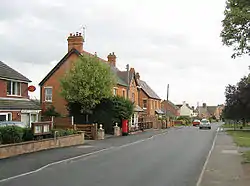
He derived his name from his birthplace, Harvington, Worcestershire; he was the son of William de Harvington or de Herwynton.[2] He had a lifelong association with Pershore Abbey. William de Harvington, Abbot of Pershore 1307-40, was his cousin and Adam in a much later lawsuit from 1419 was described as William's heir. De Herwynton seems to have been the most usual contemporary spelling of the name.
Career
His path to high office lay through the patronage of Guy de Beauchamp, 10th Earl of Warwick (died 1315). It was probably Warwick who obtained for him the position of Deputy Chamberlain of the Exchequer in 1298 and persuaded Edward I to grant him the manor of Talton, Worcestershire, in 1303.[3] He was given the living of Awre, Gloucestershire in 1305 and of Hanslope, Buckinghamshire, in 1316. He was an executor of Warwick's will in 1315 and was given a lease of certain of his lands for fifteen years. In his own will he made clear his great sense of obligation to the Earl.[4]
His association with the Diocese of Worcester had begun by 1305 when he accompanied the Bishop of Worcester, William Gainsborough, on a journey overseas;[5] in the 1320s he is found regularly acting as Vicar-general of the Diocese.[6]
He also acted on occasion for the powerful Mortimer family. In 1304 Margaret de Fiennes, widow of Edmund Mortimer, 2nd Baron Mortimer, authorised him to act as her attorney, together with Walter de Thornbury (later Lord Chancellor of Ireland), who was also executor of her husband's will: they were required to claim her dowry and the properties which had belonged to her late husband Edmund.[7]
After Warwick's death Adam acquired a new patron: this was Edward I's nephew, Thomas, 2nd Earl of Lancaster. Adam became Keeper of the Rolls of the Bench at Westminster in 1314 and was a Commissioner of oyer and terminer 1314-1322.[8] Any setback he may have suffered in his career after Lancaster's downfall and execution for treason in 1322 was temporary: he seems to have been regarded as a valued and hard working Crown official.[9] He was sent to Ireland as Chief Baron in 1324,[10] and was briefly Chancellor of the Exchequer of Ireland and Lord High Treasurer of Ireland in 1325-6; he returned to England as Chancellor of the Exchequer in 1327.
Last years
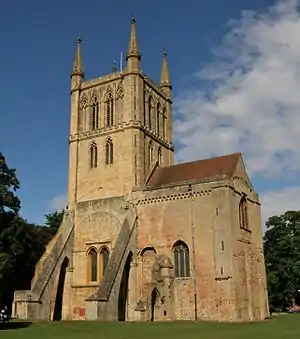
He retired to his native Worcestershire in 1330. In his last years he was a noted benefactor of Pershore Abbey. Ball gives his date of death as 1337,[11] but this is certainly too early. He was later described as the heir of his cousin Abbot Walter, who died in 1340, and he made a conveyance of land in 1342; he was certainly dead by 1346. Walter left him two manors in Worcestershire, one of which appears to correspond roughly with present day Sodington Hall. In his will he left money to Pershore Abbey to erect a chantry to pray for his soul and that of his first patron Guy, Earl of Warwick.[12]
References
- Ball, F. Elrington The Judges in Ireland 1221-1921 John Murray London 1926 Vol.i p. 25
- Ball p.66
- Ball p.66
- Willis-Bund, J.W. and Page, William editors History of the County of Worcester 1971 Vol.2 pp. 127-136
- Ball p.66
- Haines, Roy Martin Church and Politics in Fourteenth-century England: the career of Adam Orleton Cambridge University Press 2005 p.89
- Calendar of Close Rolls, Edward I, Vol.5 pp.219-20
- Ball p.67
- Haines p.89
- Ball p.25
- Ball p.67
- Willis-Bund and Page pp.127-136
Chancellors of the Exchequer under the House of Plantagenet (1216–1399) | ||
|---|---|---|
| Henry III (1216–1272) |
|  |
| Edward I (1272–1307) |
| |
| Edward II (1307–1327) |
| |
| Edward III (1327–1377) |
| |
| Richard II (1377–1399) |
| |