Adoration of the Kings (Bramantino)
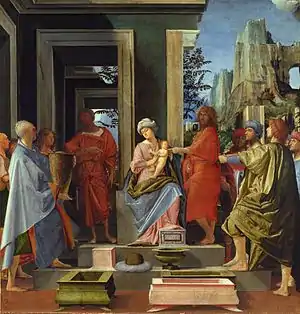
The Adoration of the Kings is a small oil painting on panel of c. 1500 by Bramantino in the National Gallery, London.[1] In it the Holy Family and the Magi are, unusually, joined by an adult John the Baptist, whose Baptism of Christ was celebrated on the same day as Epiphany in the liturgical calendar. At 56.8 cm (22.4 in) × 55 cm (22 in) it was probably commissioned for private use by an individual rather than placing in a church, but nothing is known about its early history.[2] The panel entered the National Gallery in 1916 as part of the Layard Bequest.[3]
| The Adoration of the Kings | |
|---|---|
 | |
| Year | c. 1500 |
| Medium | Oil on panel |
| Dimensions | 56.8 cm (22.4 in) × 55 cm (22 in) |
| Location | National Gallery |
| Identifiers | Art UK artwork ID: the-adoration-of-the-kings-115392 |
Bramantino was a painter in Milan, who is relatively little known outside northern Italy, where most of his paintings remain; this is the only known example in the UK.[4] In a Milanese art scene dominated by Leonardo da Vinci, Bramantino instead belonged to a tradition of "the structured but immobile realism of the Quattrocento ... that was fundamentally distinct from Leonardo's thought", descending from Piero della Francesca, via Bramantino's master Bramante.[5]
Description
The painting is "highly unusual and inventive both in its design and its iconography",[6] as are other paintings by Bramantino. In contrast to most 15th-century paintings of the subject, the Three Kings are dressed very plainly, if in loose classical robes, and are barefoot, like nearly all the male figures. There is even some uncertainty as to which figures represent them, though it is usually thought they are the older man with a blue robe at left, the red-headed man with a green robe at right, and (less certainly) the pointing man in red at the viewer's left of the Virgin, who has perhaps deposited as his gift the pink box or the urn below her feet on the first step. However, it has been suggested that this last man is the prophet Isaiah, pointing to the fulfilment of his prophecy, in which case the man in the blue turban on the right side might be the third king.[7]
On this account, Saint Joseph appears to be absent, which is unusual but not unprecedented, or relegated to the background. Some writers have suggested that the pointing figure carrying a rod to the viewer's right of the Virgin is him, but his age and appearance are unlike the conventional Josephs of the period, and much closer to that of John the Baptist. The prophet Daniel has also been proposed as the identity of this figure.[8]
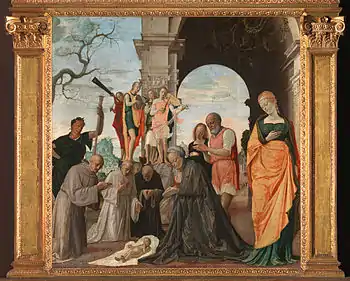
If the man wearing red with a rod is John the Baptist, then his depicted age is anachronistic, as John was regarded as only a few years older than Jesus, but much less so than for Isaiah. An earlier Adoration of the Christ Child by Bramantino (c. 1485), now in the Pinacoteca Ambrosiana in Milan, contains an even more eclectic group of figures: several wingless angels playing instruments, three medieval saints, a sibyl at far right, and at the far left a figure variously identified as the pagan god Apollo (favoured by the museum), the Emperor Augustus or the poet Virgil.[9]
The landscape background at right was changed at least once by the artist; originally there was a towering city or castle "with tall, square towers", a motif used in other paintings of his, which he perhaps realized would seem out of scale. These were a pinkish colour, and their main forms were roughly retained when they were converted to high outcrops of rock.[10]
Provenance
The history of the painting is unknown until 1862, when it was bought from the Manfrin Collection in Venice by Sir Austen Layard,[11] the excavator of Nineveh and other sites in the Near East in the 1840s and early 1850s. Layard had become wealthy from his best-selling accounts of his excavations, and embarked on a political career that included a number of ministerial positions, spending much of his time in Venice, where he built up a notable collection of paintings. In 1862 he was Parliamentary Under-Secretary of State for Foreign Affairs in the Liberal government led by Lord Palmerston.[12]
.jpg.webp)
Layard had bought the painting with an attribution to Mantegna. He sent the painting, which was in poor condition, to Guiseppe Molteni, a restorer he used in Milan. At the restorer's workshop it was seen by the National Gallery's "travelling agent", Otto Mündler, and then by Sir Charles Eastlake, then Director. Mündler identified it as a Bramantino. Eastlake described it in a letter back to the gallery as "a little picture in a not very promising state which looked like a Bramantino ... now here in the hands of Molteni, who has already removed the repaintings". He was especially interested because back in London another Adoration (NG 729) was being restored, which at the time was thought to be by Bramantino, but which is now attributed to Vincenzo Foppa.[13] Foppa was a generation older than Bramantino, and this is a far more conventional rendering of the subject.[14]
Layard died in 1894, leaving his paintings to the National Gallery with a life interest to his wife, who died in 1912, but due to complications, including exporting them from Italy, many were not received into the gallery until 1916.[15]
Notes
- Per the NG in 2021. Dunkerton, 42 dates it to the "late 1490s", Freedberg, 387 to "1500–05", but all Bramantino datings are uncertain.
- Dunkerton, 43, 50
- "The Adoration of the Kings". The National Gallery.
- Dunkerton, 43
- Freedberg, 385
- Dunkerton, 43
- Dunkerton, 43
- Dunkerton, 43
- "The Adoration: Bartolomeo Suardi detto il Bramantino (1465–1530)", Pinacoteca Ambrosiana
- Dunkerton, 58
- Dunkerton, 43
- "Austen Henry Layard", National Gallery
- Dunkerton, 43
- Image, Freedberg, 360; National Gallery page
- Davies, 574; Dunkerton, 43; "Austen Henry Layard", National Gallery
References
- Davies, Martin, Catalogue of the Earlier Italian Schools, National Gallery Catalogues, 1961, reprinted 1986, ISBN 0901791296
- Dunkerton, Jill, "The Technique and Restoration of Bramantino's Adoration of the Kings", National Gallery Technical Bulletin, Volume 14, 1993
- Freedberg, Sidney J.. Painting in Italy, 1500–1600, 3rd edn. 1993, Yale, ISBN 0300055870