2006 Somali warlord offensive
Between May and July 2006 an offensive took place against the Islamic Courts Union by an alliance of warlords who were trying to seize control of Somalia's capital city, Mogadishu. The Warlord Alliance was funded by the United States.[6] This offensive led to the 2006 Battle of Mogadishu, following which the Islamic Courts Union expanded further in Somalia.
| The rise of the Islamic Courts Union | |||||
|---|---|---|---|---|---|
| Part of the Somali Civil War and the Global War on Terrorism | |||||
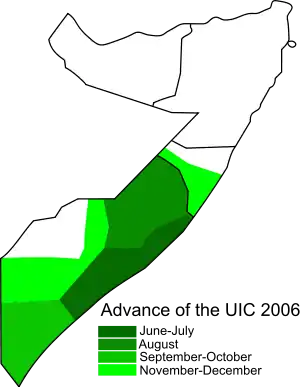 | |||||
| Belligerents | |||||
| Islamic Courts Union |
ARPCT  Ethiopia[1] Ethiopia[1] | ||||
| Commanders and leaders | |||||
|
Sharif Sheikh Ahmed  Sebhat Ephrem Sebhat Ephrem |
Mohamed Dhere Meles Zenawi | ||||
| Strength | |||||
|
|
6,000[2] 300–500 technicals 500–30,000 Ethiopian infantry [3] placed their numbers at ~7,000; military experts say now ~15,000–20,000[4]) Ethiopian heavy weapons, including artillery, GTG, GTA missiles. Unknown number of Ethiopian tank forces. Ethiopian helicopters.[4] Ethiopian fighter jets.[5] | ||||

Criticism of United States support for ARPCT Warlords
Michael Zorick, the U.S. State Department's political officer for Somalia, who had been stationed in Nairobi, was reassigned to Chad after he sent a cable to Washington criticizing Washington's policy of paying Somali warlords. The Times stated, "The American activities in Somalia have been approved by top officials in Washington and were reaffirmed during a National Security Council meeting about Somalia in March."[7]
US Failed Policy
The New York Times declared the US backing of Warlord Alliance a failed policy.[8] A Reuters report cited that the plan had backfired and destabilized the nation.[9]
Timeline
On 4 June the ICU gained control of Balad, 30 miles north of Mogadishu. Balad had previously been under the control of Musa Sudi Yalahow a warlord whose gunmen fled towards Jowhar. Another warlord named Mohamed Qanyare Afrah had started heading toward Balad with a dozen battlewagons, but changed course for Jowhar.[10]
6 June 2006
On 6 June 2006, the ICU claimed it was in control of all the lands up to 100 kilometers (62 mi) inland from Mogadishu. The US backed warlords were reported to have either been captured or to have fled the city, abandoning most of their weapons, with the majority fleeing to Jowhar, which was taken by the ICU militia on 14 June.[11]
7 June 2006
The Republic of the Congo's president and current African Union head, Denis Sassou-Nguesso, criticized the United States for its involvement in fighting in Mogadishu following his meeting with President George W. Bush and Secretary of State Condoleezza Rice.[12]
14 June 2006
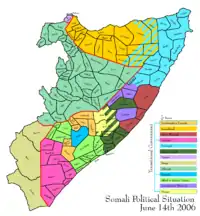
On 14 June 2006, following a stand-off that lasted for approximately eight days, the ICU militia reportedly attacked the remaining forces of the US backed Warlord Alliance in Jowhar, routing them and seizing the town.[13]
Jowhar was the most important warlord stronghold outside of Mogadishu, ruled by Mohammed Dheere. After securing allies in the town, the ICU advanced on Jowhar in early June, forcing Mohammed Dheere to flee north to Ethiopia on 14 June[14] and capturing the town.
References
- Ethiopia admits Somalia offensive, BBC.
- Somalia Islamists Discuss Defections Archived 2008-03-21 at the Wayback Machine CBS News
- Fighting erupts in northern Somalia as peace talks falter, says Islamic official; International Herald Tribune.
- FACTBOX-Somalia's role in Horn of Africa tensions Reuters
- Ethiopia launches airstrikes in Somalia, AP.
- "Efforts by C.I.A. Fail in Somalia, Officials Charge". New York Times. June 8, 2006.
- Marc Lacey and Helene Cooper Efforts by C.I.A. Fail in Somalia, Officials Charge, The New York Times, 8 June 2006
- Efforts by C.I.A. Fail in Somalia, Officials Charge New York Times
- US cash support for Somali warlords 'destabilising' Reuters
- Islamists seize key Somali town, BBC News.
- Somali Islamists capture key town, BBC News, 13 June 2006.
- AU chair lashes US over Somalia Archived 19 July 2011 at the Wayback Machine ANDnetwork 7 June 2006
- Somali Islamists capture key town BBC 14 June 2006
- Somali Islamists capture key town BBC News
.svg.png.webp)