Afeni Shakur
Afeni Shakur Davis[1] (born Alice Faye Williams; January 10, 1947 – May 2, 2016)[2] was an American political activist and former member of the Black Panther party.[3] She was the mother of rapper Tupac Shakur.
Afeni Shakur | |
|---|---|
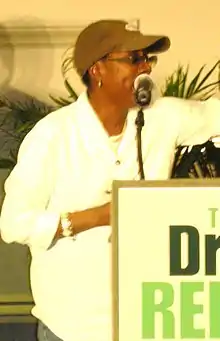 Shakur giving a speech in 2009 | |
| Born | Alice Faye Williams January 10, 1947 |
| Died | May 2, 2016 (aged 69) Sausalito, California, U.S. |
| Occupation | Activist |
| Years active | 1968–1992 |
| Political party | Black Panther Party |
| Spouse(s) | Gust Davis (m. 2004) |
| Partner(s) | Lumumba Shakur (1968–1971) Mutulu Shakur (1975–1982) |
| Children | 2, including Tupac Shakur |
Early life
Shakur was born Alice Faye Williams on January 10, 1947, in Lumberton, North Carolina.[2] She had a sister, Gloria Jean.[4] She had a troubled beginning and grew up resenting her father because he was abusive. When she, her mother, and her sister left her father in 1958, they moved to the Bronx. She tested into and was accepted at the elite Bronx High School of Science.
Activism
In 1968 she joined the Harlem Black Panther Party and changed her name to Afeni Shakur.[5][6] She became a section leader of the Harlem chapter[5] and a mentor to new members such as Jamal Joseph.[6] She also worked with Billy Garland (Tupac's biological father) and Geronimo Pratt (who became Tupac's baptismal sponsor).[7]
The Panther 21
In April 1969, she and twenty other Black Panthers were arrested and charged with several counts of conspiracy to bomb police stations and other public places in New York.[3] With bail set at $100,000 each for the 21 suspects, the Black Panthers decided to raise bail money first for Joseph and Shakur so that those two could work on raising bail for the others.[6][7] The pre-trial started in February 1970 and the actual trial on September 8, 1970.[8] Charges brought against her and the other members of the Black Panther Party were attempted murder, conspiracy to commit murder, conspiracy to bomb buildings and conspiracy.[8] Shakur represented herself at trial, interviewing several witnesses and arguing in court.[6]
One of the people Shakur cross-examined was Ralph White, a "suspect" who was in fact an undercover policeman whom Shakur had repeatedly denounced as a cop to other Black Panthers.[9] Shakur said it was because he was "a hothead ... too arrogant for a Panther";[1]: 102 White testified it was retaliation for refusing to hire her to work in the Harlem office.[9] She got White to admit under oath that he and the other two agents had organized most of the unlawful activities. She also got White to admit to the court that the activism that they had done together was "powerful, inspiring, and ... beautiful". Shakur asked White if he had misrepresented the Panthers to his police bosses. He said "Yes". She asked if he had betrayed the community. He said "Yes."
She and the others in the "Panther 21" were acquitted in May 1971 after an eight-month trial.[7] Altogether, Afeni Shakur spent two years in jail before being acquitted.[8] On June 16 her son, Lesane Parish Crooks, was born.[7][10]
Later life
After Afeni Shakur was acquitted of her charges, she did not return to the Black Panther Party. In 1975, she married Mutulu Shakur and had their daughter, Sekyiwa. They got divorced in 1982. She and her children moved to Baltimore, Maryland in 1984. She raised her children through welfare because she could not keep a job.[11] She relocated to Marin County in California to manage her drug use.[11] In 1989, her son left home because of her. The two later reconciled.[12] She overcame her addiction after she moved back to New York in 1991 and started Narcotics Anonymous meetings.[13]
In 2004, Afeni Shakur married Gust Davis Jr. In that same year, her biography, Afeni Shakur: Evolution of a Revolutionary was released.[8] In her biography, Afeni Shakur reflected in her childhood experiences and her upbringing as well as her involvement in the Black Panther Party. In the book, she stated that the party educated and directed her to channel her anger.[1] This gave her hope which she mentioned she had never experienced.[1] She spoke about how she met men who did not abuse black women in the party. It was through the party that she met Lumumba Shakur, agreed to be his second wife and converted to Islam.[8] She described her experiences in jail and how together with other inmates, they organized a bail fund to get some of the women out of jail.[8]
Involvement and mentions
Although Tupac struggled in his relationship with his mother, he paid tribute to her in his song "Dear Mama".[12] In the song, he reflects on his childhood, acknowledges Afeni's troubles with addiction, and expresses his love for her:
"You always was committed, A poor single mother on welfare, tell me how you did it. There's no way I can pay you back, But the plan is to show you that I understand: you are appreciated."[14]
Her revolutionary ideas were reflected in Tupac's music.[15] Before Tupac died, he arranged for her to receive $16,000 monthly and purchased a home for her in Stone Mountain, Georgia. She was the co-executor of Tupac's estate.[11]
Exactly one year after her son's death, with revenue from his albums released posthumously, Afeni Shakur founded the Georgia-based Tupac Amaru Shakur Foundation to provide art programs for young people and Amaru Entertainment, a holding company for all of Tupac's unreleased material. She was a comfort to many grieving mothers after the death of her son Tupac and traveled across America giving speeches at events. The foundation was sold shortly before her death.[16] She also launched a fashion clothing line, Makaveli Branded. Afeni Shakur was not involved in the production of All Eyez on Me, a film based on Tupac's life, stating she felt betrayed by her lawyer, who made the deal with the production company Morgan Creek against her wishes. When she learned of the deal, she fired her lawyer, hired new ones, and fought against the contract and production company. She went to court several times, spending millions of dollars, which she stated led to her selling the Tupac Amaru Shakur Center for the Arts, eventually settling for an undisclosed amount of money.[15]
Injunction against Death Row Records
Afeni Shakur was reportedly in federal court on July 20, 2007, to file an injunction to prevent Death Row Records from selling any unreleased material from Tupac after the company failed to prove that the unreleased songs were not part of its bankruptcy settlement.[17]
Guest appearances and lectures
Shakur traveled across the U.S., making guest appearances and delivering lectures. On February 6, 2009, she gave the keynote address for Vanderbilt University's Commemoration for Black History Month.[18] She shared with people her experiences and ways in which to overcome loss.[19]
Death
Shakur died at a hospital in Greenbrae, California, at around 10:28 p.m. on May 2, 2016, after going into cardiac arrest at her home earlier in the evening; she was 69.[20][11][21][15] Her body was cremated.[22]
See also
References
- Guy, Jasmine (2004). Afeni Shakur: Evolution of a Revolutionary. New York: Atria Books. p. 5.
- Kaufman, Gil (May 3, 2016). "Tupac's Mother, Afeni Shakur, Dead at 69". Billboard. Retrieved February 22, 2017.
- "Tupac's Mother, Afeni Shakur, Dead at 50". Billboard. Retrieved October 19, 2020.
- Guy, Jasmine (2004). Afeni Shakur:Evolution of a Revolutionary. New York: Attira Books.
- Thompson, Desire (May 5, 2016). "The Black Panther Party Releases Statement On Afeni Shakur's Passing". Vibe. Retrieved February 22, 2017.
- Hall, Mia (May 2, 2016). "Afeni Shakur, Tupac's Mom, Legacy Remembered by Fellow Panthers". NBC News. Retrieved February 22, 2017.
- Kreps, Daniel (May 3, 2016). "Afeni Shakur, Activist and Tupac Shakur's Mother, Dead at 69". Rolling Stone. Retrieved February 22, 2017.
- Cribb, Arielle G. Stories Of Gender And Injustices In The Cases Of Afeni Shakur, Angela Davis And Assata Shakur. Arielle Garden Cribb. Aug. 2009. https://ecommons.cornell.edu/bitstream/handle/1813/13786/Cribb%2c%20Arielle.pdf?sequence=1&isAllowed=y
- Evans Asbury, Edith (February 3, 1971). "Detective Joined Panthers in 1968". The New York Times. Archived from the original on August 14, 2021. Retrieved September 13, 2021.
- Afeni Shakur, mother of rapper Tupac, dies at 69, RichmondFreePress.com; accessed May 15, 2016.
- Kimble, Lindsay (May 3, 2016). "Tupac Shakur's Mother Afeni Shakur Davis Dies at 69: Police". People Magazine. Retrieved May 3, 2016.
- Ellis, Tanya (May 3, 2016). "5 Things You Should Know About Afeni Shakur". Tvone. Retrieved May 7, 2019.
- Castro, Peter (December 1, 1997). "All Eyes On Her". People. Retrieved June 3, 2019.
- Romi, Ezzo. "Dear Mama Lyrics". Genius. Retrieved June 2, 2019.
- McGee, Robyn (May 4, 2016). "Remembering Afeni Shakur, Racial Justice Activist and Mother". Bitch Media. Retrieved June 2, 2019.
- Lee, Christina (July 6, 2016). "What Happened to the Tupac Amaru Shakur Center for the Arts?". Rolling Stone. Retrieved April 23, 2019.
- Moscow-Pullman Daily News (July 26, 2007) "Tupac's mother tries to stop Death Row sale of unreleased tracks"; retrieved May 17, 2010.
- "Lecture: Afeni Shakur delivers keynote address of Vanderbilt University's Black History Month Commemoration". Discoverer Archive. Jean and Alexander Heard Library. Retrieved May 4, 2016.
- MTV News (May 3, 2016), Tupac's Mother, Afeni Shakur, Talks Faith & God | MTV News, retrieved June 2, 2019
- McLaughlin, Eliott (May 3, 2016). "Afeni Shakur Davis, Tupac's mother, dies at 69". CNN Entertainment. Retrieved June 3, 2019.
- Dillion, Nancy; Niemietz, Brian; Wagner, Meg (May 4, 2016). "Afeni Shakur, mother of hip-hop legend Tupac, dead at 69". New York Daily News. Retrieved May 4, 2016.
- Anthony, Flo; Dillon, Nancy (May 14, 2016). "Private memorial for Tupac's mom Afeni Shakur to be held in N.C." Daily News. Retrieved February 23, 2017.
External links
- Afeni Shakur at IMDb

Authority control  | |
|---|---|
| General | |
| National libraries | |
| Other | |