Afrasiab murals
The Afrasiab murals, also called the Paintings of the Ambassadors, is a rare example of Sogdian art. It was discovered in 1965 when the local authorities decided the construction of a road in the middle of Afrāsiāb mound, the old site of pre-Mongol Samarkand. It is now preserved in a special museum on the Afrāsiāb mound.
| Afrasiab murals | |
|---|---|
 Detail of the Ambassadors' Painting. | |
| Created | 648-651 CE |
| Discovered | Afrasiyad, Samarkand, Uzbekistan 39.669300°N 66.993400°E |
| Present location | Afrasiab Museum of Samarkand, Uzbekistan |
| Culture | Sogdian |
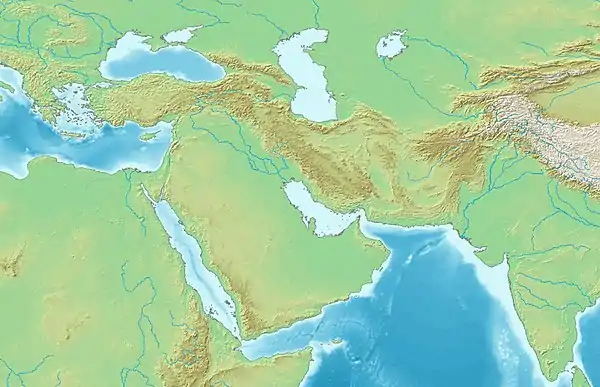   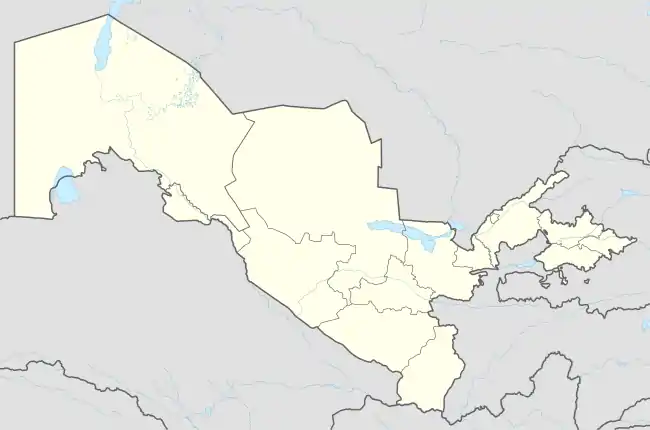 | |
Description
The paintings dates back to the middle of the 7th century CE. They were probably painted between 648 and 651 CE, as the Western Turkic Khaganate, members of which appear abundantly in the mural, was in its last days before its fall in 657 CE, and the Tang Dynasty was increasing its territory in Central Asia.[1][2][3] On the four walls of the room of a private house, three or four countries in neighbouring Central Asia are depicted. On the northern wall China (a Chinese festival, with the Empress on a boat, and the Emperor hunting), on the Southern Wall Samarkand (i.e.; the Iranian world: a religious funerary procession in honor of the ancestors during the Nowruz festival), on the eastern wall India (as the land of the astrologers and of the pygmies, but the painting is much destroyed there).
The topic on the main wall, the western wall facing the entrance is debated between specialists. Kökturk soldiers are escorting ambassadors coming from various countries of the world (Korea, China, Iranian principalities etc.). There are three main hypotheses. The leading expert on Sogdian painting, the excavator of Panjikent, B. Marshak points out that Sogdian painting, gods are always depicted on the top of the main wall. The Central figure might be the ruler of Samarkand Varkhuman or the goddess Nana.[4] However, as the Turks are guiding the embassies but are not themselves ambassadors, it has been suggested also that the Turkish Qaghan, then lord of inner and central Asia, possibly Ashina Buzhen or more probably Ashina Mishe, might be depicted there.[5]
Description of the four walls
The four walls of the palatial room in Afrasiab seem to depict the four principal civilizations in play in central Asia at that time: a Chinese depicting Chinese scene, a panel for India, an Iranian panel with the depiction of a religious ceremony during Nowruz, and possibly a Turk panel, showing numerous ambassadors being guided by Turkic officer towards a ruler, who could be a Turk Khagan.[6] A Chinese text is indeed saying that the idea of the "Four Lords of the World", here China, India, Iran and Turks, is depicted on the walls of palaces near Samarkand precisely during this period, and this would perfectly fit the four walls of this room. This palatial room was described in close detail in the Chinese chronicles of the Book of the Later Han:[7]
The country of He, also named Qushuangnijia (Koschânyah), or Guishuangni [...] To the east of the city, there is a storied pavilion inside of which are paintings. On the north wall, the former emperors of China. To the east, the princes and king of the Turks and the Hindus. To the west, the Persians and those from Byzantium. Every morning the prince of this country goes to this pavilion to pray, and then retreat."
Inscription mentioning Varhuman and the ambassadors
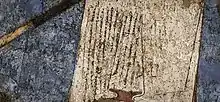
The last hypothesis makes use of an inscription mentioning the king of Samarkand Varkhuman, to propose the idea that the ambassadors are presenting their gifts to him. In the murals of Afrasiab, the inscription mentioning Varhuman, written in Sogdian reads:
Afrasiab Sogdian inscriptionWhen King Varkhuman Unash came to him [the ambassador] opened his mouth [and said thus]: "I am Pukarzate, the dapirpat (chancellor) of Chaganian. I arrived here from Turantash, the lord of Chaganian, to Samarkand, to the king, and with respect [to] the king [now] I am [here]. And with regard to me do not have any misgivings: About the gods of Samarkand, as well as about the writing of Samarkand I am keenly aware, and I also have not done any harm to the king. Let you be quite fortunate!" And King Varkhuman Unash took leave [of him]. And [then] the dapirpat (chancellor) of Chach opened his mouth.
Western Turk officers and courtiers
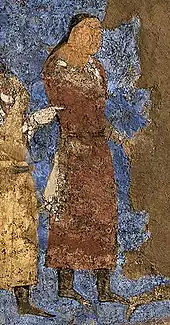
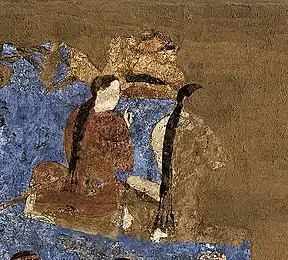
In contrast with the ambassadors from various countries, the Western Turks in the mural do not bear gifts. They are considered are attendants to the scene, and military escorts to the foreign ambassadors. They are all recognizable by their long plaits.[13]
The ambassadors from various countries may have been paying homage both to king Varkhuman and possibly Western Turk Khagan Shekui, who were both nominal vassals of China. The numerous Turkish officers and courtiers who are present may suggest the predominance of the Western Turks at the court of Samarkand during this time period.[1]
In the mural, the Western Turks are ethnic Turks, Nushibis, rather than Turkinized Sogdians, as suggested by the marked Mongoloid features and faces without beards.[14] They are the most numerous ethnic group in the mural, and are not ambassadors, but rather military attendants.[14] Their depiction offers a unique glimpse into the costumes of the Turks in the 6-7th century CE.[14] They typically wear 3 or 5 long long plaits, often gathered together into a single long one.[14] They have ankle-long monochromic sleeved coats with two lapels.[14] This fashion for the collar is first seen in Khotan near Turfan, a traditional Turkic land, in the 2nd-4th century CE.[14] They have low black sharp-nosed boots. They wear gold bracelets with lapis lazuli or pearls.[14]
Overview
There are four walls, with murals in various states of preservation. There were two registers, an upper and lower one, but the upper register of the murals was essentially destroyed by bulldozers during the construction works that led to the discovery of the murals.[13]
Various reconstructions for the whole mural have been proposed.[15]
.jpg.webp)
.jpg.webp)
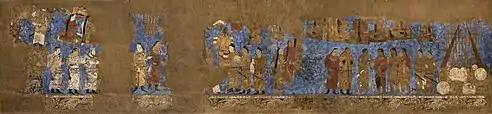
Ambassadors from various countries, paying hommage to king Varkhuman and possibly Western Turk Khagan Shekui, both nominal vassals of China. Numerous Turkish officers and courtiers are present.[1]
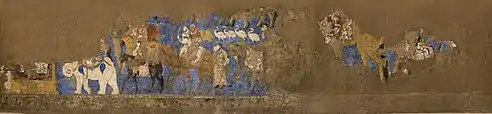
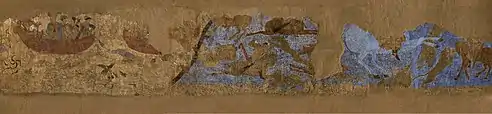
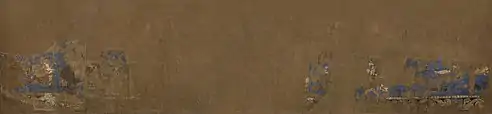
Original murals (details)
_Palace_Fresco_7th-8th_cent_Sogdian_Chamberlains_%2526_Interpreter_Introduce_Tibetan_Messengers.jpg.webp) Afrasiab Palace Fresco 7th-8th century. Sogdian Chamberlains & Interpreter Introduce Tibetan Messengers
Afrasiab Palace Fresco 7th-8th century. Sogdian Chamberlains & Interpreter Introduce Tibetan Messengers
 Chinese boat
%252C_and_Chach_(modern_Tashkent)_to_king_Varkhuman_of_Samarkand._648-651_CE%252C_Afrasiyab%252C_Samarkand.jpg.webp)
_Palace_Fresco_7th-8th_century_detail.jpg.webp) Afrasiab Palace Fresco 7th-8th century. Detail of a horserider
Afrasiab Palace Fresco 7th-8th century. Detail of a horserider
Restoration
In early 2014, France declared that it would finance the restoration of the Afrasiab painting.[18]
_and_Turkish_courtier_(right).jpg.webp) Afrasyab Chinese Embassy (left), carrying silk and a string of silkworm cocoons, and Turkish delegates (right), recognizable by their long plaits.[17][19]
Afrasyab Chinese Embassy (left), carrying silk and a string of silkworm cocoons, and Turkish delegates (right), recognizable by their long plaits.[17][19] Wall painting at the Ambassador's Hall in Afrosiab
%252C_and_Chach_(modern_Tashkent)_to_king_Varkhuman_of_Samarkand._648-651_CE%252C_Afrasiyab_Museum%252C_Samarkand%252C_Uzbekistan.jpg.webp)
 Turkish officers during an audience with king Varkhuman of Samarkand. 648-651 CE, Afrasiyab murals, Samarkand.[1][22]
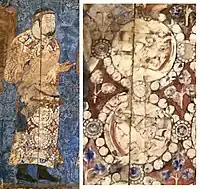 Delegate with boar head symbol on his dress in the Afrasiab murals 650 CE.[23]
See also
Sources
- Marshak, Boris; Grenet, Frantz; Sadowska-Daguin, Malgoržata (1994). "Le programme iconographique des peintures de la "Salle des ambassadeurs" à Afrasiab (Samarkand)". Arts Asiatiques. 49 (1): 5–20. doi:10.3406/arasi.1994.1349.
References
- Baumer, Christoph (18 April 2018). History of Central Asia, The: 4-volume set. Bloomsbury Publishing. p. 243. ISBN 978-1-83860-868-2.
- Whitfield, Susan (2004). The Silk Road: Trade, Travel, War and Faith. British Library. Serindia Publications, Inc. p. 112. ISBN 978-1-932476-13-2.
- Mode, Markus (2006). "Reading the Afrasiab Murals: Some Comments on Reconstructions and Details" (PDF). Rivista degli studi orientali. 78: 112. ISSN 0392-4866. JSTOR 41913392.
- de la Vaissière, Étienne (2006). "LES TURCS, ROIS DU MONDE À SAMARCANDE" (PDF). Rivista degli studi orientali. 78: 153–157. ISSN 0392-4866.
- de la Vaissière, Étienne (2006). "LES TURCS, ROIS DU MONDE À SAMARCANDE" (PDF). Rivista degli studi orientali. 78: 153–157. ISSN 0392-4866.
- Vaissière, Etienne de la (212). "Oxford Handbook of Late Antiquity: 5 Central Asia and the Silk Road". In S. Johnson (Ed.), Oxford Handbook of Late Antiquity, Oxford University Press, P. 142-169. Oxford University Press: 144–160.
- de la Vaissière, Étienne (2006). "LES TURCS, ROIS DU MONDE À SAMARCANDE" (PDF). Rivista degli studi orientali. 78: 148. ISSN 0392-4866.
- 新唐书/卷221下: "何,或曰屈霜你迦,曰贵霜匿,即康居小王附墨城故地。城左有重楼,北绘中华古帝,东突厥、婆罗门,西波斯、拂菻等诸王,其君旦诣拜则退。" in "新唐书/卷221下 - 维基文库,自由的图书馆". zh.wikisource.org (in Chinese)., quoted in de la Vaissière, Étienne (2006). "LES TURCS, ROIS DU MONDE À SAMARCANDE" (PDF). Rivista degli studi orientali. 78: 148. ISSN 0392-4866.
- "Afrosiab Wall Painting". contents.nahf.or.kr. NORTHEAST ASIAN HISTORY FOUNDATION.
- Bulatova, Vera; Shishkina, Galina V. (1986). Самарканд: музей под открытым небом "Samarkand, Open-air Museum" (in Uzbek). Publishing house of literature and art Изд-во лит-ры и искусства им. Гафура Гуляма. p. 47.
..."When king Varkhuman of the Unash dynasty approached the ambassador, the ambassador opened his mouth and said : 'I am Pukarzate..."
- de la Vaissière, Étienne (2006). "LES TURCS, ROIS DU MONDE À SAMARCANDE" (PDF). Rivista degli studi orientali. 78: 159–160. ISSN 0392-4866.
- Hansen, Valerie (2015). The Silk Road: A New History. Oxford University Press. p. 127. ISBN 978-0-19-021842-3.
- Library, British (2004). The Silk Road: Trade, Travel, War and Faith. Serindia Publications, Inc. p. 110. ISBN 978-1-932476-13-2.
- Yatsenko, Sergey A. (2004). "The Costume of Foreign Embassies and Inhabitants of Samarkand on Wall Painting of the 7th c. in the "Hall of Ambassadors" from Afrasiab as a Historical Source". Transoxiana. 8.
- Yatsenko, Sergey A. (2009). "Early Turks: Male Costume in the Chinese Art Second half of the 6th – first half of the 8th cc. (Images of 'Others')". Transoxiana. 14: Fig. 3.
- For an alternative interpretation, see: de la Vaissière, Étienne (2006). "LES TURCS, ROIS DU MONDE À SAMARCANDE". Rivista degli studi orientali. 78: 147–162. ISSN 0392-4866. JSTOR 41913394.
- Whitfield, Susan (2004). The Silk Road: Trade, Travel, War and Faith. British Library. Serindia Publications, Inc. p. 110. ISBN 978-1-932476-13-2.
- http://old.archeo-news.ru/2014/02/blog-post_8042.html
- Compareti (University of California, Berkeley), Matteo (2007). "The Chinese Scene at Afrāsyāb". Eurasiatica.
- Grenet, Frantz (2004). "Maracanda/Samarkand, une métropole pré-mongole". Annales. Histoire, Sciences Sociales. 5/6: Fig. D.
- Compareti (University of California, Berkeley), Matteo (2015). "Ancient Iranian Decorative Textiles". The Silk Road. 13: 38.
- Grenet, Frantz (2004). "Maracanda/Samarkand, une métropole pré-mongole". Annales. Histoire, Sciences Sociales. 5/6: Fig. B.
- Gordon, S. (30 April 2016). Robes and Honor: The Medieval World of Investiture. Springer. p. 47. ISBN 978-1-349-61845-3.
 |
Wikimedia Commons has media related to Afrasiyab museum paintings. |
Royal Nawrūz in Samarkand: Acts of the Conference held in Venice on the Pre-Islamic Afrāsyāb Painting, ed. M. Compareti and E. de La Vaissière, Rome, 2006.
External links
- Court art of Sogdian Samarqand in the 7th century AD - images and commentary at the University of Halle