Ahmed Balafrej
Ahmed Balafrej (Arabic: أحمد بلافريج; September 5, 1908, in Rabat – April 14, 1990[1]) was the Prime Minister of Morocco between May 12, 1958, and December 2, 1958.[2]
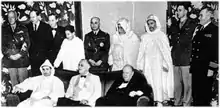
Ahmed Balafrej | |
|---|---|
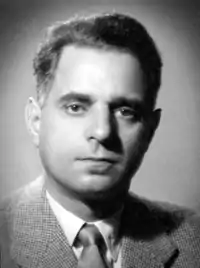 Ahmed Balafrej in 1950 | |
| Representative to Hassan II and Minister of Foreign Affairs | |
| In office 5 January 1963 – 13 November 1963 | |
| Monarch | Hassan II |
| Preceded by | under the authority of Hassan II |
| Succeeded by | Ahmed Reda Guedira (as Minister of Foreign Affairs) |
| 2nd Prime Minister of Morocco and Minister of Foreign Affairs | |
| In office 12 May 1958 – 13 December 1958 | |
| Monarch | Mohammed V |
| Preceded by | Mbarek Bekkay (as prime minister) |
| Succeeded by | Abdallah Ibrahim |
| Minister of Foreign Affairs | |
| In office 28 October 1956 – 16 April 1958 | |
| Prime Minister | Mbarek Bekkay |
| Preceded by | office established |
| Personal details | |
| Born | 5 September 1908 Rabat, Morocco |
| Died | 14 April 1990 (aged 81) Rabat, Morocco |
| Political party | Istiqlal |
Biography
Ahmed Balafrej (September 5, 1908 - April 14, 1990; in Arabic: أحمد بلافريج) was a major player in the struggle for the independence of Morocco, of which he is, once independence has been acquired, the founder of modern Moroccan diplomacy and statesman.
Balafrej was the architect of the unity of the Moroccan Nationalist Movement, mainly of the Istiqlal party, which led to the independence of Morocco on March 2, 1956 and of which he was secretary general from 1943 to 1960.
More diplomat and statesman than party man, after a stint as President of the Council in 1958, he distanced himself from the crises and splits that rocked Istiqlal after independence.
He abandoned all public office in 1972, without having, during his lifetime, given evidence of his direct participation in the history of Morocco.
Like many of his friends at the time, he excused himself by referring to the disappearance of his archives in the multiple police searches which violated his long fight for the independence of Morocco.
The construction of a nationalist consciousness
Descendant of hornacheros
Ahmed Balafrej was born in 1908 into a family of notables from the medina of Rabat, then a small city of less than fifty thousand inhabitants. His family name links him to the descendants of the three thousand Muslim Hornacheros from Extremadura expelled from Spain and landing on a beach in Rabat in the spring of 1610, and who founded the legendary republic of Bouregreg1 there.
An exceptional education
Rabat 1916: the school for the sons of notables on Bd Laalou.
His family financed his primary studies at the school of the notables of Bab Laâlou, then his secondary studies at the Muslim College of Rabat, future Moulay Youssef college. The colonial system did not allow him to pass it in Rabat, he obtained his baccalaureate in Paris at the Lycée Henri-IV.
He completed his Arabic studies at the Fouad I University in Cairo during the year 1927, then back in Paris at the Faculty of the Sorbonne (degree in letters, diploma in political science) from 1928 to 1932. This intellectual training, exceptional under the Protectorate (53 Moroccan high school graduates between 1920 and 1934), built its national consciousness, then its nationalist commitment.
May 1926 is the bloodthirsty crushing of the Rif Republic, the last act of armed resistance to colonization. Balafrej, like his young companions, took note of the occupier's military superiority and counted on the patient wear and tear of colonial totalitarianism to its self-destruction. He becomes "the architect" of the political organization of the nationalist claim. It will remain so until the day after Independence.
In August 1926, he created “the Society of Friends of the Truth” in Rabat, the first form of Moroccan nationalist organization, as much a secret society as a political discussion club.
His history studies at La Sorbonne, at the time the ideal course for any diplomatic career that he began in December 1927, already marked his ambitions as a man of a future Moroccan state. Which very naturally led him to participate in the creation of the Association of North African Muslim Students in France (AEMNAF) alongside Mohamed Hassan Ouazzani, his junior in Parisian studies, and the Tunisian Ahmed Ben Miled2, and located in Latin Quarter in Paris 115, boulevard Saint-Michel. It includes, among others, Mohamed El Fassi and Abdelkhalek Torrès, emblematic figure of the nationalist struggle in Morocco under Spanish occupation. Led by Ouazzani in 1929, then Balafrej in 1930, it was qualified by the police at the time as a “Nationalist Association”, following its decision not to accept Maghreb students (mainly Algerians, Algeria being then French department), who would have accepted French naturalization.
Building a national stature
Main article: Berber Dahir.
He was twenty-two years old in 1930. The Berber Dahir, imposed by the colonial authority as a first step towards direct administration3, was at the same time intended to break the nationalist agitation which animated the urban elites of Morocco.
Balafrej, from Paris, alerted by his companions in Salé4 and informed of the protest movement that is developing in mosques in Morocco, actively participates in the internationalization of the protest.
Meeting with Chekib Arslan
Main article: Chekib Arslan.
For this, he came into contact in the summer of 1930 with the Druze Emir Chekib Arslan, then a refugee in Lausanne, and emblematic figure of the Nahda.
The personality and the political intelligence of this great Syro-Lebanese leader and intellectual of Western and Arab dual culture can only seduce Balafrej who, orphan of father and mother, meets a paternity not only of character but of conviction.
The passionate friendship that binds them from then on strengthens their feeling of legitimacy to modify the course of the history of Morocco, and, beyond, of the Arab nation.
He shares with him the conviction that the offensive of desislamization of the Arab nation, in which the Berber Dahir participates, is a determining factor of the colonial occupation. He is opening up to pan-Arabism.
In return, he involves Chekib Arslan in the international protest against the Dahir and in support of the Maghreb nationalist claim. Extending a trip to Andalusia, Arslan met on August 8, 1930 in Tangier Balafrej, El Fassi, Benabdeljalil, before starting in Tetouan for ten days a series of conferences at the invitation of Haj Abdesslam Bennouna and Abdelkhaleq Torrès. His visit serves to federate nationalists from North and South Morocco for the first time.
Through leaflets sent from cities, alms tours as a pretext for propaganda or gatherings on the return of pilgrims from holy places, links are forged between urban youth and tribal notables from the countryside. In 1932, while police violence and arrests stifled internal protest against the Dahir, he developed protest from outside. Meeting Chekib Arslan again in Madrid during his trip to Morocco, he supports the creation in Tetouan of the “Hispano-Muslim Association” created by Abdesslam Bennouna on the initiative of the deputy of the young Spanish Republic. José Franchi Roca ((es)).
Maghreb review
one of the Maghreb 1932 Paris review.
The protest against the Dahir is only one aspect of the commitment of Balafrej and his companions. Robert-Jean Longuet, Parisian lawyer, anti-colonialist and socialist, received at the beginning of 1932 the visit of Balafrej, Ouazzani and Ben Abdeljalil come to ask him to ensure the defense of the Moroccan nationalists harassed by the authorities.
This request was transformed into the editorial board of the French-speaking magazine Maghreb. If Longuet is in charge of it, Ahmed Balafrej is the most prolific editor, with El Ouazzani, Lyazidi and Ben Abdeljalil. Entirely funded by nationalist circles, distributed over a thousand copies in Morocco and France from July 1932, his articles allowed Balafrej to make his first contacts with French liberal and socialist political circles, but also the leading spheres of the young republic. Spanish. It was banned from broadcasting in Morocco in 1934, like all the nationalist-inspired press.
Despite the annoyances and arrests inside, the international press campaign generated from Paris, Cairo and northern Morocco forced the colonial authorities to empty the Dahir of all meaning in April 1934.
From reformism to the struggle for independence
The years 1933-1934 saw the appearance of the Moroccan Action Committee, a grouping around cells created in Fez (Allal El Fassi and Mohamed Hassan El Ouazzani), Rabat (Ahmed Balafrej and Mohamed Lyazidi), Salé (Saïd Et Abdelkrim Hajji, Ahmed Maâninou, Mohamed Hassar, Boubker El Kadiri) and Tétouan (Abdesslam Bennouna, Abdelkhalek Torrès, Mohamed Daoud) young urban nationalists. The CAM constitutes the historic heart of the Moroccan nationalist movement.
Hall of the administration building of the M'hammed Guessous School, founded by Ahmed Balafrej, whose portrait can be seen in the background
From 1934, he participated in the drafting of the CAM platform known as the “Plan de Réforme”. His name does not appear in the document, because at the same time he is negotiating the authorization to open the M'hammed Guessous school in Rabat, the first non-colonial bilingual Moroccan school, which will be the crucible of the new Moroccan elite of post-independence.
This document, a 134-page printed memoir on French policy in Morocco, of reformist inspiration and which at the time did not contain any request for independence, was published in Arabic and then in French in November 1934. Its argument, very legal in its form, simply demands that the colonial authority respect its own laws.
Ignored by the circles of the Parisian parliamentary left, he received no comment from the authorities of the French Republic.
In February 1937, he became the secretary general of the CAM, replacing Mohamed Hassan El Ouazzani, whose ambition worries at least equal to that of Allal El Fassi pushes to create with a small handful of militants his own organization, which will become much later the modest PDI.
To the prohibition of the CAM by the colonial authority, it answers by the organization in April 1937 in Rabat of the clandestine congress of the new “National Party”. The incidents of October 1937, lead to arrests, and banishment of leading executives, including Allal El Fassi exiled in Gabon for nine years.
These events mark the definitive abandonment by this Moroccan nationalist youth of the hope of any sharing of power with the colonial authorities.
End of the colonial occupation and total independence, such are the conclusions drawn by the whole of Moroccan society, paradoxically deprived for five years of its most effective activists.
While in sanatorium cure in Switzerland, Ahmed Balafrej escapes the roundup. He is only 29 years old and is one of the few nationalist leaders who are almost free to move around.
On the exercise of diplomacy in wartime
The defeat of France in June 1940 alters the balance of the colonial powers. Like all the nationalists of the French colonies at the same time, in the middle of a war which is not theirs, Ahmed Balafrej took the opportunity to push the cause of independence as far as possible.
No to collaboration with Nazi Germany
In the summer of 1940, he moved to Tangier, which the Spanish authorities, taking advantage of the invasion of France by the German army, annexed since June 14, 1940.
The new masters of the colonies, intoxicated by their military victories, display intentions, if not illegible, at least equivocal. Fascist Italy claims the annexation of the entire Arab Maghreb, Morocco included, while Nazi Germany wants to bring fascist Spain out of its neutralism by granting it the annexation of all of Morocco. At the same time, the pro-nationalist propaganda of Radio Berlin or Radio Bari, relayed all the acts of nationalist resistance censored by the colonial administration. Few are the clairvoyant minds able in this autumn 1940 to give clear directives to the nationalist struggle. Balafrej assumes his responsibilities 5.
At the instigation of Chekib Arslan, who organized the interview, he moved from Switzerland to Berlin for a few days in October 1940, to notify the German Foreign Ministry of the need to recognize Moroccan independence as quickly as possible. "I am trying to see what sauce we will be eaten, but I can tell you right now: do not let yourself be taken by the song of the German siren" he wrote in a letter addressed to his companions.
He is one of those figures of Arab nationalism who categorically oppose any alliance with Nazism, refusing in advance any support from the Axis forces, which in any case will never come.
Anfa's interview
Main article: Anfa conference.
Children of war: misery and famine.
He returned clandestinely to northern Morocco at the end of 1940, before being again authorized in December 1942 to circulate in his country, thanks to Operation Torch, which at the cost of 1,800 dead allowed the landing of Anglo-American troops on the coasts of Casablanca.
The Moroccan population, at the end of 1942, was in an alarming general state, in a situation of near famine, aggravated by an epidemic of typhus which decimated towns and countryside. Food is rationed, oddly more for the Moroccans than for the colonists; the colonial administration, whose Petainist parenthesis has durably exacerbated anti-Arab racism, Muslims and Jews alike, comes under the control of the Free France government of General de Gaulle. Apart from timid approaches, quickly broken off, in 1943 with Allal El Fassi still in exile, it is rather through the surveillance of military security that contact between nationalists and the new colonial authorities continued.
January 1943: Interviews with Mohamed V and Roosevelt in his villa in Anfa.
The news comes from the Sultan who met on January 22, 1943 face-to-face with President Roosevelt, on the sidelines of the Anfa conference.
Assured of American support for the reestablishment of the monarchy, he decided from that date to publicly assume the independence claim. He will stay there until independence.
Manifesto of independence
In 1944, having intelligently anticipated the process of decolonization that the Anglos-French would inevitably initiate after their victory over Nazi Germany, he was the historic drafter of the Independence Manifesto (Ouatiqate al-Istiqlal) signed by 67 of his friends. nationalists and contributed to the founding of the Istiqlal party in 1944, of which he became the first secretary.
Publicly submitted to the Sultan on January 11, 1944, this first public demand for independence led, on January 28, 1944, to his arrest by French military security under the orders of Philippe Boniface, as well as that of 17 of the signatories, on the grounds ... intelligence with the enemy. The explosion of anger which follows makes sixty deaths, and does not prevent, after four months of prison without trial, his exile in Corsica in May 1944. Only his state of health makes moreover give up the authorities to the exile to Madagascar, after having threatened him with the death penalty in a trial devoid of all reason and which will never see the light of day.
Amnestied and back in Morocco in June 1946, in September he founded the first national Arabic-language daily, Al Alam, of which he was the first editor.
In 1947, at the end of the historic speech of Sultan Mohamed V in which the latter officially rallied to the independence theses, the French colonial lobby lobbied to impose General Juin, a colonial extremist, as General Resident in Morocco.
Internationalization of the Moroccan cause
In 1947, Ahmed Balafrej took his family to safety in Tangier, then in Madrid, from which he led a diplomatic campaign in the United States, Switzerland, France and Spain in order to promote the Moroccan cause there.
Secretary General of the Istiqlal Party, he is above all, for those who worked with him at that time, the Foreign Minister of independent Morocco before his time.
It gives priority to the internationalization of the national cause and continues the diplomatic offensive for the recognition of independence.
In particular, in New York, he runs the “Moroccan Bureau of Information and Documentation”, a true spokesperson for the Moroccan cause, whose press releases he will oversee including during his frequent travels.
Its strategy, in part paying off, consists in forcing the French government to negotiate the abandonment of its prerogatives in matters of police, diplomacy, currency and the army to any sovereign Moroccan authority within internationally recognized borders.
Protected by a Pakistani diplomatic passport, it quickly gained the support of non-aligned countries. On the other hand, he must fight hard to convince American diplomacy to transfer from its French ally to an independent Moroccan power the defense of its strategic interests in the Mediterranean, in the midst of the cold war,
So in October 1953, he defended the cause of independent Morocco before the United Nations General Assembly. The vote on a resolution calling for Morocco's self-determination is adopted by the United Nations General Assembly. This decision should be placed in the context of the formalization of the concept of non-alignment six months later at the Colombo meeting, a prelude to the Bandung conference which made the French authorities aware that independence was inevitable.
In December 1952, the violent demonstration of the central quarries of Casablanca, in protest against the terrorist assassination of Tunisian trade union leader Ferhat Hached, is the pretext used to behead the national movement, all organizations included. The troops shoot the demonstrators killing a hundred, imprison some four hundred cadres of the Istiqlal party, exile its forty most senior officials. The sultan himself was exiled with his family to Madagascar in 1953.
Politics by Arms
Since 1952, but particularly in 1954, the violent repression of any independentist public expression, the flight abroad or the clandestinity of the main leading cadres of the Independence Party, the very opportunistic Soviet military aid to the triumphant Egyptian nationalism favored the birth of armed resistance. "Politics by arms" competes with "the arms of politics".
Playing on the tolerance of the Spanish occupier of northern Morocco, the first groups of young resistance fighters were organized in Tetouan. Then gradually, around Nador, with the support of the first heads of the Algerian FLN, a Moroccan Liberation Army (ALM) was formed which, at the end of 1955, operated in a territory of around one hundred kilometers from the Rif to the Middle Atlas. The control of these armed groups becomes a strategic issue for the actors of independence: the Istiqlal party (Allal El Fassi, Ben Barka, Torres), emissaries of the royal family (Dr Khatib), or irredentists (Sanhaji, Mesaadi) ).
By conviction as much as by character, Balafrej favors the weapons of diplomacy. Unlike Allal el Fassi who, from Cairo, claims to be leader of the secret resistance, he maintains a distance from armed action, but without ever condemning it.
He never took sides in the violent clashes for the control of the armed groups that marked the first years of independence.
Weapons of politics: independence negotiations
Incapable of resisting international pressure, especially American pressure, Paris is looking for interlocutors in Morocco with whom to build a Moroccan authority that is admittedly independent but docile, and to maintain its military presence throughout the Maghreb in order to play on an equal footing with the American Atlanticist power.
France is negotiating with Istiqlal
Thus in August 1955, drawing inspiration from the negotiations with Bourguiba which led to the independence of Tunisia, the French government decided to negotiate with the party of Balafrej and his companions, considered until then as extremists.
A French delegation of five ministers led by Edgar Faure meets in Aix-les-Bains, after some notables collaborators, or opportunists, or not very representative like the PDI, a delegation of Istiqlal led by the young Abderrahim Bouabid6. Not having been authorized to stay in France, Balafrej, from Geneva where the delegation meets daily, follows and directs the talks.
Aware of the risks of generalization of political violence, as well as of the possible hold-up of independence by some influential tribal notables, he sets the priorities of the Independence Party: return of the Sultan from exile as a non-negotiable prerequisite, then constitution, under the authority of the Sultan, of a transitional government, finally abrogation of the colonial treaty of Fez of 1912. This is the scenario that history retains.
The Istiqlal accompanies the monarchy
Without his inflexibility and that of the Istiqlal negotiators, Morocco would never have welcomed the return of Sultan Mohamed V and his family from his forced exile in early November 1955. This debt owed to him by the royal family, explains in part the singular loyalty that he maintains with Sultan Mohamed V, then his son Hassan II, until the divorce of 1972.
In November 1955, the Sultan of Morocco and Prince Hassan returned to Morocco. Their triumphant return, which popular memory still retains today, is organized and protected by the tremulous Ben Barka, effective “steward” of the Istiqlal party. The royal family, assailed by individual testimonies of allegiance or rallying, became aware of the indisputable representativeness of the party of which Balafrej was the strategist7.
A competition begins for the control of executive power where Balafrej tries to get the sultan to compose the transitional government according to a program and not a balance of rivalries which the royal cabinet would be the arbiter. On November 22, 1955, he summons and obtains in Madrid the agreement of the historical leaders of Istiqlal, including Allal el Fassi, against whom he opposes a personal rivalry of public notoriety, on the program assigned to the provisional government that the sultan s 'ready to constitute.
From left to right: Bouabid, Balafrej, Abdeljalil, Benjelloun returned from exile in November 1955.
Quickly, his return from exile with his companions on November 25, 1955, and the extraordinary congress of the Istiqlal party that he organized in Rabat in December 1955 and which confirmed it in his post of secretary general, authorized the promulgation of the first Moroccan transitional government. The way opens for the abrogation of the Treaty of Fez and the declaration of independence of the Kingdom of Morocco on March 2, 1956.
Modernist spirit, inspired as much by the thought of a Chekib Arslan as of a Djemâl ad-Dîn al-Afghânî, he was able to capture and integrate into his political struggle the moral rigor of anti-colonial French such as Robert-Jean Longuet, Daniel Guérin, Charles André Julien, François Mauriac, as much as respect for French politicians (Edgar Faure or Pierre Mendès France).
A certain idea of Morocco
Building the voice of Morocco in the world
In March 1956, independence entrusted power to a compromise government where his party agreed to have only 9 ministers out of 21, in accordance with the La Celle-Saint-Cloud agreements.
Prince Hassan takes command of the new National Army, assisted by Captain Oufkir, son of a collaborator and former officer of the French Army.
Now independent, Morocco must urgently organize the international representation of its interests. On April 26, 1956, Ahmed Balafrej officially became the Prime Minister of Foreign Affairs of the Kingdom of independent Morocco. He is reappointed to this post in the second government of M'barek Bekkai.
He is the true founder and initiator of Moroccan diplomacy. It was he who opened the first Moroccan embassies abroad, who set up the first consulates and who made Morocco's accession to major international organizations including the UN in July 1956, the League of Arab States and the organization. of African Unity. -
1956, first Ministry of Foreign Affairs. Balafrej and his collaborators8
Its first mission is the signing of the Franco-Moroccan convention of May 20, 1956, consecrating the foundation of a Moroccan diplomacy freed from French tutelage. Then there is the liberation of Tarfaya negotiated with Spain, then a Spanish colony, as well as the return of Tangier under Moroccan authority.
Building a State in an Emergency
Without experienced executives, dependent on the commercial and financial flows of a France from which it is emancipating itself, ensuring its internal security through an Istiqlal party with authoritarian tendencies inherited from years of clandestinity, the Bekkaï government does not resist. not to clashes between clans and people.
On May 12, 1958, the Sultan resolved to appoint Balafrej President of the Council of the first and only fully istiqlalien government in the history of Morocco. Until December 2, 1958, he worked to build a modern constitutional monarchy for Morocco.
One of its outstanding actions is the promulgation of the code of public freedoms and the right of association, largely inspired by the French republican code in this area.
This law, although very widely violated since its edition, has never been called into question.
It remains the legal basis and the Moroccan singularity as much of the multiparty system as of the legal existence of non-governmental organizations, a potential melting pot of a civil society in the making.
It displays an uncompromising nationalist position with regard to French and American military presences on Moroccan soil but without really having the means for its policy.
It was Prince Hassan, who became King Hassan II, in his capacity as Chief of Staff of the Armed Forces, who personally negotiated and obtained the evacuation, final in 1960 for the French soldiers, in 1963 for the American bases present. on Moroccan soil.
From his fidelity to the years of exile to the judgment of history
A situation of political violence shakes the newly independent Morocco at the end of 1958. Relinquishment of control of the new army commanded by Prince Moulay Hassan, far from the executive apparatus of the party and the violent clan struggles that shake it, forced to negotiate step by step and at the lowest cost the recovery of the prerogatives still under the control of the former colonial powers, Prime Minister Balafrej draws the consequences and presents the resignation of his government.
The unity of the National Movement that he embodied shattered with the series of splits from January 1959. The epilogue of this half-century of struggle for the independence of Morocco is sealed with the deletion, on the proposal of Allal El Fassi, from his post as Secretary General of the Istiqlal Party at the January 1960 Congress.
In 1962, he was once again briefly appointed by Hassan II as Minister of Foreign Affairs, then from 1963 to 1972, personal representative of the King, a protocol function on the sidelines of a Ministry of Foreign Affairs controlled by the confidants of the Royal Cabinet9. To date, he is the only one to have been given this function which, while paying tribute to his qualities as a statesman, "depoliticizes" the former head of a party in rivalry for hegemony with the Palace. .
In 1972, the arbitrary arrest by the political police led by General Oufkir of his son Anis, a modernist activist, made him resign from all his official functions.
He remains one of the only Moroccan politicians who had the courage to impose his resignation in a political system where this act of individual freedom remains inconceivable.
From that date, he retired from all political activity, and died in May 1990 in Rabat following a long illness.
Place chosen by him during his lifetime, he rests inside the Moulay Mekki mosque
References
- Wolf, Jean (1994). Les secrets du Maroc espagnol: l'épopée d'Abd-el-Khaleq Torrès (in French). Eddif. p. 173. ISBN 2-7158-1050-4. Retrieved 20 June 2010.
- "Political Leaders:Morocco". Archived from the original on 2012-09-20.
- [PDF] La déportation des Morisques, un génocide oublié [archive] Maroc Hebdo International, n°521
- ↑ Mohamed Bekraoui, Les étudiants marocains en France à l’époque du Protectorat 1927-1931, Présences et images franco-marocaines au temps du protectorat. (Textes réunis par Jean-Claude Allain), Paris, L’Harmattan, 2003, p.89-109.
- ↑ Se justifiant par une ethnicisation (ou communautarisation) de la société marocaine, décrite comme une contrée peuplée de berbères islamisés par des envahisseurs arabes islamisants de force, ce décret vise à saboter le peu de pouvoir judiciaire encore aux mains de l'autorité du Sultan
- ↑ A. Sbihi, traducteur du Dahir, est le premier à alerter ses compagnons. Lahrech, Hajji puis de Fes Allal El Fassi amplifient la protestation.
- ↑ La Méditerranée fasciste, Juliette Bessis, éd. Kartala, p.275
- ↑ La délégation du PI est composée de : Bouabid, Benabdeljalil, Lyazidi, Ben Barka, Ben Seddik, Boucetta, Douiri.
- ↑ les estimations donnent autour de cent mille militants pour un pays de dix millions d'habitants, soit une famille sur vingt, auxquels adjoindre les deux cent mille syndicalistes de l'UMT. Le PDI ne dépasse pas le millier de militants.
- ↑ De gauche à droite autour de Balafrej : Iraqi, Jaïdi, El Kouhen, Smires, Benani, Ghallab, Snoussi, Filali, Boucetta
- ↑ À ce titre, les négociations avec les autorités françaises lors de la crise gravissime de 1966-1967 liées à l'affaire Ben Barka sont confiées à Ahmed Guedira, ministre des Affaires étrangères, intime du roi, chargé, puis à Driss Slaoui, directeur du Cabinet royal
- Robert Rezette, Les Partis politiques marocains, Librairie Armand Colin, 1955
- Hahn, Lorna. North Africa: Nationalism to Nationhood. Washington, DC: Public Affairs Press, 1960.
- Ashford, Douglas. Political Change in Morocco. Princeton, NJ: Princeton University Press, 1961.
- J.Waterbury. The Commander of the Faithful. London Weidenfeld and Nicolson 1970
- BESSIS, Juliette, 1978, Chekib Arslan et les mouvements nationalistes au Maghreb, Revue historique, 1978
- C.A.Julien: Le Maroc face aux Impérialismes. Jeune Afrique Éditions.
- Daniel Rivet, Lyautey et l'institution du protectorat français au Maroc, Éditions L'Harmattan, 1988
- A. Benjelloun, Le patriotisme marocain face au protectorat espagnol, Rabat, 1993
- ابؤبكر القادري.الحاج احمد بلأفريج.جميع لحقؤق محفؤظة 1996
- Pennell, C. R. Morocco since 1830: A History. New York: New York University Press, 2000
- Anne-Claire de Gayffier-Bonneville, Renaissance arabe et solidarité musulmane dans La Nation arabe, Revue des mondes musulmans et de la Méditerranée avril 2002
- Ahmed Balafrej documentaire de la chaine TV 2M 1994 [archive]
Authority control  | |
|---|---|
| General | |
| National libraries | |
| Other | |