Ahshislepelta
Ahshislepelta is a genus of herbivorous ankylosaurine ankylosaurid dinosaur from the Late Cretaceous (late Campanian stage) deposits of San Juan Basin, New Mexico, USA.
| Ahshislepelta Temporal range: Late Cretaceous, | |
|---|---|
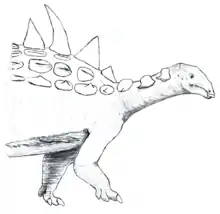 | |
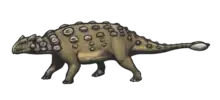
| Restoration | |
Scientific classification  | |
| Kingdom: | Animalia |
| Phylum: | Chordata |
| Clade: | Dinosauria |
| Order: | †Ornithischia |
| Suborder: | †Ankylosauria |
| Family: | †Ankylosauridae |
| Genus: | †Ahshislepelta Burns & Sullivan, 2011 |
| Species: | †A. minor |
| Binomial name | |
| †Ahshislepelta minor Burns & Sullivan, 2011 | |
Discovery and naming
Ahshislepelta is known from the holotype SMP VP-1930, a closely associated and incomplete postcranial skeleton of an adult individual consisting of the shoulder girdle, a partial left forelimb, vertebrae and osteoderms. It was discovered in 2005 and collected between 2005 and 2009 from the Hunter Wash Member from the Kirtland Formation at the Ahshislepah Wash locality. Ahshislepelta was first named by Michael E. Burns and Robert M. Sullivan in 2011 and the type species is Ahshislepelta minor. The generic name comes from the Ahshislepah Wash locality, where the fossils were found, and pelta, "shield" in Greek. The specific name is derived from minor, "small" in Latin, in reference to its smaller adult size relative to other ankylosaurids from North America. Humerus length is about thirty-one centimetres.[1]
Description
Ahshislepelta is a rather small ankylosaur. The humerus is thirty-one centimeters long, which indicates a body length of four meters and a weight of one ton. The shoulder girdle is fifty-one centimeters long.
The describers were able to identify one unique derived feature: a protrusion on the scapula, the lateral acromion forms an overhang that is a quarter of the width of that scapula. This overhang is more prominent than most of the other taxa evaluated.[1]
The scapulocoracoids are fused completely, a sign that it is not a young animal. The blade of the scapula is quite broad. The humerus is massively built. It has a well-developed deltopectoral crest that protrudes fifteen centimeters and is angled 23° from the shaft. The upper two-thirds of the radius has been found with a length of about seventeen centimeters.
A large number of bony plates are known, some of which were fused to the left shoulder blade. The larger ones are circular or crescent-shaped with a curved keel and a concave bottom so that the thickness is not great; the smaller ones have a higher keel and are more oval in shape. The largest osteoderm found has a size of fifteen by twelve centimeters and a keel that is ten centimeters high. The smallest elements have a diameter of one centimeter. Ankylosaur species have a distinctive surface structure of their osteoderms. However, that of Ahshislepelta resembles that of Euoplocephalus: The rough surface is formed by evenly spaced pits, pervaded by a widely spaced network of grooves for the veins and nerves, the openings for which end up on the bone surface. Because the specimen is so much smaller than Euoplocephalus and because of the deviating shoulder blade, it was concluded that it is a separate taxon.[1]
Classification
Ahshislepelta was assigned to the Ankylosauridae and more precisely to the Ankylosaurinae.[1]
See also
References
- Michael E. Burns & Robert M. Sullivan (2011). "A new ankylosaurid from the Upper Cretaceous Kirtland Formation, San Juan Basin, with comments on the diversity of ankylosaurids in New Mexico" (PDF). Fossil Record 3. New Mexico Museum of Natural History and Science, Bulletin. 53: 169–178.
| |||||||||||||||||||||||||||||||||||||||||||
| |||||||||||||||||||||||||||||||||||||||||||
| |||||||||||||||||||||||||||||||||||||||||||
| |||||||||||||||||||||||||||||||||||||||||||