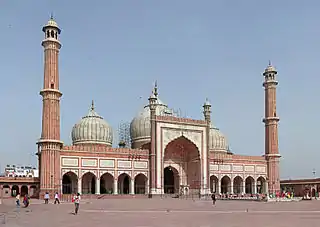
Alamgir Mosque
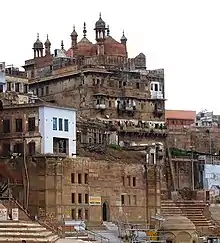
The Alamgir Mosque, Varanasi, also known as Beni Madhav ka Darera and Aurangzeb's Mosque, is a mosque built in the 17th century by Mughal Emperor Aurangzeb in the Indian state of Uttar Pradesh.[1][2]
| Alamgir Mosque, Varanasi Aurangzeb's Mosque | |
|---|---|
 | |
| Religion | |
| Affiliation | Islam |
| Ecclesiastical or organizational status | Functional |
| Location | |
| Location | Varanasi, India 25.31 N 83.01 E |
| State | Uttar Pradesh |
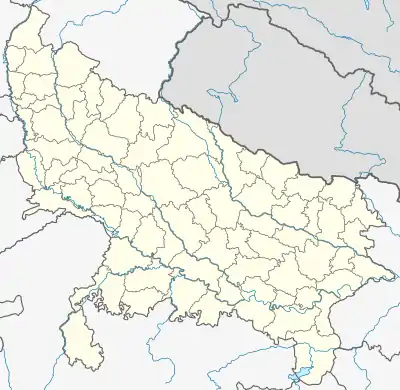  Location in Uttar Pradesh, India | |
| Geographic coordinates | 25.311°N 83.01°E |
| Architecture | |
| Founder | Aurangzeb |
Location
The mosque is located at a prominent site above the Panchganga Ghat. The ghat has broad steps that go down to the Ganges.[3]
Aurangzeb built a mosque 1669[4] and named it as Alamagir Mosque in the name of his own honorific title "Alamgir", which he had adopted after becoming the emperor of the Mughal empire. In 1663 Aurangzeb captured the Varanasi and demolished the Kashi Vishwanath Temple in 1669. Bindu Madhav Temple was also destroyed in 1673 and Aurangzeb built the Alamgir mosque on the ruins of the temple. The foundation of the temple was used for the construction of the mosque which is also believed to be as deep as the height of it. Aurangzeb also added 2 minarets and 3 domes to give the structure a striking look. Each minaret was 163 feet long and was equipped with a staircase and a balcony. However, the minarets couldn’t withstand the test of time and in the 19th century, an English scholar James Prinsep had to restore them. In 1948 one of the minarets collapsed killing a few people around the time of the floods. Later the govt pulled down the other minaret due to security reasons. [5][6]
Features
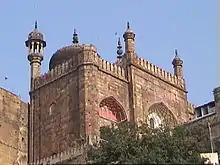
The mosque is architecturally a blend of Islamic and Hindu architecture.[5] The mosque has high domes and minarets.[7][6] Two of its minarets were damaged; one minaret collapsed killing a few people and the other was officially brought down owing to stability concerns.[6] The Panchaganga Ghat where the mosque is situated is where five streams are said to join. In October lamps are lighted on top of a bamboo staff as a mark of guidance to the ancestors.[7]

References
Citations
- Crowther, Raj & Wheeler 1984.
- "Alamgir Mosque – Lost Vishnu Temple Of Varanasi". Varanasi Guru. 6 April 2018. Retrieved 6 April 2018.
- Hussain 1999, p. 70.
- Dunlop, Sykes & Jackson 2001, p. 135.
- Kumar 2003, p. 90.
- Betts & McCulloch 2013, p. 213.
- Shetty 2014, p. 73.
Bibliography
- Betts, Vanessa; McCulloch, Victoria (27 September 2013). India – The North: Forts, Palaces, the Himalaya Dream Trip. Footprint Travel Guides. ISBN 978-1-907263-74-3.
- Crowther, Geoff; Raj, Prakash A.; Wheeler, Tony (1984). India, a Travel Survival Kit. Lonely Planet.
- Dunlop, Fiona; Sykes, Carol; Jackson, Felicity (2001). Fodor's Exploring India. Fodor's Travel Publications. ISBN 978-0-679-00707-4.
- Hussain, Ansar (1 January 1999). Rediscovery of India, The: A New Subcontinent. Orient Blackswan. ISBN 978-81-250-1595-6.
- Kumar, Brajesh (2003). Pilgrimage Centres of India. Diamond Pocket Books (P) Ltd. ISBN 978-81-7182-185-3.
- Shetty, Rekha (1 May 2014). Innovation Sutra: The Secret of Good Business and a Good Life. Penguin Books Limited. ISBN 978-93-5118-696-0.
Further reading
- Vit-Suzan, Dr Ilan (28 March 2014). Architectural Heritage Revisited: A Holistic Engagement of its Tangible and Intangible Constituents. Ashgate Publishing, Ltd. ISBN 978-1-4724-2064-0.
 |
Wikimedia Commons has media related to Alamgir Mosque. |