Alan Wilson (musician)
Alan "Blind Owl" Christie Wilson (July 4, 1943 – September 3, 1970) was an American musician, best known as the co-founder, leader, co-lead singer, and primary composer of the blues band Canned Heat. He sang and played harmonica and guitar with the group live and on recordings. Wilson was the lead singer for the group's two biggest U.S. hit singles: "On the Road Again" and "Going Up the Country".
Alan Wilson | |
|---|---|
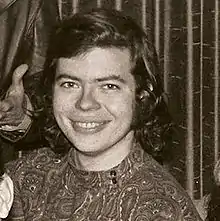 Wilson in 1968 | |
| Born | July 4, 1943 |
| Died | September 3, 1970 (aged 27) |
| Cause of death | Accidental barbiturate overdose |
| Resting place | Cremated; ashes scattered in Sequoia National Park |
| Other names | Blind Owl, Charles Holloway, Esq |
| Education | |
| Occupation |
|
| Awards |
|
| Musical career | |
| Genres | |
| Instruments |
|
| Years active | 1960–1970 |
| Labels | Liberty Records |
| Associated acts | |
| Website | alanwilsoncannedheat |
| Signature | |
 | |
Early years
Alan Christie Wilson was born to John (Jack) Wilson (1914-2000), a bricklayer, and Shirley Bingham (1922-2011) on July 4, 1943, and grew up in the Boston suburb of Arlington, Massachusetts. [1] His parents divorced when he was 3 and both later remarried. Wilson was highly intelligent, setting him apart from his peers. As a result he was often bullied by his schoolmates. His father Jack enjoyed radio ham operation. Alan became involved as a child but soon turned his interest to music after his stepmother Barbara bought him a jazz record. Some of Wilson's first efforts at performing music publicly came during his teen years when he learned trombone, teaching himself the instrumental parts from the aforementioned jazz record. Later he formed a jazz ensemble with other musically oriented friends from school called Crescent City Hot Five.[2] At this time, Wilson was into traditional New Orleans music, and later, Classical European and Indian music. He was also on the high school tennis team. Eventually Wilson quit trombone. It was around this same time that Wilson developed a fascination with blues music after a friend played a Muddy Waters record for him, The Best of Muddy Waters.[3] Inspired by Little Walker, he took up harmonica, and soon after the acoustic guitar after hearing a John Lee Hooker record. After graduating from Arlington High School in 1961, he majored in music at Boston University. His academics earned him a National Merit Scholarship and the F.E. Thompson Scholarship Fund from the Town of Arlington. Wilson developed into a dedicated student of early blues, writing a number of articles for the Broadside of Boston newspaper and the folk-revival magazine Little Sandy Review, including a piece on bluesman Robert Pete Williams. [4] Anxious to play music rather than study it, Wilson quit school after only a year and a half. To make ends meet, Wilson worked with his father as a bricklayer, and occasionally gave harmonica and guitar lessons.
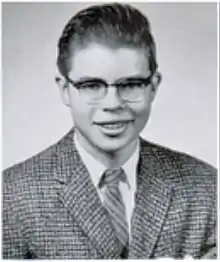
Wilson was considered by many of his musical peers to be an expert on the blues musicians who came before him; many considered him as possessing an exceptional ability for connecting musically with the elder bluesmen.[5][6] His biggest influences included Skip James, Robert Johnson, Son House, Charley Patton, Tommy Johnson, John Lee Hooker, Muddy Waters, and Bukka White. James, in particular, was greatly admired by Wilson. In high school, Wilson studied James' 1931 recordings with great ardor. Subsequently, Wilson began singing similar to James' high pitch. Wilson eventually perfected the high tenor for which he would become known.[7]
After Son House's 'rediscovery' in 1964, it was evident that House had forgotten his songs due to his long absence from music. Wilson showed him how to play again the songs House had recorded in 1930 and 1942. Wilson played House's old recordings for him and demonstrated them on guitar to revive House's memory.[8] House recorded Father of Folk Blues for Columbia Records in 1965. Two of the selections on the set featured Wilson on harmonica and guitar. In a letter to Jazz Journal published in the September 1965 issue, Son House's manager Dick Waterman remarked the following about the project and Wilson: "It is a solo album, except for backing on two cuts by a 21-year-old White boy from Cambridge by the name of Al Wilson. Al plays second guitar on Empire State Express and harp on Levee Camp Moan. Al never recorded before, but he has backed John Hurt, Skip James, Sleepy John Estes, Bukka White and many others. He is good, and the record will prove it."[9]
Canned Heat
During his time performing in Cambridge, Wilson met American guitarist John Fahey. From Fahey, he acquired the nickname "Blind Owl" owing to his extreme nearsightedness, roundish facial features and scholarly nature.[10] In one instance when he was playing at a wedding, he laid his guitar on the wedding cake because he did not see it. As Canned Heat's drummer, Fito de la Parra, wrote in his book: "Without the glasses, Alan literally could not recognize the people he played with at two feet, that's how blind the 'Blind Owl' was."[11] With Fahey's encouragement, Wilson moved with Fahey to Los Angeles with the aim of having Wilson assist Fahey with his UCLA master's thesis on Charley Patton. In Los Angeles Wilson met Bob Hite, a fellow blues enthusiast and record collector who later established Canned Heat with Wilson.[12]
With Canned Heat, Wilson performed at two prominent concerts of the 1960s era, the Monterey Pop Festival in 1967 and Woodstock in 1969. Although Canned Heat's live performance was cut from the original theatrical release of the Woodstock film, they were featured in the 25th anniversary "Director's Cut."[13] The studio version of "Going Up The Country" was featured in the Woodstock film.
Wilson also wrote and sang the hit record "On the Road Again". In an interview with DownBeat magazine he remarked, "... on 'On The Road Again' [second LP] I appear in six different capacities – three tamboura parts, harmonica, vocal, and guitar, all recorded at different times."[14] On the double album Hooker 'N Heat (1970), John Lee Hooker is heard wondering how Wilson is capable of following Hooker's guitar playing so well. Hooker was known to be a difficult performer to accompany, partly because of his disregard of song form, yet Wilson seemed to have no trouble at all following him on this album. Hooker concludes that "you [Wilson] musta been listenin' to my records all your life". Hooker is also known to have stated "Wilson is the greatest harmonica player ever."[15]
Death
On September 2, 1970, Canned Heat was scheduled to leave for Germany to begin a European tour. Partly due to the inconveniences preventing his from spending time outdoors, Wilson despised touring and travelling by plane. He often missed flights and the band would fly without him while he caught a later flight. [16]When he missed his Sept 2 flight, this did not raise any alarms, and Bob Hite assumed he was doing laundry to prepare for the tour. On September 3, 1970, Wilson was found dead in his sleeping bag on the hillside behind Hite's Topanga Canyon home where he often slept. He was 27 years old. An autopsy identified his manner and cause of death as accidental acute barbiturate intoxication. [17] Although his death is sometimes reported as a suicide, this is not clearly established as he left no note, and there were 4 pills left in his pants found next to his body. [18] Wilson's death came just two weeks before the death of Jimi Hendrix, four weeks before the death of Janis Joplin, and ten months before the death of Jim Morrison, three artists who also died at the same age. Wilson was cremated, and on September 13, 1970 a memorial service was held at Menotomy Rocks Park in his hometown of Arlington. The service was led by Reverend Wilbur Canaday who said, "We are using the sky as a roof, and the ground as a floor, because he himself used nature’s great wonders as his home.” [19] Wilson's ashes were later scattered in Sequoia National Park amongst the redwoods his deeply loved.
Stephen Stills' song "Blues Man" from the album Manassas is dedicated to Wilson, along with Jimi Hendrix and Duane Allman.
Conservationism
Wilson was a passionate conservationist who loved reading books on botany and ecology. He often slept outdoors to be closer to nature, and amassed a large collection of pinecones. Wilson communicated with trees and plants better than he did with people. He believed that trees were sentient beings that could experience pain. [20] In 1969, he wrote and recorded a song, "Poor Moon", which expressed concern over potential pollution of the moon. His clothes were often dirty and disheveled from collecting leaf and soil samples outdoors. For this reason, Wilson avoided arrest in a drug sting in 1970, when authorities raided Canned Heat's hotel room. [21]In 1970 Wilson established a conservation fund called Music Mountain in the Skunk Cabbage Creek area of California to purchase a grove to be added to Redwood National Park. The purpose of this organization was to raise money for the preservation of the coastal redwood, which Wilson saw increasingly endangered by pollution, and urban sprawl. [22] Canned Heat along with their manager agreed to donate proceeds from major concerts after Wilson's death, however the donations were later misappropriated. He wrote an essay called 'Grim Harvest', expressing his concern for the logging of redwoods, which was printed as the liner notes to the Future Blues. It begins, "The redwoods of California are the tallest living things on Earth, nearly the oldest, and among the most beautiful to boot." It ends with a plea to save the trees through his organization. In order to support his dream, Wilson's family purchased a "grove naming" in his memory through the Save the Redwoods League of California. The money donated to create this memorial would be used by the League to support redwood reforestation, research, education, and land acquisition of both new and old growth redwoods. [23] Wilson was cremated and his ashes were later scattered in Sequoia National Park amongst the redwoods he passionately loved.
Equipment
Wilson played a variety of guitars, but his main choice was a 1954 goldtop Gibson Les Paul. A 1960's white Fender Mustang was used during Canned Heat’s performance at the 1967 Monterey Pop Festival. For promotional and mimed performances on various local and European television dance shows, Wilson often used a late 1960's blond Fender Telecaster. It is believed Wilson did not own this guitar, and may only have been provided as a prop. During a live performance on Playboy After Dark, Wilson is seen playing a late 1960's cherry Gibson ES 335. Wilson's mainstay gold Les Paul was not a factory stock model. The stock tuners were replaced sometime prior to Woodstock with modern Grover tuners, as the stock tuning pegs at the time did not keep the instrument in tune as well as later models. In addition, the pick guard and bracket were also removed to provide room for his finger picking style. The model had a combination bridge / stop tail piece that provided both string support and intonation in one unit. It also featured P-90 single coil pickups. Both of these features were keys to Wilson’s tone. [24]

Discography
- Father of the Delta Blues: The Complete 1965 Sessions, w/ Son House 1965
- The Great San Bernardino Birthday Party & Other Excursions, w/ John Fahey 1966
- Fred Neil w/ Fred Neil 1967, Capitol Records
- Slim's Got His Thing Going On w/ Sunnyland Slim, 1969 World Pacific Records
- John The Revelator: The 1970 London Sessions w/ Son House, 1970, Vequel Records (re-released in 1995 on Capitol Records as Delta Blues and Spirituals)
- Alan Wilson: The Blind Owl, 2013 (2 CD Severn Records)
References
- Davis, Rebecca (2013). Blind Owl Blues: The Mysterious Life and Death of Blues Legend Alan Wilson. Blind Owl Blues. p. 7. ISBN 978-0-615-79298-9.
- Davis, Rebecca (2013). Blind Owl Blues: The Mysterious Life and Death of Blues Legend Alan Wilson. Blind Owl Blues. p. 10. ISBN 978-0-615-79298-9.
- Davis, Rebecca (2013). Blind Owl Blues: The Mysterious Life and Death of Blues Legend Alan Wilson. Blind Owl Blues. p. 20. ISBN 978-0-615-79298-9.
- Unterberger, Richie (2002). Turn!Turn!Turn!:The 60's Folk Rock Revolution. Backbeat Books. p. 190. ISBN 9780879307035.
- Davis, Rebecca (2013). Blind Owl Blues: The Mysterious Life and Death of Blues Legend Alan Wilson. Blind Owl Blues. pp. 37, 53, 54. ISBN 978-0-615-79298-9.
- Milward, John (2013). Crossroads: How the Blues Shaped Rock N' Roll (and Rock Saved the Blues). Northeastern University Press. p. 35. ISBN 978-1-55553-744-9.
- Davis, Rebecca (2013). Blind Owl Blues: The Mysterious Life and Death of Blues Legend Alan Wilson (2nd ed.). Blind Owl Blues. p. 45. ISBN 978-0-615-79298-9.
- Gioia, Ted (2008). Delta Blues: The Life and Times of the Mississippi Masters Who Revolutionized American Music (2nd ed.). W.W. Norton & Company, Inc. p. 372. ISBN 9780393062588.
- Jazz Journal, published September, 1965"' Jazz Journal" '". Jazz Journal Limited.
- Davis, Rebecca (2013). Blind Owl Blues: The Mysterious Life and Death of Blues Legend Alan Wilson. Blind Owl Blues. pp. 62, 63. ISBN 978-0-615-79298-9.
- de la Parra, Fito (2000). Living The Blues: Canned Heat's Story of Music, Drugs, Death, Sex, and Survival. Canned Heat Music. p. 125. ISBN 0-9676449-0-9.
- Milward, John (2013). Crossroads: How the Blues Shaped Rock N' Roll (and Rock Saved the Blues). Northeastern University Press. p. 80. ISBN 978-1-55553-744-9.
- de la Parra, Fito (2000). Living The Blues: Canned Heat's Story of Music, Drugs, Death, Sex, and Survival. Canned Heat Music. p. 19. ISBN 0-9676449-0-9.
- Down Beat magazine, published June 19, 1968
- la., Parra, Fito de (2000). Living the blues : Canned Heat's story of music, drugs, death, sex and survival. [Place of publication not identified]: RUF. ISBN 0967644909. OCLC 43376694.
- Davis, Rebecca (2013). Blind Owl Blues: The Mysterious Life and Death of Blues Legend Alan Wilson. p. 156. ISBN 978-0-615-79298-9.
- Davis, Rebecca (2013). Blind Owl Blues: The Mysterious Life and Death of Blues Legend Alan Wilson. Blind Owl Blues. pp. 229, 243. ISBN 978-0-615-79298-9.
- Rolling Stone issue #68, published October 29, 1970
- Grant, Spencer (September 16, 1970). "Requiem for Rock Musician". The Boston Globe: 3. Retrieved December 8, 2021.
- Davis, Rebecca (2013). Blind Owl Blues: The Mysterious Life & Death of Blues Legend Alan Wilson. pp. 8–9. ISBN 978-0-615-79298-9.
- Bell, Max. "Canned Heat: The Badass Blues Band that Death Couldn't Kill". Classic Rock The Home of High Voltage Rock "N' Roll. Retrieved December 8, 2021.
- Davis, Rebecca (2013). Blind Owl Blues: The Mysterious Life and Death of Blues Legend Alan Wilson. Blind Owl Blues. pp. 218–219. ISBN 978-0-615-79298-9.
- "Redwood Dedication". Alan Wilson Canned Heat. One2One Strategies. Retrieved December 8, 2021.
- Walters, Bob. "The Blind Owl's Tone". Tune Your Sound. Retrieved December 2, 2021.
Further reading
- Fito De La Parra, Living The Blues. Canned Heat's story of Music, Drugs, Death, Sex and Survival (2000) ISBN 0-9676449-0-9
- Boogie with Canned Heat: The Canned Heat Story, a documentary (on DVD, Eagle Ent., 2007)
External links
- Alan Wilson authorized tribute website
- Alan Wilson at IMDb
- Alan Wilson at Find a Grave
- Alan Wilson at AllMusic
- Official Facebook
Authority control  | |
|---|---|
| General | |
| National libraries | |
| Other | |