Alfred Corbin
Alfred Valentin Corbin (26 February 1916 at Clichy, France; 28 July 1943 in Plötzensee Prison, Berlin) was a communist sympathiser, French editor, later commercial director, [1] and resistance fighter.[2] In 1941, Corbin worked as a director of the Paris-based, Simex black market trading company, that was in reality a cover for a Soviet espionage organisation, later known as the Red Orchestra ("Rote Kapelle").[3]
Life
At the start of the war, Corbin lived in an apartment on the 17th arrondissement of Paris along with his wife and his 16-year-old daughter.[4] Before the war, Corbin and his brother Robert Corbin, ran their own business making poultry feed and breeding chickens in Giverny.[4][3] At the same time as he ran the business, Corbin worked as a reviewer and editor, under the name A. Belleme, for the Brussels's based, Rustica publishing house.[4] At the time, Rustica published farm animal care and feeding books.
Career
Corbin was recruited to work in a Soviet espionage group that was run by Leopold Trepper, a career Soviet agent of the Red Army Intelligence and the technical director of a Soviet Red Army Intelligence in western Europe.[5] Hillel Katz, who was the espionage group's recruiter and knew Corbin personally, approached[6] Corbin to store a Wireless transmitter in Giverny, that was planned to be used to contact Soviet intelligence in Moscow, when required.[4] Katz and Corbin had been in the same regiment in the French Foreign Legion, before the war.[6] They had both escaped imprisonment by swimming the Somme [7] after being captured in June 1940 during the German advance.[8]
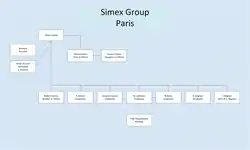
In December 1941, Corbin became the commercial director of Simex, after Jules Jaspar left in January 1942. to establish a new branch of Simex in Marseille with Anatoly Gurevich.[9][10] This left Grossvogel, the previous manager of the company, to act in the role of assistant to Trepper's, carrying out instructions as he met with businessmen and industrialists.[1] Initially Corbin never knew anything about the nature of the espionage network but was gradually drawn in over many months, eventually becoming a core member.[11]
In February 1942, the Simex company moved to 3rd floor offices at 89 Boulevard Haussmann in the 9th arrondissement of Paris,opposite the Saint Augustine church, at the insistence of Corbin, who believed their current location was rife with thieves.[12]
Arrest
On 19 November 1942, Corbin along with Suzanne Cointe, a secretary at Simex, were arrested by Gestapo officer Karl Giering of the Sonderkommando Rote Kapelle.[13] Corbin was put under enhanced interrogation by the Gestapo and subsequently informed them of the address of Trepper's dentist,[14] that resulted in Trepper being arrested on 25 November 1942 by Karl Giering.[15] Corbin was executed in Plötzensee Prison on 28 July 1943.
References
- Kesaris, Paul. L, ed. (1979). The Rote Kapelle: the CIA's history of Soviet intelligence and espionage networks in Western Europe, 1936-1945 (pdf). Washington DC: University Publications of America. p. 90. ISBN 978-0-89093-203-2.
- Kesaris, Paul. L, ed. (1979). The Rote Kapelle: the CIA's history of Soviet intelligence and espionage networks in Western Europe, 1936-1945 (pdf). Washington DC: University Publications of America. p. 269. ISBN 978-0-89093-203-2.
- Perrault, Gilles (1969). The Red Orchestra. New York: Schocken Books. p. 161. ISBN 0805209522.
- Langeois, Christian (2017). Les chants d'honneur : de la chorale populaire à l'Orchestre rouge : Suzanne Cointe (1905-1943) (in French). Paris: Cherche midi. p. 137. ISBN 9782749150697. OCLC 1004364617.
- Bauer, Arthur O. "KV 2/2074 - SF 422/General/3". The National Archives, Kew. p. 14. Retrieved 26 October 2019.
- Perrault, Gilles (1969). The Red Orchestra. New York: Schocken Books. p. 161. ISBN 0805209522.
- Langeois, Christian (2017). Les chants d'honneur : de la chorale populaire à l'Orchestre rouge : Suzanne Cointe (1905-1943) (in French). Paris: Cherche midi. p. 136. ISBN 9782749150697. OCLC 1004364617.
- Langeois, Christian (2017). Les chants d'honneur : de la Chorale populaire à l'Orchestre rouge, Suzanne Cointe (1905-1943) (in French). Paris: Cherche midi. p. 136. ISBN 9782749150697. OCLC 1004364617.
- Kesaris, Paul. L, ed. (1979). The Rote Kapelle: the CIA's history of Soviet intelligence and espionage networks in Western Europe, 1936-1945. Washington DC: University Publications of America. p. 77. ISBN 0-89093-203-4.
- Perrault, Gilles (1969). The Red Orchestra. New York: Schocken Books. p. 100. ISBN 0805209522.
- Kesaris, Paul. L, ed. (1979). The Rote Kapelle: the CIA's history of Soviet intelligence and espionage networks in Western Europe, 1936-1945. Washington DC: University Publications of America. p. 269. ISBN 0-89093-203-4.
- Langeois, Christian (2017). Les chants d'honneur : de la Chorale populaire à l'Orchestre rouge, Suzanne Cointe (1905-1943) (in French). Paris: Cherche midi. pp. 146–147. ISBN 9782749150697. OCLC 1004364617.
- Perrault, Gilles (1969). The Red Orchestra. New York: Schocken Books. pp. 242–248. ISBN 0805209522.
- Bauer, Arthur O. "KV 2/2074 - SF 422/General/3". The National Archives, Kew. p. 58. Retrieved 23 July 2020.
- Perrault, Gilles (1969). The Red Orchestra. New York: Schocken Books. pp. 254–258. ISBN 0805209522.
Authority control  | |
|---|---|
| General | |
| National libraries | |