Alfred Priest
Alfred Priest[note 1] (12 December 1810 – 1850) was an English painter of landscapes and a member of the Norwich School of painters.
Alfred Priest | |
|---|---|
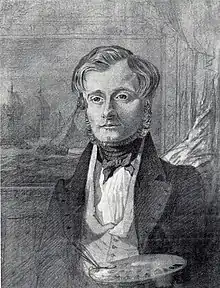 | |
| Born | 12 December 1810 |
| Died | 1850 Norwich |
| Nationality | English |
| Known for | Landscape painting |
| Movement | Norwich School of painters |
Life
Alfred Priest was born in the English city of Norwich on 12 December 1810, the son of John Fox Priest and his wife Elizabeth Neal (née Raven), and was baptised at St Gregory's Church, Norwich two days later.[2] His father was a chemist, who educated him to follow his profession. Acting against his father's wishes, he left home. He returned to Norwich after a period at sea and then briefly worked as an apprentice to a surgeon in the Norfolk town of Downham Market.[3]
Priest was living in London by 1833, when he was residing at 14, Crawford Row, Chelsea. In 1835 he married, and moved to 34, Pembroke Square, Kensington.[4] He returned to Norwich in 1848, and spent much of the following year living on the Norfolk coast.[5] He died in Norwich of tuberculosis in 1850, aged about 40.[6][note 2] He was buried in the churchyard at Cringleford, outside Norwich.[5]
According to the art historian William Dickes, writing in 1905, Priest "too often yielded to the sad art of fortifying himself with brandy". Priest was noted by Dickes for his fondness for children and animals, and produced a children's book, The Hare and Three Leverets, in 1848.[8]
Artistic career
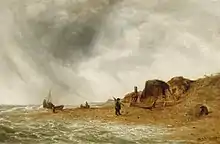
Priest, along with Robert Leman, Thomas Lound, Henry Bright and John Middleton, is considered by the art historian Andrew Moore to be one of the outstanding artists of final phase of the Norwich School during the middle of the 19th century.[9]
With the support of his father,[4] Priest studied etching under Henry Ninham and James Stark, and Edward William Cooke. Priest specialised in marine painting and is noted for his depictions of water and waves.[6] By 1834 he was working as a portraitist.[10]
Priest exhibited at the Society of British Artists in 1837 and 1838.[11] His pictures were shown for the first time at the Royal Academy in 1833. He exhibited a total of 89 works between 1833 and 1847.[4] He painted river scenes so as to demonstrate his ability to depict flowing water. The works he exhibited were Scene at Taverham, Norfolk, Water Mill, Maple Durham, near Reading and Iffley Mill, near Oxford.[11] His choice of subject matter in his oil paintings and watercolours was shared with his close friend Miles Edmund Cotman, who visited him in Reading, and it seems that the artists worked closely together for a period.[11][6] During the 1840s their styles diverged, with Priest working less meticulously than his colleague.[11] Priest is mentioned in the correspondence of the Cotman family and the artist Edward Thomas Daniell.[4]
Over 50 etchings by Priest are known.[6] His first known original engraving was Sketch of the opening the Harbour at Lowestoft on the 9th of August 1831.[9] The British Museum hold proofs of Priest's etchings, which are small and of every find of subject. He produced a few lithographs and mezzotints.[4] The art historian Josephine Walpole describes his work as "extremely competent".[6]
Walpole notes that Priest was "talented to the point of facility". She considers his best works to be his seascapes, which have an authenticity lacking in some of his landscapes. that may be because of his ability to depict transparent effects. Although his landscapes make good use of warm ochres, greens and browns; his later paintings can be dull-looking.[6]
Gallery
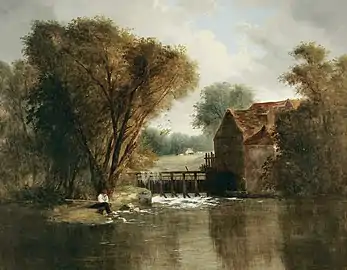 Iffley Mill, Oxford (1844), Norfolk Museums Collections
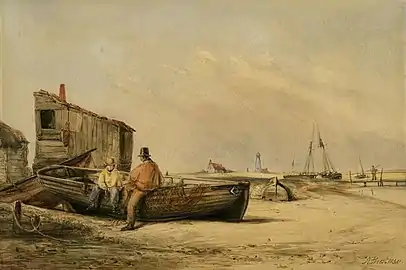 The Sands at Rye (1849), Norfolk Museums Collections
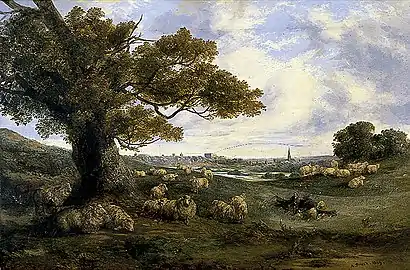 Norwich from the South East (1849), Norfolk Museums Collections
.jpg.webp) Thorpe River, Norwich (undated), Norfolk Museums Collections
Thorpe River, Norwich (undated), Norfolk Museums Collections View with cottages behind tree (undated), British Museum
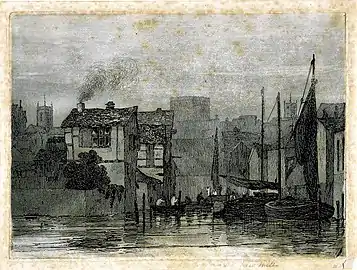 Front of New Mills, Norwich (undated), British Museum
Notes
- Not be confused with the English portraitist Alfred Priest (1874 – 1929)[1]
- A 39-year-old man from the Norwich suburb of Heigham named Alfred Priest was recorded as being buried in Cringleford, Norfolk, on 19 December 1850.[7]
References
- "Alfred Priest". Art UK. Retrieved 1 December 2021.
- Image 56: Alfred Priest in "Archdeacons transcripts for Norwich parishes, 1600-1812", FamilySearch (Alfred Priest).
- Dickes 1905, pp. 566–567.
- Dickes 1905, p. 567.
- Dickes 1905, p. 568.
- Walpole 1997, p. 156.
- Alfred Priest in "Norfolk, England, Church of England Deaths and Burials, 1813-1995", Ancestry (Image 587). Citing Norfolk, England, Church of England Deaths and Burials, 1813-1995. (subscription required)
- Dickes 1905, pp. 567–568.
- Moore 1985, p. 129.
- Moore 1985, p. 130.
- Moore 1985, p. 136.
Bibliography
- Dickes, William Frederick (1905). The Norwich school of painting: being a full account of the Norwich exhibitions, the lives of the painters, the lists of their respecitve exhibits and descriptions of the pictures. Norwich: Jarrold & Sons Ltd. OCLC 558218061.
- Moore, Andrew W. (1985). The Norwich School of Artists. London: HMSO/Norwich Museums Service. ISBN 978-0-903101-48-6.
- Walpole, Josephine (1997). Art and Artists of the Norwich School. Woodbridge: Antique Collectors' Club Holme. ISBN 978-1-85149-261-9.
External links
 |
Wikimedia Commons has media related to Alfred Priest. |
- Works by Priest in the Norfolk Museums Collections
- Works by Priest at Art UK
- Works by Priest at the British Museum
- The Hare and Three Leverets, a children's poem by Priest (from Google Books)
Authority control  | |
|---|---|
| General | |
| Art research institutes | |