Andrija Zmajević
Andrija Zmajević (Cyrillic: Андрија Змајевић; 6 June 1628 - 7 September 1694) was a Baroque poet, the Archbishop of Antivari and a theologian.
Andrija Zmajević Андрија Змајевић | |
|---|---|
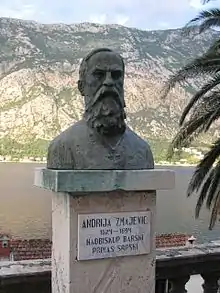 Bust of Andrija Zmajević | |
| Born | 6 June 1628 |
| Died | 7 September 1694 |
| Nationality | Venetian |
| Occupation | theologian and poet |
Notable work | "Slovinska dubrava", "Peraski boj" ("The Battle of Perast") |
Biography
Zmajević was born in Perast, in the Bay of Kotor, at the time part of the Republic of Venice (now Montenegro) in late July 1628. The Zmajević family hailed from Njeguši; when the last members of the Crnojević family left Principality of Zeta, Nikola Zmajević and his cousins Ivaniš and Vučeta moved to Kotor. Becoming appealed and somewhat wealthy, the family quickly converted from Christian Orthodoxy in favor of Roman Catholicism.[1][2]
Work
He also collected epic and lyric folk songs and transcribed works of the poets of Dubrovnik, notably Gundulić. His only published work, the song "Od pakla" ("Hell") saw the light of day in Venice in 1727. Almost all of his other works remained in manuscripts. He wrote:[3]
- Hronika or Ljetopis crkveni (Church Annals or Church Chronicles) illustrated by himself and his countryman Tripo Kokolja.
- Svadja Lazarevih kćeri, Brankovice i Miloševice ("The Quarrel of Lazar’s daughters, wife of Branko and wife of Miloš")
- Peraški boj ("The Battle of Perast").
- Slovinskoj Dubravi (Of Slavic Dubrovnik")
- Tripu Škuri ("Of Tripo Škura)
Zmajević wrote both in Cyrillic and in Latin scripts.[4] Zmajević called the language in which he wrote "Slavic" (slovinski). He justified his decision to write in "Serb letters" (Cyrillic script) since "the whole of our nation uses it" (kojim se služi čitava naša nacija).[5][6] His inspiration comes both from current events and from Serbian history and epic so that he often mentions Saint Sava,[7] Nemanja, Miloš Obilić and other historical and legendary figures.
References
- Translated and adapted from Serbian Wikipedia: Андрија Змајевић
- Poezija Dubrovnika i Boke Kotorske u doba renesanse, baroka i prosvećenosti, Zlata Bojović
- Prednjegoševsko doba, Titograd 1963.
- Književnost na tlu Crne Gore i Boke Kotorske od XVI do XVIII veka, Miroslav Pantić
- When Ethnicity Did Not Matter in the Balkans: A Study of Identity in Pre-Nationalist Croatia, Dalmatia, and Slavonia in the Medieval and Early-Modern Periods, John V. A. Fine, Jr.
- Ljetopis Crkovni, Mato Pižurica
- D. Živković, Zoran (2016). Mediterranean World in Serbian Literature. Belgrade: University of Belgrade. p. 223.
- Poezija Dubrovnika i Boke Kotorske u doba renesanse, baroka i prosvećenosti, Zlata Bojović
- "Primjeri filantropije u Crnoj Gori do kraja XX vijeka". Issuu. Retrieved 2019-07-04.
- "[Projekat Rastko Cetinje] Miroslav Pantic: Knjizevnost na tlu Crne Gore i Boke Kotorske od XVI do XVIII veka (1990)". www.rastko.rs. Retrieved 2019-07-04.
- When Ethnicity Did Not Matter in the Balkans: A Study of Identity in Pre-Nationalist Croatia, Dalmatia, and Slavonia in the Medieval and Early-Modern Periods, John V. A. Fine, Jr.
- When Ethnicity Did Not Matter in the Balkans: A Study of Identity in Pre-Nationalist Croatia, Dalmatia, and Slavonia in the Medieval and Early-Modern Periods, John V. A. Fine, Jr.

Authority control  | |
|---|---|
| General | |
| National libraries | |
| Other | |