Animal Farm (1999 film)
Animal Farm is a 1999 British-American television movie directed by John Stephenson and written by Alan Janes. Based on the 1945 novel of the same name by George Orwell and serving as an allegory of the Russian Revolution and its aftermath, it features Kelsey Grammer, Ian Holm, Julia Louis-Dreyfus, Patrick Stewart, Julia Ormond, Paul Scofield, Pete Postlethwaite and Peter Ustinov. In the movie, a group of anthropomorphic animals revolt successfully against their own human owner, only to slide into a more brutal tyranny among themselves.
| Animal Farm | |
|---|---|
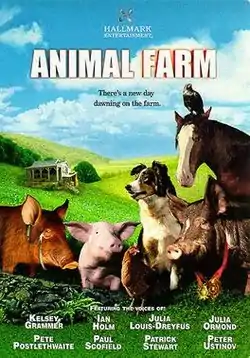 Theatrical poster | |
| Based on | Animal Farm by George Orwell |
| Written by | Alan Janes Martyn Burke (teleplay) |
| Directed by | John Stephenson |
| Starring | Kelsey Grammer Ian Holm Julia Louis-Dreyfus Patrick Stewart Julia Ormond Paul Scofield Pete Postlethwaite Peter Ustinov |
| Theme music composer | Richard Harvey |
| Country of origin | United States United Kingdom |
| Original language | English |
| Production | |
| Producers | Greg Smith Robert Halmi |
| Cinematography | Mike Brewster |
| Editor | Colin Green |
| Running time | 91 minutes |
| Distributor | Hallmark Films |
| Budget | $23 million |
| Release | |
| Original network | TNT |
| Original release | 3 October 1999 |
Plot
During a storm, a huge downpour of rain washes away a large structure. Jessie, an elderly Border collie, narrates how she how she had been in hiding, but is now ready to come out. She then begins to tell how they came to be in this situation.
In a flashback sequence to the 1940s, farmer Pilkington drives through Manor Farm with his wife and two sons. Jones, the cruel and rarely sober farmer of Manor Farm, invites him to a gathering he is hosting, also wishing to talk about his debts with Pilkington, who brushes him off saying that he could just sell him his farm. Jessie informs Mollie, the horse pulling the cart, that there will be a meeting for the animals tonight.
At the meeting, Old Major, the prize Middle White boar of Manor Farm, holds a meeting with all the animals in the barn. He tells the animals that humanity is their enemy, for they serve and provide for mankind without reward. For this, he proposes that the animals form a revolution and stand together united to defeat this common enemy. All the animals then start singing an anthem created by Major, but is interrupted when Jones hears the singing (all he hears is just animal noises), only for him to slip in mud while investigating the sound, accidentally firing his shotgun which indirectly hits Major, causing him to stagger backwards and fall to his death from the top of the barn (in complete contrast to the original book where Old Major simply died in his sleep from old age). Jones would then later use Major for meat by cutting up his body into joints. The next day, he goes into town without feeding the animals. Once returning home, Jones still does not feed them, which results in Boxer, a strong and kind-hearted shire horse, leading the animals to break into the food shed to help themselves. When Jones and his cronies investigate, the animals rebel against him, causing Jones to flee with his wife and men to the Red Lion Inn for refuge.
Now that Jones is gone for good, Manor Farm is now ruled by a young boar named Snowball, who learns how to read and write while renaming the place "Animal Farm". He even paints on the barn doors what he calls the Seven Commandments of "Animalism" which embody Old Major's feelings. Meanwhile, Napoleon, a Berkshire boar, calls for a secret meeting in which he has Pincher, one of the farm's dogs, swear loyalty to him and become part of the animal guard before ordering him to take away young newborn puppies belonging to Jessie so that he can raise them himself, claiming that it is best for them to receive an education from him. When later confronted by the other animals about the disappearance of the farm's milk and apples, Snowball confesses that he and the other pigs have taken the milk and apples for themselves. Napoleon's loyal subordinate Squealer explains that the pigs' well-being takes priority because they are the brains of the farm. Jessie is the only one who is unconvinced. Having learned that Jones is homeless and has lost control of his farm, Pilkington leads an invasion into Animal Farm with the aid of other local farm workers led by Frederick so they can overthrow the animals and claim the farm for themselves. Snowball has planned for this and the animals, except Napoleon and Squealer, launch a counter-attack, fending Pilkington and his men off. Defeated, Pilkington considers working with the animals instead.
During a meeting, Snowball makes plans to build a windmill to better the animals' lives and improve their operations, but Napoleon thinks it is a waste of time. When the animals vote in favor of Snowball, Napoleon summons the animal guard, revealed to be Jessie's puppies now trained by Pincher as Napoleon's private army, to attack him and chase Snowball out of Animal Farm, leaving his fate unknown. Jessie is unable to stop her children from doing this as they failed to recognize her. Napoleon declares Snowball a "traitor and a criminal" and Squealer claims that the windmill was actually his idea the entire time, leaving the animals unaware that Napoleon is truly the real traitor.
Napoleon declares that a "special committee of pigs will now decide all aspects of the farm" and the animals begin the hard work of building the windmill with Boxer's help. Meanwhile, Pilkington hears over a microphone planted in the barn that the pigs can speak English, deciding that if they can talk, then they can trade. The next day, he arrives at Animal Farm and begins to trade with Napoleon. Later, Boxer remembers Old Major mentioning that animals were not to engage in trade with humans, but Napoleon explains that "Animal Farm cannot exist in isolation". Napoleon even has Old Major's skull placed in front of the barn to oversee the Farm's progress and has a statue of himself erected nearby. Jessie confesses to the other animals that she observed the pigs living in the abandoned farmhouse and sleeping in the beds. Squealer explains that no commandment has been broken and had in fact, "altered" the commandment, "No animal shall sleep in a bed", to "No animal shall sleep in a bed with sheets." Later that night at the Red Lion Inn, Pilkington and Frederick are talking in which Frederick shows concern about the animals whom are supposedly starving in hunger.
Jones, having been both exiled and humiliated by the other farmers, conspires with his wife to sabotage Animal Farm by blowing up the almost-complete windmill with dynamite to get revenge on the animals for taking his farm. Napoleon blames it on Snowball, declaring a death sentence against him. The pigs consume more food, leaving the other animals with little to eat. That night, Napoleon declares that Snowball is causing the food shortage and that the hens will have to surrender their eggs to the market. When the hens oppose, Napoleon angrily declares that the hens are all criminals and that no food will be given to them (and that any animal caught giving food to a hen will be punished by death). Squealer begins making propaganda films about Napoleon showing animals on trial for working with Snowball that are sentenced to death, as well as animals supposedly happy with Napoleon's rule. It is revealed that the commandment, "No animal shall kill any other animal", has been changed to "No animal shall kill any other animal without cause." The commandment, "No animal shall drink alcohol", is also changed to, "No animal shall drink alcohol to excess".
During the rebuilding of the windmill, Boxer is injured and Squealer informs Jessie that Napoleon will be sending him to the hospital. When the time comes for Boxer to be transported, Jessie and Benjamin, a wise donkey, realize that the van is from the glue factory and that Boxer is to be slaughtered, but he is taken away before they can intervene. As Jessie and Benjamin make a plan to flee from Animal Farm, Napoleon is paid by Pilkington for selling Boxer to the glue factory in exchange for more whiskey, and Squealer's latest propaganda film assures the animals that the van that took Boxer away was actually from the hospital, but had previously been the property of a horse slaughterer. That night, Jessie watches through a warped glass window as Pilkington and his wife dine with the pigs in the farmhouse. While proposing a toast, Napoleon announces that the farm's name will revert to its original name Manor Farm. Watching the meeting between the two, Jessie cannot tell the difference between them. Muriel the goat and Benjamin notice that the final commandment, "All animals are equal", has been extended to include "but some animals are more equal than others." As Jessie, Muriel, Benjamin and a few other animals escape the farm before things can get any worse, a film plays with animals singing the greatness of Napoleon, who shows up standing on two legs wearing Jones' clothes, declaring that the farm will devote itself to making weapons and building walls for the protection of themselves and their way of life. He also declares that the revolution is now over and all animals are free.
In the present day, Jessie narrates how she and her companions have waited for Napoleon's rule to come to an end. Flooding from the storm had caused a wall to collapse, and the animal refugees are able to return to Manor Farm. When they arrive, they find it in ruins and largely abandoned, meaning that Napoleon, Squealer, and all the other animals that remained in Manor Farm have died, although some have survived the fall of Napoleon's regime. Jessie suddenly finds some dogs emerging from the ruins, revealing they are now freed from Napoleon's lies and realizes they are her own puppies. In response, her children immediately recognize Jessie as their mother and return to her. Jessie finds that Napoleon's statue has now collapsed, remarking that she knew that one day, his crimes would bring about his ruin.
Sometime later, Jessie sits in the sun surrounded by her puppies until a white convertible Jaguar suddenly arrives with the new owners of Manor Farm, a human blond couple and two blond children (although the whereabouts of Jones and his wife are unknown). Jessie remarks she will not let this family "make the same mistakes" of the neglect of Jones or the abuse of Napoleon, and is aware the small remnant of animals will now have to work alongside their new human masters to restore Manor Farm so they will finally be free at last. (This never happens in the book.)
Cast
- Pete Postlethwaite as Jones, the original owner of Manor Farm who is overthrown by his own animals due to his abusive behaviour towards them, likely because of his drunkenness. He represents Czar Nicholas II.
- Caroline Gray as Mrs. Jones, Jones' shrewish wife.
- Alan Stanford as Pilkington, the owner of Foxwood Farm and neighbor of Jones who later works for Napoleon, thus is the only human who trades with him. He represents the British ruling class.
- Gail Fitzpatrick as Mrs. Pilkington, Pilkington's unfaithful wife.
- Gerard Walsh as Frederick, the owner of Pinchfield Farm. He represents Adolf Hitler.
Voices
- Julia Ormond as Jessie, a wise and virtuous Border collie who serves as the narrator of the film. She represents one of the oppressed masses under Stalin or under any other dictator. In the book she had no general role but her character now seems to derive from Clover, the motherly mare.
- Kelsey Grammer as Snowball, a noble domestic pig who is in charge of Animal Farm after the exile of Mr. Jones until he is later overthrown by Napoleon. He represents Leon Trotsky.
- Patrick Stewart as Napoleon, a greedy, sadistic Berkshire boar and the oppressive ruler of Animal Farm after Snowball's banishment. He represents Joseph Stalin.
- Ian Holm as Squealer, a sinister and intelligent Tamworth pig who is Napoleon's assistant and acts as the minister of propaganda. He represents Vyacheslav Molotov.
- Paul Scofield as Boxer, a kind-hearted shire horse and the gentle giant of all the animals who serves as the strongest and is later taken away to a glue factory, where he would be made into glue. He represents Alexey Stakhanov.
- Pete Postlethwaite as Benjamin, a wise donkey and a friend of Boxer who is the oldest of all the animals. He represents the Menshevik intelligentsia. Postlethwaite also played Mr. Jones in the film.
- Julia Louis-Dreyfus as Mollie, a young mare who is obsessed with ribbons. She represents the petit bourgeoisie that fled from Russia a few years after the Russian Revolution.
- Peter Ustinov as Old Major, a benevolent Middle White boar who is the original chief of Manor Farm until his death. He represents Karl Marx and Vladimir Lenin.
- Charles Dale as Moses, a dim-witted raven with a sense of humour and the former pet of Jones who is later a minion of Napoleon. He represents organized religion.
- Dale also plays Pincher, a Rottweiler who serves as Napoleon's head of his personal guard and chief enforcer, thus is responsible for taking away Jessie's puppies so that Napoleon can raise them as his private security. He represents Lavrentiy Beria.
- Jean Beith as Muriel, an elderly Saanen goat.
Production
Filming began on 25 August 1998 and ended on 6 November. Because of the extensive CGI work and other post-production requirements, the film was not delivered to TNT and Hallmark Entertainment until June 1999.
Fourteen animals were built to represent the animals of Animal Farm at Jim Henson's Creature Shop in London: four pigs (Old Major, Snowball, Napoleon, and Squealer), two horses (Boxer and Mollie), a sheepdog (Jessie), a donkey (Benjamin), a raven (Moses), a goat (Muriel), a sheep, a rat, a chicken, a duck, a cat, and a dove.[1]
Ten dogs were cast into the film from Fircroft Kennels. Their Border collie, Spice, played the role of Jessie.
In early screenplays done by Martyn Burke for this film, Jessie was set to be a male character, rather than a female.
Reception
The film received mixed reviews. It holds a 40% approval rating on Rotten Tomatoes, based on five reviews.[2] It was criticized for its loose adaptation of the book, its simplicity and lack of subtlety, and for being too dark and political for children while being too familiar and simplistic for adults.
The film won Best Special Effects and was nominated for best film in the 2000s Fantasporto International Fantasy Film Award.[3]
The film's director John Stephenson was nominated for Starboy Award in the 2000s Oulu International Children's and Youth Film Festival.[4]
Differences between the book and the film
.svg.png.webp)
_(vertical).svg.png.webp)
- In the movie, there is an implication that Pilkington might have been the cause of everything, from refusing to help Jones with his money problems to persuading Napoleon to be more dictator-like. In the book, the cause of the Jones' downfall was his drinking and neglect. No mention in the book was made of financial problems aside from Jones "having becoming much disheartened after losing money in a lawsuit."
- In the movie, Jessie is set as the main character and the events are told from her point of view. There is no central character in the book. She could possibly be taking over the role of Clover the horse, who is not in the film, though a black horse seen several times is presumed by people to be her.
- Like the 1954 adaptation of the film, Jessie's mate, Bluebell was not seen nor mentioned. Pincher, however, is in the film and works as Napoleon's bodyguard.
- Jones's drinking is scaled down in the movie.
- In the movie, Jones cheats on his wife with Pilkington's wife. This never happens in the book.
- There are only four pigs in the movie (Old Major, Snowball, Napoleon, and Squealer). While in the book, there are several who begin to run the farm and to oversee the work done by the other animals.
- Old Major dies of old age three days after his speech in the book and is buried. In the movie, he dies after getting accidentally shot and falls; his body is then cut up into joints which were discovered by the other animals when they look around the house.
- The animals' rebellion takes place during midday in the book, while in the movie, it takes place during the night.
- In the movie, it was Boxer the horse who breaks open the door to the feed shed, while in the book, it was one of the cows.
- In the book, when Jones realizes that the animals had broken into the feed shed, he and his helpers march inside. And started cracking whips in order to drive the animals out. In the movie, they just go and see what is going on before the animals start attacking them. They also don't have whips, although Jones has a shotgun with him.
- In the book, the animals begin burning all the things owned by Jones, including whips, harnesses, butcher's knives, and chains, and start singing "Beasts of England" around it. While in the movie, the animals are seen singing around a large fire. This fire is started by a lantern that was kicked over.
- In the movie, there is an implication that Napoleon and Squealer were plotting to take over the farm even seconds after the revolution.
- The humans use a hidden microphone to eavesdrop on the animals in the movie. This never happens in the book.
- The humans try to retake the farm twice in the book, while they only try once in the movie.
- In the book, the puppies who would later become Napoleon's savage secret police and guards are the offspring of Jessie and Bluebell. In the movie, they are Jessie's own children, as Bluebell has been adapted out.
- Mr Frederick, the other named human farmer besides Pilkington, has a different role in the film than in the book: In the book, he is the one that begins trade with Animal Farm but pays them with counterfeit money, and leads the second attempt to retake the farm after the pigs discover the deceit and declare war on him. In the film, it is Mr Pilkington who trades with the animals with shady deals while Mr Frederick has a reduced role and even expresses sympathy for the animals at one point.
- Mollie the mare has a larger and different role in the film than in the book, and instead of leaving for another farm after the revolution in the book, in the film, she only leaves with the other animals after Boxer's death.
- The pigs use a television set and film to spread their propaganda in the movie, which doesn't happen in the book.
- In the book, the windmill gets destroyed twice: first by a storm (which Napoleon attributes falsely to the exiled Snowball), then by the second human attempt to retake the farm. In the movie, Mr Jones destroys the windmill with dynamite before fleeing with his wife, although their truck is also destroyed in the process, with its wreck later added to the rebuilt windmill.
- In the book, Boxer gets shot in the leg after the second attempt by the humans to retake the farm; this, along with overworking to rebuilt the windmill, causes him to badly damage his leg and to retire from work. In the movie, he does not get shot in the leg and it is the overworking that causes him to have an accident. But in both the book and the film, the pigs deliberately send him off to the glue factory while lying that he is going to a hospital for animals.
- In the book, a new generation of pigs are born after Napoleon takes over as leader. This doesn't happen in the movie, seeing that Napoleon and Squealer are the only pigs present on the farm at that point.
- In the book, the animals discover to their horror that they cannot tell the difference between the pigs and humans when they eavesdrop on a meeting between the pigs and the farmers. In the movie, it is Jessie who realizes it when she sees Napoleon and Squealer entertaining Pilkington and his wife, through a dirty window that warps their faces. In addition, only Pilkington and his wife attend as opposed to several humans in the book, and there is no brawl over an Ace of Spades in the film.
- In the book, all of the pigs begin to walk on their back legs and to wear human clothing. In the movie, only Napoleon is seen standing upright and wearing clothes. Squealer is also seen wearing a spectacle in the movie.
- In the movie, some of the animals (including Jessie) manage to escape into the nearby woods and only returned after Napoleon's dictatorship led the farm into self-destruction. In the book, they don't and there is no happy ending, with Muriel the goat having died prior to the book's ending.
- At the end of the movie, a new and kinder family moves into the farm who the surviving animals will work alongside to produce a better future. This never happens in the book.
References
- Production Facts Archived 13 September 2011 at the Wayback Machine. TNT. Retrieved 11 July 2010.
- Rotten Tomatoes – Animal Farm (1999 adaptation). Retrieved 26 October 2014
- "Fantasporto (2000)".
- "Oulu International Children's Film Festival (2000)".
External links
 |
Wikiquote has quotations related to: Animal Farm (1999 film) |
- Animal Farm at IMDb
| Characters |  | |
|---|---|---|
| Concepts | ||
| Adaptations | ||
| Inspired music | ||