Anthoceros
Anthoceros is a genus of hornworts in the family Anthocerotaceae. The genus is global in its distribution. Its name means 'flower horn', and refers to the characteristic horn-shaped sporophytes that all hornworts produce.
| Anthoceros | |
|---|---|
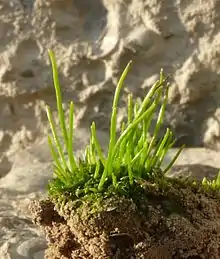 | |
| Anthoceros agrestis | |
Scientific classification  | |
| Kingdom: | Plantae |
| Division: | Anthocerotophyta |
| Class: | Anthocerotopsida |
| Order: | Anthocerotales |
| Family: | Anthocerotaceae |
| Genus: | Anthoceros L. |
| Species | |
|
See text | |
Description
Species of Anthoceros are characterized by having a small to medium-sized, green thallus that is more or less lobed along the margins.[1] The spores are dark gray, dark brown or black, this is the easiest way to distinguish Anthoceros from the related genus Phaeoceros, which produces spores that are yellow.[1][2]
The sporophytes of Anthoceros are larger and much more complex than those of Riccia, Marchantia, and Pellia.The mature sporophyte consist of a bulbous foot , a meristematic region and a smooth,long,slender,cylindrical capsule. Sporogonium appears like a bristle or horn. There is no seta. It arises in clusters from the dorsal surface of the thallus each surrounded at the base a tubular involucre[it protects sporophyte in its younger stages].
Anthoceros species are host to species of Nostoc, a symbiotic relationship in which Nostoc provides nitrogen to its host through cells known as heterocysts, and which are able to carry out photosynthesis.[3] The Nostoc colonies are present on the lower ventral surface and are visible as blue-green patches which open outwards by slime pores.
DETAILED STUDY
This hornwort grows in moist clay soils on hills, in ditches, and in damp hollows among rocks. The adult plant body is a gametophyte.
Thallus is prostrate, green , fleshy , dorsoventrally flattened , gametophytic with rare dichotomous branching . it lacks air chambers and scales . it has no well defined mid rib . it has unicellular smooth rhizoids in the ventral region. thallus is irregularly lobed with folded margins
T.S OF THALLUS
there is very little / no tissue differentiation. it is composed of thin, compactly arranged uniform parenchymatous cells with single large chloroplast with pyrenoids ;which stores starch.
in dorsal region there is non-well defined mid rib. Air pores / Air chambers , scales etc are absent. In the ventral region there is unicellular smooth walled rhizoids for attachment and absorption of minerals. slime pores are present in the ventral region . slime pores are guarded by two cells and are filled with mucilage.
Reproduction:
it is mainly by two ways :
- VEGETATIVE
- SEXUAL
Vegetative Reproduction :
- Fragmentation { parent thallus become fragments by death or decay or any other external / internal means }
- Tubers { during unfavourable conditions tubers are formed mainly during droughts. on favourable conditions the tubers germinates to form a new thallus }
- Persistent Apices { some apex cells remain dormant on unfavourable conditions and forms new thallus on favourable condition}
- Apospory {it is the phenomenon of development of diploid gametophyte directly from vegetative cells of diploid sporophyte }
Sexual Reproduction :
Male - Antheridium ( with massive multicellular stalk) = Antherozoids { Biflagellate linear} rod shaped
Female - Archegonium = Egg
After fertilisation it forms 2n zygote.
it further divides to form embryo .
The embryo undergoes divisions resulting in the formation of an elongated structure with bulbous base ( sporophyte) it has three parts basal foot, meristematic region and capsule . meristematic region divides to form horn like capsule.
foot provides anchorage for the sporophyte to gametophytic thallus and absorption of water and minerals. Meristematic region constantly adds new cells to capsule and it helps the capsule to live long. Capsule is long , slender, cylindrical unlike normal gametophytic thallus it shows complex tissue differentiation .
Capsule is divided into three regions: outer capsule tissue{ multi-layered 4-6 layered} ;have outermost epidermis with stomata . epidermis is made of vertically elongated cells with cutinised outer capsule wall. below epidermis there is loosely arranged parenchymatous photosynthetic jacket cells.
middle sporogenous tissue [cylinder of cells around columella] it exhibit sporogenous series
inner columella{ for mechanical support to sporophyte and in water and mineral conduction}
Different regions of sporophyte shows shows a progressive growth and development of cells like spores and elaters from spore mother cell and elater mother cell. elaters lack spiral thickenings; so called Pseudoelaters.
Species include:[4]
- Anthoceros agrestis
- Anthoceros himalayensis
- Anthoceros hispidus
- Anthoceros lamellatus
- Anthoceros neesii
- Anthoceros punctatus
- Anthoceros sambesianus
- Anthoceros scariosusaditya pathsk
- Anthoceros tristanianus
References
- Peng, Tao; Zhu, Rui-Liang (2013). "A revision of the genus Anthoceros (Anthocerotaceae, Anthocerotophyta) in China". Phytotaxa. 100 (1): 21–35. doi:10.11646/phytotaxa.100.1.3. ISSN 1179-3163.
- Proskauer, Johannes (1951). "Studies on Athocerotales. III". Bulletin of the Torrey Botanical Club. 78 (4): 331–349. doi:10.2307/2481996. JSTOR 2481996.
- Enderlin, C. S. and J. C. Meeks. (1983). Pure culture and reconstitution of the Anthoceros-Nostoc symbiotic association. Planta 158(2) 157-65.
- Ibarra-Morales, A., M. E. Muñíz, and S. Valencia. (2015). The genus Anthoceros (Anthocerotaceae, Anthocerotophyta) in Central Mexico. Phytotaxa [S.l.], v. 205, n. 4, p. 215–28.