Aram-Damascus
The Kingdom of Aram-Damascus (/ˈærəm dəˈmæskəs/) was an Aramean state around Damascus in Syria,[1] from the late 12th century BC to 732 BC.
Kingdom of Aram-Damascus | |||||||
|---|---|---|---|---|---|---|---|
| Late 12th century BC–732 BC | |||||||
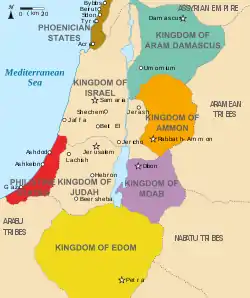 The region around 830 BCE, with Aram-Damascus in green | |||||||
| Status | Monarchy | ||||||
| Capital | Damascus | ||||||
| Common languages | Old Aramaic language | ||||||
| King | |||||||
• 885 BC – 865 BC | Ben-Hadad I | ||||||
• 865 BC – 842 BC | Ben-Hadad II | ||||||
• 842 BC – 796 BC | Hazael | ||||||
• 796 BC – 792 BC | Ben-Hadad III | ||||||
• 754 BC – 732 BC | Rezin (last) | ||||||
| History | |||||||
• Established | Late 12th century BC | ||||||
• Annexed by the Neo-Assyrian Empire | 732 BC | ||||||
| |||||||
History
The Hebrew Bible gives accounts of Aram-Damascus' history, mainly in its interaction with Israel. There are texts in the Bible referencing David's battles against Arameans in southern Syria in the 10th century BC.[2]
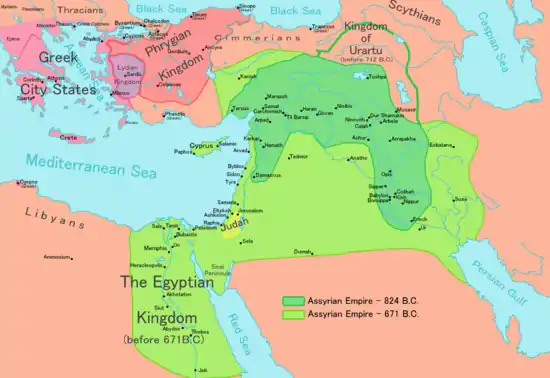
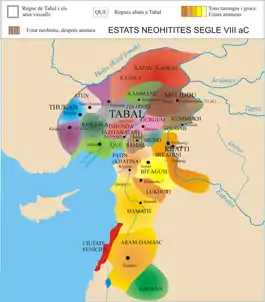
In the 9th century BC, Hazael fought against the Assyrians, had some influence over the north Syrian state Unqi and conquered Israel.[3][4]
To the southwest, Aram-Damascus reached most of Golan to the Sea of Galilee.[5]
In the 8th century BC, Rezin had been a tributary of Tiglath-Pileser III, the king of Assyria.[6] In c. 732 BC, he formed an alliance with Pekah, the king of Israel, to attack Ahaz, the king of Judah. Ahaz appealed to Tiglath-Pileser III for help. This the Assyrian king obliged after Judah paid tribute to the Assyrian king.[7] Tiglath-Pileser III attacked Damascus and annexed Aram.[6] The population was deported and Rezin was executed. Tiglath-Pileser recorded this act in one of his inscriptions.[8]
Kings
| Arameans |
|---|
| Syro-Hittite states |
| Aramean kings |
| Aramean cities |
| Sources |
- Ben-Hadad I 885-865 BC
- Hadadezer (Ben Hadad II) 865–842 BC
- Hazael 842–805 or 796 BC
- Ben-Hadad III 796 to 792 BC
- Rezin 754 BC–732 BC
See also
References
- Pitard, Wayne T. (2000). "Arameans". In David Noel Freedman; Allen C. Myers; Astrid B. Beck (eds.). Eerdmans Dictionary of the Bible. Wm. B. Eerdmans Publishing Co. p. 86.
- "2 Samuel 10:6-19". Bible. Holman. ASIN B000MX2BZM. ISBN 978-0999989265.
- James B. Pritchard, ed., Ancient Near Eastern Texts Relating to the Old Testament (3rd ed.; Princeton NJ: Princeton University Press, 1955) 246.
- "2 Kings 13:3". Bible (Christian Standard ed.). Holman. ISBN 978-0999989265.
- Suzanne Richard (2003). Near Eastern Archaeology: A Reader (Hardcover ed.). Eisenbrauns. p. 377. ISBN 1-57506-083-3.
- Lester L. Grabbe, Ancient Israel: What Do We Know and How Do We Know It? (New York: T&T Clark, 2007): 134
- "2 Kings 16:7-9". Bible (Christian Standard ed.). Holman. ISBN 978-0999989265.
- James B. Pritchard, ed., Ancient Near Eastern Texts Relating to the Old Testament (3rd ed.; Princeton NJ: Princeton University Press, 1969) 283.
Sources
- Amadasi-Guzzo, Maria Giulia (2019). "What Do We Know about the Borders and Exchanges between Aram and Phoenicia in the 9th–8th Centuries B.C.E. in Anatolia and Syria?". Aramaean Borders: Defining Aramaean Territories in the 10th–8th Centuries B.C.E. Leiden-Boston: Brill. pp. 149–171.
- Bagg, Ariel M. (2019). "At the Limits of Historical Geography: Reconstructing Aramaean Territories in the West According to the Neo-Assyrian Written Sources". Aramaean Borders: Defining Aramaean Territories in the 10th–8th Centuries B.C.E. Leiden-Boston: Brill. pp. 1–25.
- Edmonds, Alexander J. (2019). "A People without Borders? Tracing the Shifting Identities and Territorialities of the Ahlameans". Aramaean Borders: Defining Aramaean Territories in the 10th–8th Centuries B.C.E. Leiden-Boston: Brill. pp. 26–62.
- Gzella, Holger (2015). A Cultural History of Aramaic: From the Beginnings to the Advent of Islam. Leiden-Boston: Brill.
- Lipiński, Edward (2000). The Aramaeans: Their Ancient History, Culture, Religion. Leuven: Peeters Publishers.
- Lipiński, Edward (2013). "The Aramaeans in the West (13th–8th centuries)". Arameans, Chaldeans, and Arabs in Babylonia and Palestine in the First Millennium B.C. Wiesbaden: Harrassowitz Verlag. pp. 123–147.
- Lemaire, André (2019). "The Boundary between the Aramaean Kingdom of Damascus and the Kingdom of Israel". Aramaean Borders: Defining Aramaean Territories in the 10th–8th Centuries B.C.E. Leiden-Boston: Brill. pp. 245–266.
- Sader, Hélène (2014). "History". The Aramaeans in Ancient Syria. Leiden: Brill. pp. 11–36.
- Younger, Kenneth Lawson (2016). A Political History of the Arameans: From Their Origins to the End of Their Polities. Atlanta: SBL Press.
- Zwickel, Wolfgang (2019). "Borders between Aram-Damascus and Israel: A Historical Investigation". Aramaean Borders: Defining Aramaean Territories in the 10th–8th Centuries B.C.E. Leiden-Boston: Brill. pp. 267–335.
