Araneomorphae
The Araneomorphae (also called the Labidognatha) are an infraorder of spiders. They are distinguishable by chelicerae (fangs) that point diagonally forward and cross in a pinching action, in contrast to the Mygalomorphae (tarantulas and their close kin), where they point straight down. Araneomorphs comprise the vast majority of living spiders.
_W2_IMG_2780.jpg.webp)
| Araneomorph spiders Temporal range: | |
|---|---|
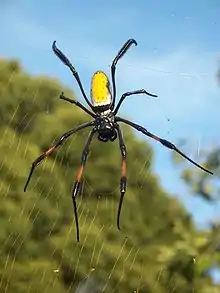 | |
| Nephila inaurata (Nephilidae) | |
Scientific classification  | |
| Kingdom: | Animalia |
| Phylum: | Arthropoda |
| Subphylum: | Chelicerata |
| Class: | Arachnida |
| Order: | Araneae |
| Suborder: | Opisthothelae |
| Infraorder: | Araneomorphae |
| Subdivisions | |
| |
| Diversity | |
| 95 families | |
Distinguishing characteristics
Most spider species are Araneomorphae, which have fangs that face towards each other, increacing the orientations they can employ during prey capture. They have fewer book lungs (when present), and the females typically live one year.
The Mygalomorphae have fangs that face towards the ground, and which are parallel to the long axis of the spider's body, thus they have only one orientation they can employ during prey capture. They have four pairs of book lungs, and the females often live many years.[1]
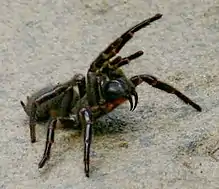 This Atrax robustus shows the orientation of Myglamorphae fangs.
 This Cheiracanthium punctorium shows the orientation of Araneomorphae fangs.
Spiders included
Almost all of the familiar spiders are included in the Araneomorphae group, the major exception are the Tarantulas. There are a few other Mygalomorphae species that live around homes or gardens, but they typically are relatively small and not easily noticed.
The Araneomorphae, to the contrary, include the weavers of spiral webs; the cobweb spiders that live in the corners of rooms, and between windows and screens; the crab spiders that lurk on the surfaces of flowers in gardens; the jumping spiders that are visible hunting on surfaces; the wolf spiders that carpets hunting sites in sunny spots; and the large huntsman spiders.
Systematics
In older schemes, the Araneomorphae are divided into two lineages, the Hypochilae (containing only the family Hypochilidae), and the Neocribellatae. The Neocribellatae are in turn divided into the Austrochiloidea, and the two series Entelogynae and Haplogynae, each containing several superfamilies:
A cladogram shows the relation among major groups.[2]
| |||||||||||||||||||||||||||||||||||||
Most spiders in the Haplogynae series have six eyes, while most of those in the Entelegynae series have eight.
Table of families
| Genera | 1 | ≥2 | ≥10 | ≥100 |
| Species | 1–9 | ≥10 | ≥100 | ≥1000 |
References
Citations
- http://www.publish.csiro.au/samples/spiders/html/SPIDERS.HTM
- Magalhaes, Ivan L. F.; Azevedo, Guilherme H. F.; Michalik, Peter; Ramírez, Martín J. (February 2020). "The fossil record of spiders revisited: implications for calibrating trees and evidence for a major faunal turnover since the Mesozoic". Biological Reviews. 95 (1): 184–217. doi:10.1111/brv.12559. ISSN 1464-7931. PMID 31713947. S2CID 207937170.
- World Spider Catalog (2018), Currently valid spider genera and species.
General sources
- "Currently valid spider genera and species". World Spider Catalog. Natural History Museum Bern. 2018.
- Coddington, Jonathan A. (2005). "Phylogeny and classification of spiders" (PDF). In Ubick, D.; Paquin, P.; Cushing, P.E. & Roth, V. (eds.). Spiders of North America: an identification manual. American Arachnological Society. pp. 18–24. Retrieved 2015-09-24.
Explanatory notes
- Unless otherwise shown, currently accepted families and counts based on the World Spider Catalog version 19.0 as of 11 July 2018.[3] In the World Spider Catalog, "species" counts include subspecies. Assignment to sub- and infraorders based on Coddington (2005, p. 20) (when given there).
- June 2019 data
External links
 Media related to Araneomorphae at Wikimedia Commons
 Data related to Araneomorphae at Wikispecies
| Arachnology |  | |
|---|---|---|
| Taxonomy |
| |
| Anatomy | ||
| Human interaction | ||
| Webs | ||
| ||
