Archangel (Gibson comic)
Archangel, also written as William Gibson Archangel or William Gibson's Archangel, is a five-issue limited series comic book written by William Gibson, created by William Gibson and Michael St. John Smith, with art by Butch Guice and story breakdown by Michael Benedetto. It is Gibson's first comicbook series. It tells the story of an alternative 2016, where the Vice President of America travels back in time to 1945 to secure power in the past.
| William Gibson Archangel | |
|---|---|
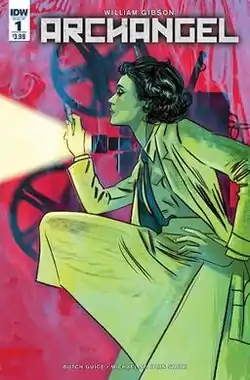 Cover of the first issue of Archangel. | |
| Publication information | |
| Publisher | IDW Publishing |
| Schedule | Monthly |
| Format | Limited series |
| Publication date |
|
| No. of issues | 5 |
| Main character(s) |
|
| Creative team | |
| Created by |
|
| Written by | William Gibson |
| Artist(s) | Butch Guice |
| Inker(s) | Tom Palmer |
| Letterer(s) | Shawn Lee |
| Colorist(s) | Diego Rodriguez |
| Collected editions | |
| Hardcover | ISBN 978-1631408755 |
The comic was initially released from May 2016 to August 2017 by IDW Publishing, then as a hardcover graphic novel in October 2017. It was nominated for an Eisner Award for Best Limited Series. The comic was adapted as a radio play which was released by Audible.
Synopsis
In an alternative 2016, US Vice President Junior Henderson uses a device called the Splitter to travel back in time to 1945 Allied-occupied Berlin with six commandos. They kill his grandfather, an Office of Strategic Services major, and Junior takes his place. Another faction in 2016, led by Major Torres, seize control of the Splitter and send a stealth plane to stop Henderson, but it crashes, with the sole survivor landing in US-occupied territory. Royal Air Force officer Naomi Givens, who had been investigating foo fighters, agrees to share information with her ex-boyfriend Vince Matthews, a US Intelligence officer who has custody of The Pilot. Henderson arrives to take command but The Pilot escapes using a stealth suit sent by Torres. To complete his mission, The Pilot joins with Givens, who accepts him as a time traveller based on what she has observed, and Matthews, who is skeptical but realizes that Henderson is a dangerous imposter.
The Pilot predicts the Hiroshima bombing and reveals Henderson's plan to use the second atomic bomb to attack the Port of Arkhangelsk, destroying half of the Soviet fleet and killing Joseph Stalin and most of the Soviet chain-of-command, allowing the United States to rule the world unchallenged. With the aid of Soviet Colonel Yermakov, they locate Henderson's B-29 in flight and Torres teleports them on board where they defeat Henderson and his commandos. In 2016, US government forces breach the Splitter's bunker and easily overpower Torres. Physicist Jack Davis, the inventor of the Splitter who until then had expressed doubts of the wisdom of Torres's plan, activates the Splitter. The armed nuclear bomb detonates at a temporary White House outside the Splitter facility, while Givens and Matthews are returned to Berlin as news of the nuclear attack on Nagasaki is received in a restored timeline. The Pilot arrives in a peaceful 2016 Berlin, having thwarted one megalomaniac US President only to be confronted by a newspaper headline and the possibility of another.
Characters
1945
- Naomi Givens: An RAF Intelligence Officer, a materials scientist, and one of the main protagonists of the story.
- Vince Mathews: A US Intelligence Officer, who is Naomi's ex-boyfriend, and one of the main protagonists of the story.
- Fritz: Naomi's driver and black market expert.
- Herr Säugling (Mr Baby): Owner of the last surviving night club in Berlin.
- Yermakov: A Ukrainian colonel in Soviet intelligence
2016
- The Pilot: A tattooed Marine sent back to 1945, and one of the main protagonists of the story.
- Junior Henderson: The US Vice President, who goes back in time to make sure his powerbase in entrenched in the past. His father is the US President for life.
- Major Guadalupe[1] Torres: A scientist who is in control of the Splitter.
- Jack Davis: A physicist who created the Splitter; a detainee and eventual ally of Torres.
Writing and development
William Gibson took inspiration from supernatural and conspiracy stories of World War II, which he called "The Weird War", and drew upon his own Cold War nuclear anxiety.[2][3]
Gibson and Michael St. John Smith (writer and TV/film actor[4]) originally pitched the idea for Archangel to a German television company[5] which declined it, so the pair developed the idea into a screenplay and briefly as a computer game.[4] When IDW Publishing approached Gibson about doing an adaptation of a novel, he immediately proposed developing Archangel into a comic book. The IDW team include art by Butch Guice, inking by Tom Palmer, colors by Diego Rodriguez, and letters by Shawn Lee.
The main setting of Berlin is a holdover from the project's original pitch to German television.[6] Gibson stated that the story became "leaner" and "more linear" as a comic.[7] Gibson wrote in the afterward of the hardcover edition that the story was continually revised due to then-current events. The final frames gave the ending a context that the creators "could [not] have possibly imagined when we began work on our first issue."[1][3]
Art
Art was by Guice, except for the fifth issue which was by Wagner Reis and inker Tom Palmer.[8] Publishers Weekly noted how the art contrasts the bright neon of future technology with dark and earthy tones in the 1940s "that evokes wartime cloak-and-dagger exploits."[9] A review in Paste noted that the "conscious interplay of shadows and silhouettes" in the composition of frames made for "a thrilling combination of uncertainty, dynamism and intrigue" required of the genre.[10]
Publication history
The comic was initially published as a five-issue limited edition, with the first issue released on 18 May 2016[10] and the final issue released in August 2017.[8] The hardcover graphic novel was released on 3 October 2017.[2][7]
Critical reception
Critical reception has been positive. Tom Batten of Library Journal described the graphic novel as "thought-provoking, unabashedly political [science fiction]."[11] Joel Cunningham described the graphic novel as a "twisting, complex narrative ... perfectly suited to the medium."[7]
Writing on the first issue, Toussaint Egan of Paste found it an impressive first comic by Gibson and Smith, with strong artwork aiding the establishment of the main characters.[10] Jonathan Gitli of Ars Technica states that Archangel has "hit a chord", and is "thought-provoking science fiction", and comments positively on the female characters with "strong wills and personalities". They also note that IDW sold out the initial run in just a few days.[6] Cory Doctorow reviewed issue #1 in BoingBoing.net and said it "fires on all cylinders" and that the "art and dialog work extra duty to convey a story that is native to the medium". He concludes that the comic is "spectacular".[12]
A review in Publishers Weekly stated that the graphic novel "mines the rich pseudoscience mythology surrounding World War II, or 'The Weird War'."[9] Laura Hudson of Wired wrote that the graphic novel is part of a "long tradition of 'what if' stories about World War II", which examines "the apocalyptic terror of nuclear weaponry" and alludes to repeating self-destructive human impulses.[2] Jason P. Woodbury of Comic Book Resources gave the series a positive review, and thought that it felt "deliriously contemporary" as it was published during the 2016 United States presidential election and featured "power-hungry politicians, complicated conspiracies involving Russia, UK and US agents caught between shifting national allegiances [...] pondering the justification of their actions". He took particular note of the Twilight Zone-like ending and asks "What if the true dystopia is whatever dystopia you happen to inhabit?"[8]
Nomination
Archangel was nominated for an Eisner Award for Best Limited Series.[8][9][13]
Adaptations
The graphic novel was adapted into a full-cast three-hour radio play, cowritten by Gibson and Smith, and produced and released by Audible.[14]
On 25 July 2016, at Comic-Con International in San Diego, William Gibson stated that Archangel had been optioned for television, which he later confirmed on Twitter.[15]
References
- Gibson, William; Smith, Michael St. John (w), Guice, Butch; Barrionuevo, Alejandro; Reis, Wagner (p), Palmer, Tom; Guice, Butch (i). Archangel (hardcover) (October 2017), San Diego, California: IDW Publishing, ISBN 978-1-63142-875-5
- Hudson, Laura (2 October 2017). "William Gibson's New Graphic Novel Takes Nuclear Anxiety to Its Terrifying End". Wired. Archived from the original on 8 October 2017. Retrieved 1 November 2021.
- Merchant, Brian (24 August 2017). "William Gibson: 'I Never Expected to Be Living in an American Retro-Future'". Vice. Archived from the original on 12 November 2020. Retrieved 1 November 2021.
- "William Gibson Goes From Sci-Fi To Sky High With Archangel". Archived from the original on 2016-05-12. Retrieved 2016-06-02.
- "William Gibson on his time-bending trip into comics with IDW's new Archangel miniseries". Archived from the original on 2016-05-21. Retrieved 2016-06-02.
- Gitlin, Jonathan M. (29 May 2016). "William Gibson has written a comic, and you should read it". Ars Technica. Archived from the original on 26 December 2016. Retrieved 15 June 2017.
- Cunningham, Joel (25 September 2017). "William Gibson's Archangel Is a Story That Demanded to Be a Comic". Barnes & Noble. Archived from the original on 4 December 2019. Retrieved 1 November 2021.
- Woodbury, Jason P. (7 August 2017). "Archangel Successfully Brings William Gibson's Cyberpunk to Comics". Comic Book Resources. St Laurent, Quebec. Archived from the original on 8 March 2021. Retrieved 1 November 2021.
- "William Gibson's Archangel". Publishers Weekly. Archived from the original on 1 November 2021. Retrieved 31 October 2021.
- Egan, Toussaint (20 May 2016). "William Gibson & Butch Guice's Archangel Takes Mind-Bending Flight". Paste.
- Batten, Tom (1 November 2017). "William Gibson's Archangel". Library Journal. Archived from the original on 1 November 2021. Retrieved 1 November 2021.
- Doctorow, Cory (8 July 2016). "William Gibson's Archangel: intricate military sf, mercilessly optimized for comics". Boing Boing. Archived from the original on 12 July 2016. Retrieved 14 July 2016.
- Brown, Tracy (3 May 2017). "2017 Eisner Award nominees include 'The Art of Charlie Chan Hock Chye' and 'Saga'". Los Angeles Times. Archived from the original on 19 August 2018. Retrieved 1 November 2021.
- Gunderson, Alexis (20 August 2018). "With William Gibson's Archangel, Audible Translates a Graphic Novel into a Radio Play". Paste.
- "William Gibson Tweet: "Optioned for television"". Archived from the original on 2018-12-16. Retrieved 2016-08-06.