Ardeae
Ardeae[3] is a clade of birds that contains Eurypygimorphae and Aequornithes, named in 2014 by genome analysis.[4] Members of Eurypygimorphae were originally classified in the obsolete group Metaves, and Aequornithes were classified as the sister taxon to Musophagiformes or Gruiformes.[5][6]
| Ardeae | |
|---|---|
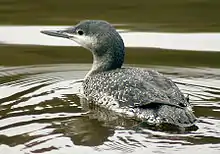 | |
| Juvenile red-throated loon (Gavia stellata) | |
Scientific classification  | |
| Kingdom: | Animalia |
| Phylum: | Chordata |
| Class: | Aves |
| Clade: | Passerea |
| Clade: | Ardeae Wagler, 1830 |
| Subgroups | |
Ardeae has also been used in older classifications as a suborder of Ciconiiformes containing herons and related species.[7]
| Ardeae |
| |||||||||||||||||||||||||||||||||||||||




_white_background.jpg.webp)

}}
Cladogram based on Schulz (2010).
References
- Slack, Kerryn E.; Jones, Craig M.; Ando, Tatsuro; Harrison, G.L. "Abby"; Fordyce, R. Ewan; Arnason, Ulfur; Penny, David (2006). "Early Penguin Fossils, plus Mitochondrial Genomes, Calibrate Avian Evolution". Molecular Biology and Evolution. 23 (#6): 1144–1155. CiteSeerX 10.1.1.113.4549. doi:10.1093/molbev/msj124. PMID 16533822. Supplementary Material Archived December 16, 2009, at the Wayback Machine
- Kuhl., H.; Frankl-Vilches, C.; Bakker, A.; Mayr, G.; Nikolaus, G.; Boerno, S. T.; Klages, S.; Timmermann, B.; Gahr, M. (2020). "An unbiased molecular approach using 3'UTRs resolves the avian family-level tree of life". Molecular Biology and Evolution: 143. doi:10.1093/molbev/msaa191.
- "TiF Checklist: Ardeae: Eurypygimorphae & Aequornithes".
- Jarvis, E.D.; et al. (12 December 2014). "Whole-genome analyses resolve early branches in the tree of life of modern birds". Science. 346 (6215): 1320–1331. Bibcode:2014Sci...346.1320J. doi:10.1126/science.1253451. PMC 4405904. PMID 25504713.
- Ericson, P. G.P; Anderson, C. L; Britton, T.; Elzanowski, A.; Johansson, U. S; Kallersjo, M.; Ohlson, J. I; Parsons, T. J; Zuccon, D.; Mayr, G. (22 December 2006). "Diversification of Neoaves: integration of molecular sequence data and fossils". Biology Letters. 2 (4): 543–547. doi:10.1098/rsbl.2006.0523. PMC 1834003. PMID 17148284.
- Hackett, S. J.; Kimball, R. T.; Reddy, S.; et al. (27 June 2008). "A Phylogenomic Study of Birds Reveals Their Evolutionary History" (PDF). Science. 320 (5884): 1763–1768. Bibcode:2008Sci...320.1763H. doi:10.1126/science.1157704. PMID 18583609. S2CID 6472805.
- Wetmore, Alexander (1960). "A classification for the birds of the world". Smithsonian Miscellaneous Collections. 139 (11): 1–37. hdl:10088/22963.
This article is issued from Wikipedia. The text is licensed under Creative Commons - Attribution - Sharealike. Additional terms may apply for the media files.