Ariane flight VA256
Ariane flight VA256 is the 256th Ariane mission, which will launch the James Webb Space Telescope into space.[2]
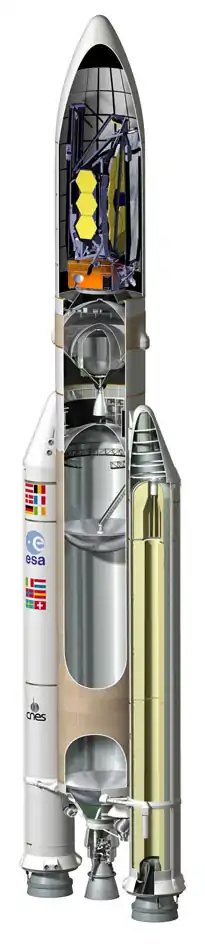 JWST inside Ariane 5 | |
| Ariane 5 launch | |
|---|---|
| Launch | 24 December 2021[1] |
| Operator | Arianespace |
| Pad | ELA-3 |
| Payload | |
| Outcome | Planned |
| Ariane launches | |
Launch configuration
Rocket
Ariane 5 is a heavy lift two-stage rocket with two solid fuel boosters. It will be used in its ECA variant, which offers the highest payload mass capacity. The total launch mass of the vehicle is of the order of 770,000 kg (1,700,000 lb).
Payload
The only payload of the flight is the James Webb Space Telescope (JWST), NASA's flagship space-based observatory, of which the launch itself is one of the European Space Agency's contributions.[3][2] It has a launch mass of about 6,500 kg (14,300 lb) and a design lifetime of 5 to 10 years.
Preparation campaign
Arrival in Kourou
The payload arrived in Kourou, French Guiana on 12 October 2021 where it was unloaded from the MN Colibri cargo ship and transported to the space centre.[4]
.jpg.webp) Arrival in French Guiana onboard MN Colibri
Arrival in French Guiana onboard MN Colibri.jpg.webp) Arrival in French Guiana onboard MN Colibri
Arrival in French Guiana onboard MN Colibri.jpg.webp) Unloading from the MN Colibri
Unloading from the MN Colibri.jpg.webp) En route to the space centre
En route to the space centre.jpg.webp) En route to the space centre
En route to the space centre.jpg.webp) En route to the space centre
En route to the space centre
Integration incident
On 22 November 2021 an incident was reported by NASA and Arianespace that a clamp band securing the payload to the adapter was released during integration activities, causing vibrations to the telescope.[5] After some tests were performed, a review board concluded on 24 November 2021 that no payload component was damaged, and fuelling operations could be started on the next day, with the launch planned for 22 December at that time.[6][7]
Fuelling operations
Fuelling operations began on 25 November 2021, for a duration of about 10 days.[6]
Interface communication issue
On 14 December 2021, a joint press release by NASA and Arianespace revealed that "a communication issue between the observatory and the launch vehicle system" was being tackled, further delaying the launch to no earlier than 24 December 2021.[1][8]
.jpg.webp) Entering the cleanroom airlock
Entering the cleanroom airlock.jpg.webp) Unboxing
Unboxing.jpg.webp) Unboxing
Unboxing.jpg.webp) In the cleanroom
In the cleanroom.jpg.webp) In the cleanroom
In the cleanroom.jpg.webp) In the cleanroom
In the cleanroom.jpg.webp) In the cleanroom
In the cleanroom
Launch
The rocket is planned to be launched from the ELA-3 launch pad of the Guiana Space Centre on 24 December 2021.[1][8]
Orbit
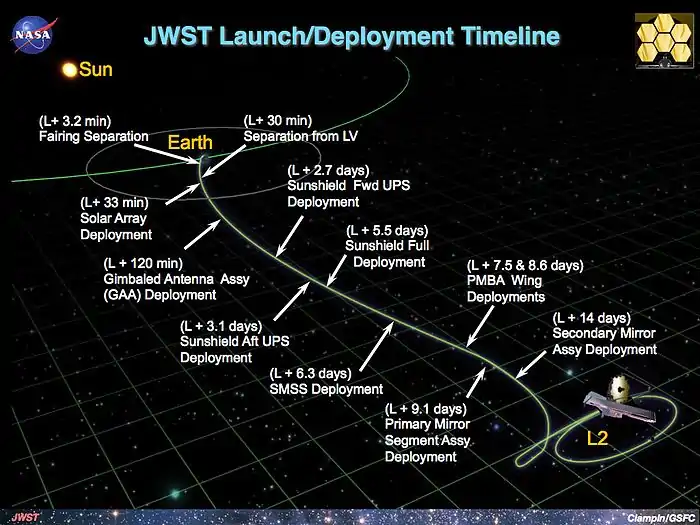
The James Webb Space Telescope will be injected into a transfer trajectory that will take it to the second Earth-Sun Lagrange point (L2).
The separation of the launch vehicle and the spacecraft will happen approximately 30 minutes after liftoff. After this separation, the telescope will become autonomous and start deploying its mechanisms. After about 30 days it will execute a maneuver placing it in a halo orbit around the L2 point, where it can begin its science mission.[9]
References
- Fisher, Alice (14 December 2021). "Webb Space Telescope Launch Date Update – James Webb Space Telescope". NASA Blogs. Retrieved 15 December 2021.
- "Targeted Ariane 5 launch date for James Webb Space Telescope". Arianespace. 8 September 2021. Retrieved 14 September 2021.
- "European agreement on James Webb Space Telescope's Mid-Infrared Instrument (MIRI) signed". esa.int. European Space Agency. 10 June 2004. Retrieved 15 December 2021.
- Fisher, Alise (28 October 2021). "The Journey to Kourou". NASA Blogs. NASA. Retrieved 1 December 2021.
- Fisher, Alise (22 November 2021). "NASA Provides Update on Webb Telescope Launch". NASA Blogs. NASA. Retrieved 1 December 2021.
- Fisher, Alise (24 November 2021). "Testing Confirms Webb Telescope on Track for Targeted Dec. 22 Launch". NASA Blogs. NASA. Retrieved 1 December 2021.
- "Testing Confirms Webb Telescope on Track for Targeted Dec. 22 Launch". arianespace.com. Arianespace. 25 November 2021. Retrieved 1 December 2021.
- "Webb Space Telescope Launch Date Update". arianespace.com. Arianespace. 14 December 2021. Retrieved 15 December 2021.
- "Orbit - Webb/NASA". NASA JWST. NASA. Retrieved 12 December 2021.
Arianespace launches | ||
|---|---|---|
| Ariane 5 |
|  |
| Soyuz-ST | ||
| Vega |
| |
| ||
| Organizations | .jpg.webp) | |
|---|---|---|
| Rockets | ||
| Launch sites | ||
| Engines | ||
| Launches | ||
| Flights | ||
| Related | ||
| ||


| Instruments and sensors |
|  |
|---|---|---|
| Elements | ||
| Related |
| |