Assamese Brahmins
Assamese Brahmins or Bamun are the Brahmins present in the Assamese society. There are two classes in Assam. One is the Ganaks, who are also known as Daivajna (Astrologers). That group follows the Atharva Veda (the solar cult). They are mostly called as "Bamun" or "Brahman" in Assamese language. They were originally priests. Religious worship in temples is generally carried out by them.[4]
| Regions with significant populations | |
|---|---|
| India | Assam |
| Languages | |
| Assamese | |
| Religion | |
| Hinduism | |
| Part of a series on the |
| Culture of Assam |
|---|
 |
.png.webp)
.svg.png.webp)
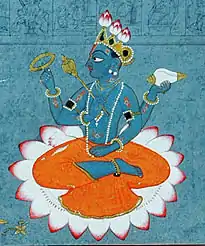






There they promoted learning, Vedic religion and astrology, as well as imparting general vedic knowledge to the public.[5] The Indo-Aryans of Assam are the descendants of early migrants from the Gangetic valley and a succession of influences, ideas and cultures entered Assam with them. The Brahmins and Kayasthas came to Assam from Videha (Mithila) and Kannauj.[6]
History
Brahmins are considered to be one of the oldest Hindu settlers in the region and held the highest positions in society.[7][8]
Assamese Brahmins are the community in that state who are considered to have Caucasoid origins.[9]
Tradition and culture
Lagundeoni
Traditionally, the ceremony of Lagundeoni – one of the Sanskaras or rites of passage marking acceptance of a student by a Guru, is a quite prevalent ritual within the community.[10] A sacred thread – Lagun, given by a Pujari during the ceremony is a symbolic reminder to the young male born to the Brahmin family of his purpose at school, as well as a social marker of the student as someone who has embarked his journey into formal education, where education itself is not limited to ritual and philosophical speculations, but extends to all practical aspects of culture and life in general. The ceremony is typically performed between ages 12 – 14 among Brahmin males.
Death rituals
Brahmins of the Assam valley follow a different death ritual as opposed to the other indigenous communities in Assam. A religious rite, known as Caturthā is performed on the 4th day of a person's demise unlike Tiloni, performed on the 3rd day of person's demise by non–Brahmin indigenous communities.[11]
Lifestyle
Although in general Brahmins observe all the customary rituals, they appear usually less rigid[13] in some of their traditional lifestyle choices, such as they may eat meat, fish, unlike their counterparts in North India.[web 1]
Present
The Brahmins constitute one of the Forward classes of Assam[web 2] based on the classifications of Government of India, although the recent trend on economic condition has not been very well within the community. Assam's former Chief Minister, Tarun Gogoi announced setting up of development councils for several communities in the state, including Brahmins.[web 3]
Notes
- "639 Identifier Documentation: aho – ISO 639-3". SIL International (formerly known as the Summer Institute of Linguistics). SIL International. Retrieved 29 June 2019.
Ahom [aho]
- "Population by Religious Communities". Census India – 2001. Ministry of Home Affairs, Government of India. Retrieved 1 July 2019.
Census Data Finder/C Series/Population by Religious Communities
- "Population by religion community – 2011". Census of India, 2011. The Registrar General & Census Commissioner, India. Archived from the original on 25 August 2015.
- (Barua 2000, p. 1-3)
- (Dikshit & Dikshit 2013, p. 397)
- (Dikshit & Dikshit 2013, p. 390)
- (Bose 1989)
- "Culture – Social Life, Social Institutions, Women". Government of Assam. Archived from the original on 6 September 2017. Retrieved 6 September 2017.
- (Patra 2011, p. 15)
- "Assam State Gazetteer Vol. 1, page 317 – Government of Assam". Mr. Amlan Baruah and S.B. Roy Choudhury. 1999. Archived from the original on 8 January 2014. Retrieved 6 September 2017.
- (Sarma 1990, p. 54)
- "Religion and Caste". Assam On–line Portal, Government of Assam. Archived from the original on 31 August 2012. Retrieved 6 September 2017.
- (Bose 1989, p. 44)
References
Published sources
- Barua, Preeti (2000). Nalinibala Devi. ISBN 9788126009169.
- Dikshit, K. R.; Dikshit, Jutta K. (2013). North-East India: Land, People and Economy. Springer Science & Business Media. ISBN 9789400770553.
- Bose, Manilal (1989). Social History of Assam: Being a Study of the Origins of Ethnic Identity and Social Tension During the British Period, 1905-1947 – Pre–British History and Society. Manilal Bose, Concept Publishing Company. ISBN 9788170222248.
- Patra, S. C. (2011). Socio-economic profile of Rural India (series II) – Roots. S.C. Patra and Ashish Vachhani, Concept Publishing Company, 2011. ISBN 9788180697241.
- Sarma, Anjali (1990). Among the Luminaries in Assam: A Study of Assamese Biography. Anjali Sarma, Mittal Publications. ISBN 9788170992073.