Australia–Solomon Islands relations
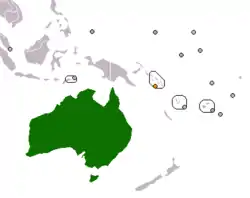
Foreign relations exist between Australia and Solomon Islands. Australia has a High Commission in Honiara and Solomon Islands has a High Commission in Canberra.
 | |
.svg.png.webp) Australia |
 Solomon Islands |
|---|---|
History
In the 1950s, British and Australian government officials discussed transferring sovereignty of the British Solomon Islands to Australia. The Australian external affairs minister Paul Hasluck brought a proposal for a transfer to cabinet in 1956, but it was rejected primarily for reasons of cost.[1][2]
Under the government of John Howard, Australia's relations with Manasseh Sogavare's Solomon Islands were strained, primarily because of the "Julian Moti affair". Sogavare notably accused Australia of conducting neo-colonialism in the Solomon Islands via RAMSI. On 1 October 2007, the Solomon Islands' Foreign Affairs Minister Patteson Oti addressed the General Assembly of the United Nations, and accused Australia of undermining his country's sovereignty:
Mine is too nationalistic a government to become captive to the fortunes which justify our perpetual retention under siege. My [country's government] remain[s] unmoved by Australian resistance to our attempts to reclaim our sovereignty and independence.[3]
This led Australia to exercise its right of reply, denying the accusation.[4] Relations subsequently improved when both Howard and Sogavare lost office in December 2007, and their successors -Kevin Rudd and Derek Sikua- immediately set out to improve relations between Canberra and Honiara.
Australian aid
Australia is a significant foreign aid donor to the Solomon Islands.
Australia led other nations as part of the Regional Assistance Mission to Solomon Islands. Over 7,000 Australian Defence Force members have been deployed in the Solomon Islands as part of that mission.[5] In 2013, the Australian government committed $500 million to assisting the Solomon Islands through the regional assistance mission in the following four years.[6] The mission officially ended on 30 June 2017.
In June 2018, the two countries signed an agreement for the sinking of an undersea high speed internet link between the Solomon Islands and the Australian mainland. Though seen as a security issue for Australia, it is believed more than $100 million will come out of Australia's aid budget.[7]
References
- Thompson, Roger (1995). "Conflict or co‐operation? Britain and Australia in the South Pacific, 1950–60". The Journal of Imperial and Commonwealth History. 23 (2): 301–316.
- Goldsworthy, David (1995). "British Territories and Australian Mini-Imperialism in the 1950s". Australian Journal of Politics and History. 41 (3): 356–372.
- Patteson, Oti (2 October 2007). "Statement at the 62nd session of the United Nations General Assembly" (PDF). un.org.
- Australia exercises its right of reply to Patteson Oti's statement Archived 2 April 2012 at the Wayback Machine, United Nations General Assembly, 2 October 2007
- "Defence congratulates RAMSI on 10 years of operations - Department of Defence". Defence.gov.au. 2013-07-29. Retrieved 2016-10-22.
- "Australian Government celebrates successes in helping Solomon Islands pull back from failed state - Australia Network News - ABC News (Australian Broadcasting Corporation)". Abc.net.au. Retrieved 2016-10-22.
- Deal to be inked for Solomon Islands undersea internet cable Australia stopped China building
| Africa |  | ||||
|---|---|---|---|---|---|
| Americas | |||||
| Asia | |||||
| Europe |
| ||||
| Oceania | |||||
| Former | |||||
| Multilateral organizations | |||||
| Related topics | |||||
| Americas |  | |
|---|---|---|
| Asia | ||
| Europe | ||
| Oceania | ||