Australian rules football in Queensland
Australian rules football in Queensland ( typically referred to as "AFL", or less frequently "Australian Football", "Aussie Rules" or "Australian Rules") was the first official football code played in 1866.[3] The Colony of Queensland was the second after Victoria to adopt Australian rules football and it became established across the colony as the most popular code however it soon fell into the shadow of British football variants for more than a century. The introduction of the Brisbane Bears to the national competition in 1987 did little to help the code grow and access to suitable stadiums hampered it until the 1993 redevelopment of the Brisbane Cricket Ground (Gabba) to host AFL matches. However the AFL's move from the Gold Coast to Brisbane set in motion enormous growth in popularity, resulting in average attendances tripling by 1996.[4][5][6]
| Australian rules football in Queensland | |
|---|---|
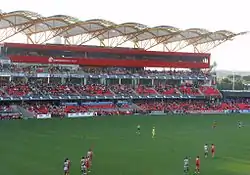 Australian football at Carrara Stadium on the Gold Coast 2011 | |
| Governing body | AFL Queensland |
| First played | June 1866, Brisbane |
| Registered players | 55,227[1] |
Club competitions | |
Audience records | |
| Single match | 37,473 (2019). AFL Brisbane Lions vs Richmond (Gabba, Brisbane)[2] |
Queensland has two fully professional teams competing in the Australian Football League: the Brisbane Lions (1996) and Gold Coast Suns (2009). These two teams compete against each other in the QClash.
The sport has surged in South East Queensland and the Cairns Region since the 1990s. The Brisbane Lions threepeat premiership era in the national Australian Football League (AFL) saw a participation boom and increase in drafted players. The Lions 3 Grand Final appearances in the national women's competition from its inaugural season in 2017 and 2021 premiership helped further fuel female participation despite a lack of success from the Lions and Suns senior men's teams. In recent years, AFL in Queensland has grown throughout the state. The AFL reported in 2017 that it had surpassed 250,000 participants[7] (40% are female). However Ausplay reports a substantially lower figure, with 55,227 players state-wide placing it third after soccer and rugby league. In 2018, it outgrew rugby union, to become the 3rd most played code in the state. While it has only a quarter of soccer's participants, it is very close in participation to the state's most popular football code, rugby league. An inreasing number of players have found pathways to the elite professional national level. As at 2020, since the rebranded AFL competition in 1990 and the formation of the national AFLW competition in 2017 more than 100 Queensland males and almost 50 Queensland females had played at the sport's highest level however only a dozen have played more than 200 AFL/AFLW games.
AFL Premiership matches are now regularly played in Brisbane, the Gold Coast, Cairns and since 2019, Townsville (AFL) and Mackay (AFLW).[8][9] Queensland was the first state to host the AFLW Grand Final (the inaugural 2017 AFL Women's Grand Final held at the Gold Coast) and the first state other than its traditional home of Victoria to host the AFL Grand Final, the 2020 AFL Grand Final held at the Brisbane Cricket Ground.[10][11]
Apart from affecting the availability of AFL venues, the COVID-19 pandemic had an overall positive effect on the sport in Queensland, both in terms of AFL clubs being based in the state and grassroots participation,[12] though the first Australian Football International Cup tournament scheduled to be hosted outside of Victoria (on the Sunshine Coast) was cancelled due to COVID.[13]
Despite growing popularity and participation, AFL attracts the lowest media profile and lowest attendance record of the four major football codes.
History
1860s: Early Beginnings in South East Queensland
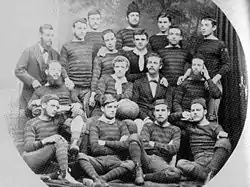
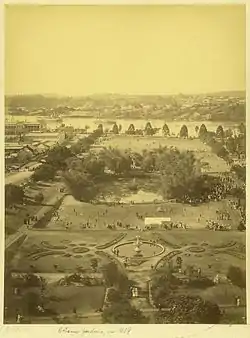
Football matches had been played early on in Queensland. However thee earliest known record of the Australian code in the Colony of Queensland was in 22nd May 1866, when the Brisbane Football Club (Defunct since this 1880s this club has no relationship to the modern Brisbane Bears or Lions) was formed to play under the Melbourne Football Club rules.[14]
Queensland at the time was one of the poorest colonies (especially in comparison to booming Victoria), having begun as a penal settlement it was very much a frontier colony and relied heavily on investment from the southern colonies.[15] Brisbane was the first football club of any code in the colony.
It is unclear as to why specifically Victorian rules were adopted, though several member of the founding committee were Victorians and the timing of the Melbourne committee's redrafting of the laws was coincidentally on the 1st May. One of three members of the founding committee was Charles Edward Wallen, who had played for Scotch College in the experimental rules matches umpired by Melbourne Football Club founder Tom Wills in 1858.[16] Founding chair David Watterston had grown up in Melbourne on arrival to Australia from Scotland and was a member of Brisbane's Victorian Cricket Club (formed 1863 and consisting of ex-Victorian players)[17] and that the Victorian Club had on 26th May proposed that cricket make way off-season for football.[18] Significantly, on 1st June, 1866, the Brisbane Courier published the Melbourne Football Club rules as the official rules for the Queensland colony.
Brisbane played its first match on Saturday 9 June 1866 at Queen's Park (now part of the Brisbane City Botanic Gardens).[19] A second team, Civil Service, formed possibly after 19th July[20] split off to faclitate scratch matches.[21] While there were sufficient numbers for scratch matches Brisbane FC struggled early on for competition and at times during its early years switched to Association Football to facilitate matches with early football clubs like Volunteer Artillery.[22]
Despite the slow start the game began to spread rapidly during the 1870s. By 1870 there were five clubs: Brisbane, Volunteer Artillery, Brisbane Grammar, Civil Service and Ipswich, all adopting the Victorian Rules (as it was then known). Ipswich Grammar adopted the sport in 1869 and the first schoolboys match was between Brisbane Grammar and Ipswich Grammar the next year. Ipswich Grammar's influence in the code's development was formidable, while the senior clubs went into recess early in the decade due to player numbers, the school continued to fly the flag and by the end of the decade the flow of juniors helped the city of Ipswich become the major stronghold for the code with no less than 7 clubs regularly competing against each other.
1870s: The code spreads north and west
A club also formed in Rockhampton, Capricornia in 1873 to play under Australian rules on the local cricket ground.[23]
By the time rugby was imported from Britain in 1876, Victorian Rules had well established itself as the colony's premier football code. Though in areas outside Brisbane there was growing confusion amongst clubs over which set of rules to adopt, and while some experimented with rugby most simply defaulted to the Victorian rules.[24]
The game had spread to the Darling Downs by 1876 with a match between Civil Service and the newly formed club Toowoomba.[25] As the game spread further west of the Great Divide to places including Warwick[24] clubs were split on whether to adopt rugby. Some of the Downs clubs lacked nearby opponents and appear to have preferred rugby, as a result competition went into recess a few years later until matches were played by Toowoomba Grammar.[26] The code in Brisbane was still dominant and in 1876 several football from the newly formed Brisbane rugby union including Rangers and Bonnet Rouge moved to switch codes[27] citing the game's huge popularity in Melbourne.[28] However Brisbane FC's decision to defect to rugby to join the other two clubs helped establish the rugby code in the state.
Queensland clubs affiliated with the Victorian Football Association (VFA) in 1877, and the game became known in Queensland as the "Victorian Association rules", "Victorian association football" (or sometimes just "Association rules").
In 1878, Rangers and Bonnet Rouge folded and Brisbane FC returned to Australian rules and rugby was left without any clubs in the city. However it was beginning to gain ground in smaller country towns which didn't have the numbers of funds to tour as full Australian Football teams.
Former Brisbane Grammarian and Brisbane FC player Herbert W. Bryant, while playing with Essendon in the VFA had the honour of being the first Queenslander to play for Victoria's team in the first intercolonial Victoria v South Australia (1879).[29]
Competition began in Wide Bay–Burnett in 1881, with the establishment of clubs in Maryborough[30] and Gympie.[31] The Darling Downs competition also expanded to include Allora in 1883 providing more regular interaction between the clubs.[32]
While Victorian Association remained popular, Queensland clubs, particularly the newly formed ones that were beginning to make hard decisions on rule adoption. Many players wanted to represent Queensland and many were convinced that adopting rugby would be the best option for this. Rules to protect players against dangerous pushing during contests for example were desperately sought, and some were claiming that rugby rules were safer as a result. Clubs were becoming increasingly disgruntled by the lack of representation or consultation on the laws of the game and governance from Melbourne.[33]
1880s: Queensland Football Association era
A meeting was held on 30th April 1880 at the Queen's Hotel[34] for the purpose of forming the Queensland Football Association (QFA) to affiliate with the Victorian Football Association. The formation was opposed by the premier Queensland club, the Brisbane Football Club, through its representative E.C. Binge, believing that it had the right to govern itself and use its position of influence to lead the other clubs. However his motion lapsed and the formation proceeded.[35] While there were no dedicated rugby clubs, many of Brisbane and Wallaroo best players preferred to play both codes so rugby matches were facilitated during the season on a Saturday every 4 weeks. While club rugby was nowhere near as popular with the public, Brisbane FC being by far the strongest club would often field its best players in rugby and its seconds in Victorian Association matches. By 1883 QFA membership consisted of 900 Victorian Association members from throughout the colony and 80 Rugby Union members mosty from Brisbane.[36]
Rugby rebellion: local clubs and schools reject the Victorian Association
A growing rift between Victorian Association and its Rugby Union members came to a head in 1883 after QFA clubs had been pushed annually to vote as to whether to continue under the Victorian Association or adopt Rugby Union rules. Whilst the rugby fraternity was vastly outnumbered, their push for intercolonial matches was popular. There was also pressure for Queensland to adopt a code that would enable it to play intercolonial matches, specifically against New South Wales. There was increasing discontent among all QFA members with Melbourne's apparent disinterest in sending teams to Queensland. The QFA felt that the wealthier Victorian Assocation were more capable of covering the travel expenses than the Queenslanders, while the Rugby Union members were more than prepared to cover the costs of the shorter trip to Sydney. Rugby players were also disgruntled with having to play under Association rules and were dissatisfied with the Victorian Association's growing contempt for rugby.[37] Under pressure from its members, the QFA organised the first intercolonial to be played under Victorian Rules between New South Wales and Queensland. The two colonies played each other in a two-game series in Brisbane in August 1884 resulting in a 1–1 draw.[38][39] The first match attracted a modest crowd of 300 spectators and increased interest in the contest resulted in the second match drawing 2,000. Many of the players also played rugby and Queensland rugby footballers began to bypass the QFA to directly organise rugby tests with New South Wales. This angered the QFA and in an effort to uphold Victorian Rules, and with support unforthcoming from Melbourne on the issue, a motion was passed by the QFA secretary that effectively barred players found to be playing Rugby Union from playing at a Victorian Association club, effectively segregating the two codes for the first time since its inception.[40] The move was to backfire as the breakaway Northern Rugby Union (NRU) formed, taking disgruntled clubs and players with it.[36] These clubs in response, instituted the barring of rugby players from playing Victorian rules[41] and Rugby players and officials began derogatively reverting to the term "Melbourne Association" and "Melbourne Rules" in reference to the QFA and its rules[42] fuelling a sentiment of them being increasingly anti-rugby and anti-Queensland.
The lack of a player transfer system was exposed in 1886 when players began freely changing clubs and codes from week to week without accountability, the situation was becoming farcical and supporters quickly lost confidence in the QFA.[43]
Suffering from dwindling numbers, the 1886 Queensland team was humiliated by New South Wales in their intercolonial matches. The Victorian game supporters were struggling hard to uphold the premier position they had gained. In contrast within just two years of its founding, the locally governed breakaway NRU competition came to dominate sport in Queensland and, according to one writer, "The defining moment in the code battle came with the 1886 Queensland [Rugby] side, who defeated NSW for the first time in Sydney. "The success of this team undoubtedly won the day for rugby game in Queensland. fter the brilliant performance of the 1886 Queensland rugby team, who lost only one match through their tour, the rugby game became very popular and the next season several new clubs were formed and the Victorian game began to wane".[44]
Australian rules, however, was still strong in the schools. Brisbane Grammar through Richard Powell Francis had switched to rugby in 1885 and pushed for the other Independent Schools to also. Perhaps the death blow occurred when Independent Schools headmasters in 1887 voted by 1 vote to adopt rugby.[45] The majority of councillors objected on the basis that the reference of "Victorian" in the name of the sport did not represent the interests of Queenslanders.
Between 1885 and 1887, for the first time in the history of the colony, mainstream newspapers began to report rugby result first, followed by Australian Football and Association Football signally the premier status of the rugby code. Despite the Victorian Association having 10 times the participation of rugby in terms of players and clubs, regular competitive intercolonial representation was by far the most important to the players and the public, the QFA was just not able to offer this.
1890s: Football slips through the cracks

Despite the advances made by Queensland football, it was clear that Victoria was progressing faster than any other state while the code in Queensland had been going backwards. In an effort to reverse the decline, the QFA had been calling on the VFA for years to send teams to Queensland to play exhibition matches which were largely ignored. In 1888 it finally secured the first visit from a colonial team slated to be from all of Victoria, however a representative Melbourne team arrived in June 1888, playing against a QAFA Queensland (made up of combined Brisbane and Ipswich players) team at the Brisbane Exhibition Grounds which the home team lost 3–5 to the visitors 6–16 in front of 5,000 spectators.[46][47] Rugby officials had deferred matches for the event, though noted that both Queenslander players and spectators appeared to have little understanding of the game.[48] Several Melbourne clubs followed shortly thereafter including the Melbourne Football Club.
A representative match between Brisbane and Ipswich was held in June 1890 won by Brisbane 3 goals 6 to Ipswich 3 goals 5.[49]
On 21 June 1890, South Melbourne Football Club toured, playing against Queensland on Albion Park. The result of the match was a complete 6–17 to 1-0 humiliation (behinds were recorded in the scores at the time but did not actually count until 1897). The humiliation was obviously felt by the players as when Queensland defeated a New South Wales Rugby Union team shortly afterwards many of the former rugby players receded from the Australian football ranks and formed clubs of their own.[50]
The Queensland Football Association, already under heavy criticism,[51] folded at the end of the 1890 season. With the gap left by the collapse of Victorian Association, the majority of the Brisbane clubs switched to rugby, while many of the clubs in Ipswich and Toowoomba either folded and to join the ranks of the Anglo-Queensland Football Association. The Australian code quietly disappeared with no clubs surviving the 1890s.
Revival attempts
A meeting was held in 1892 to re-establish the code.[52] It was initially successful, with a well attended representative match played between Brisbane and Ipswich staged at the North Ipswich Reserve. Ipswich won 4 goals 12 to 3 goals 7.[53] The teams met again in August at Queens Park in Brisbane.[54] While interest remained strong in Ipswich, the rugby dominated Brisbane media appeared disinterested in the return match and the series quickly died.
1900s: Post-Federation Australasian Rules Revival

With Federation of the colonies Australian rules was to benefit from a renewed interest in Australian nationalism.
A meeting was held in 1900 in an effort to revive the code.[55] Reviving the code in Queensland was made more difficult as rugby interests had rebranded their sport in Queensland as "Australian Football" and soccer was then known as "Anglo-Australian Football", presenting a major branding obstacle. A provisional title for the new league was "Queensland Association of the Australian Game of Football".[55]
The code was revived when the Queensland Football League (QFL) was formed in July 1903 at a meeting with 50 present at the South Brisbane Cycling Club and a total of 150 signed on as members.[56] Unlike the previous league which affiliated with the VFA, this new body decided to affiliate with the Victorian Football League.[57] Practice matches were held in August that year in the Botanical Gardens and attracted large crowds and interest.[58] The first premiership was held in 1904 with most games being played at Queen's Park, a sporting facility within the grounds of the Brisbane Botanic Gardens.
Competition in Ipswich, once the code's stronghold in Queensland was rekindled through an exhibition match between Locomotives and Brisbanes.[59][60] The Ipswich Football Club was reformed in May 1906[61] and matches resumed at the North Ipswich Reserve.[62][63] Several Ipswich clubs and schools resuming to play the sport from the following year including juniors at Ipswich North State School and Newtown schools.[64][65]
From 1905 to 1914 games were regularly played at the Brisbane Cricket Ground. Clubs included Brisbanes, Locomotives, Ipswich, Citys, Valleys and Wynnum.
In 1908, Queensland again sent delegates to the Australasian Football Council, this time, fielding a side in the Jubilee Australian Football Carnival which saw all Australian states as well as New Zealand compete.
In 1914 a carnival to promote the code was held in Brisbane. The participating teams were Collingwood, Perth, South Adelaide and Cananore.
Between 1915 and 1919 the competition went into recess owing to World War I. Since the inception of the QFL, more than fifty teams have played in the premiership competition.
In August 1927 at a meeting of the Australian National Football Council it was decided that each of the state leagues were to include the words 'Australian National' in their names. Accordingly, the QFL was renamed the Queensland Australian National Football League (QANFL) and football continued a steady growth in Brisbane.
Between the Wars: The Game Expands

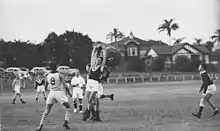
AFL was introduced to Far North Queensland during both World Wars. In 1913, a team of servicemen briefly existed on Thursday Island. In 1944, a league of servicemen was formed around the Atherton Tableland. Teams represented included Wongabel, Wondelca, Kairi, Mareeba and Ravenshoe. The first matches in Mount Isa were played in 1932.[66]
1940s: Queensland Football Comes of Age
The late 1940s and early 1950s would see an era of growth.
In 1946, Queensland defeated New South Wales for the first time in interstate football. Unlike the first few decades, matches during the following decades would be close between the two sides increasing the interest in the contests.
Erwin Dornau became the first Queenslander in to play in the VFL in 1948.[67]
With the increasing interest in the code, Brisbane Rugby League administrators began to block access to the Brisbane Cricket Ground for proposed exhibition matches by the VFL[68] leaving only the Brisbane Exhibition Ground for the VFL to play on.
In 1952, the Brisbane Exhibition Ground hosted a VFL match between Essendon and Geelong drew 28,000 spectators and was the first official VFL match to be played under floodlights.[69]
In 1955 a league was introduced to Townsville. In 1957 land was purchased in Cairns for the first dedicated field and competition began there. A league was also introduced to Mount Isa later.
Another VFL exhibition game was played at the Brisbane Cricket Ground in 1959, attracting a large crowd.
In 1964 the QANFL became the Queensland Australian Football League (QAFL), a limited liability company.
In the early 1970s, the first permanent leagues appeared on the Sunshine Coast (1970)[70] Mackay (1970), the Darling Downs (1971), Bundaberg (1971) and Rockhampton (1972).
1980s: Brisbane Bears Era
Born and raised Queenslander Jason Dunstall debuted for the Hawthorn Hawks in 1985 and quickly became one of the greatest players in the game, despite remaining almost unknown in his home state. He briefly represented a Queensland State of Origin team which played in a low key game against New South Wales in Sydney.
On 1st October 1986 the VFL board was announced that teams from Brisbane (Brisbane Bears) and Perth (West Coast Eagles) would compete in the Victorian Football League (VFL) from 1987.[71] Much of the Bears team were South Australian players from the South Australian National Football League and Victorians from the Victorian Football League. Although the team was known as Brisbane, home games were played at Carrara Stadium on the Gold Coast, nearly 100 km from Brisbane.
The Bears were hugely unsuccessful on the field, and with the admission of the successful Brisbane Broncos rugby league team into the New South Wales Rugby League, the popularity of Australian rules football plummeted, while the successful Broncos, made up primarily of local talent, thrived. The NSWRL had resisted the move for a team in Queensland for years but created the Broncos and the Gold Coast-Tweed Giants the very next season.
The admission of the Bears had a deleterious effect on the QAFL which weakened over the following years.
During this era, few local players, besides Jason Dunstall, were produced with the exception of Gavin Crosisca and Marcus Ashcroft who were successful at VFL level.
Demographic trends saw Victorian and South Australians (states where the code is extremely popular) migrating interstate in large numbers to Queensland. Support for Australian rules football grew, despite a lack of success from the Bears and support from fans.
1990s: AFL comes to Brisbane, New Governing Body
1990 saw the Brisbane Bears receive their first Wooden Spoon, which saw new coach Queensland-born Norm Dare sacked at the end of the season.
1991 was a mixed year for the Brisbane Bears. At the end of the home and away season, the Bears' Seniors team would receive the Wooden Spoon again while the Bears' Reserves team finished in 3rd position. They qualified for the Reserves Grand Final, where they scored a 34-point victory over the Melbourne Demons to become the first team from outside Victoria to win an AFL premiership.
1992 saw the debut for the Brisbane Bears of the most significant locally produced young talent to emerge from the state – Michael Voss. Although born in country Victoria, Voss spent most of his childhood in Queensland and represented the state at junior level where he shone, before going on to captaining the Brisbane Lions and becoming one of the all-time greats of the game. Voss was followed by a small number of players from Queensland to find their way into the newly named Australian Football League (AFL).
In 1993, the Brisbane Bears moved from the Gold Coast, to the Brisbane Cricket Ground in the inner-Brisbane suburb of Woolloongabba. Interest, crowds and membership in the team increased considerably. Games between the Bears and popular Victorian sides Collingwood, Essendon and Hawthorn drew particular interest.
In 1995, the Bears made the AFL finals for the first time.
In 1996, six sell-out games at the Gabba caused the State Government to consider funding re-development of the ground, something that would be done several times over the following years to transform the small stadium into a world-class venue.
After the 1996 season, the QAFL, having weakened significantly with the introduction of the Bears, finally went into receivership. A new governing body, the Queensland Australian Football Council, was formed in 1997, alongside a new premiership competition, Queensland State Football League (QSFL).
Boom Times: Brisbane Lions Threepeat Era
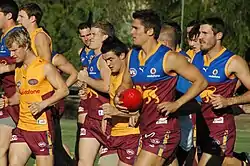
The Brisbane Lions began in 1996, when the AFL approved a merger between the Brisbane Bears and the formerly Melbourne based Fitzroy Football Club and on-field success increased substantially with the injection of Fitzroy players, further boosting the popularity of the code.
In a breakthrough for Australian Football in late 1990s, GPS schools in South East Queensland began playing Australian Rules for the first time since the turn of the century. Previously to this, South East Queensland private schools had been a staunchly rugby union stronghold and many schools did not allow Australian Football to be played as it would compete with rugby for players. The Jason Dunstall Cup (named after champion Queensland product Jason Dunstall) was later begun, with independent schools such as BBC, ACGS and Nudgee College, represented with teams in the first division of the Queensland Independent Schools Australian Football League (QISAFL). However interest soon waned and the trophy holds very little interest to the schools.
Also in the 1990s, the Cairns league experienced enormous growth financially on the back of gaming, with the Cazaly's social club quickly becoming the largest sporting club north of Brisbane. The Cazaly's Stadium received lights to play popular night football games and the western stand from the Gabba was transplanted to Cazaly's Stadium, enabling it to host AFL matches.
In 1999, the QSFL also went into voluntary liquidation, being replaced by a new organisation, AFL Queensland (AFLQ) in 2000. The new premiership competition was called the AFLQ State League. That year, Nick Riewoldt became the first Queensland produced player to be taken as number 1 pick in the AFL Draft, recognised as the best junior talent in the nation.
In 2001, a Women's Footy competition began in earnest.
Three successive premierships for the Brisbane Lions in 2001, 2002 and 2003 saw crowds to Australian Football League matches in Brisbane to grow to an average of over 30,000, and in terms of attendance and membership, the AFL team in 2003 was the most popular team of any football code in the state. However, despite increasing television ratings and media exposure, Australian rules football remains overall less popular than rugby league and rugby union in the state.
During the Lions premiership years, junior Aussie Rules numbers exploded in South East Queensland, and grew solidly right across the state.
2000s: Period of Stabilization
From 2005, the growing local State League expanded to two divisions.
A record number of 13 Queenslanders were invited to attend the 2006 AFL Draft camp, representing 18% of the 72 camp invitees.[72]
Although state league crowds have dwindled with the increase in support for the Brisbane Lions AFL team, a healthy crowd of 3,257 saw the Southport Sharks defeat Morningside in the 2005 AFLQ Grand Final at the Gabba, while a crowd of over 3,000 saw the Southport Sharks win back-to-back premierships in 2006 at Carrara.
In 2006, support for the Brisbane Lions waned substantially due to two successive seasons out of the finals. From 2005 to 2006 total memberships decreased from 30,027 to 26,429 and the average home crowd fell from 33,101 to 28,305.
The impact of the Brisbane Lions fall from grace was felt at grassroots level by the sport in Brisbane. From 2006, the much celebrated Jason Dunstall Cup was no longer contested by its former powerhouse schools – ACGS or BBC. Most other major private schools ceased playing the sport at the top level. Despite the decline of school competitions, local junior club numbers continued to grow.
Nevertheless, Queensland performed extremely well in the 2006 AFL Draft with a record 11 recruits, including 8 of the first 32 picks. Surprisingly, the majority of the movement was in the regional areas, with some picks from previously undrafted regional areas such as Townsville, Toowoomba and Mackay providing AFL talent.[73][74]
AFL on the Gold Coast
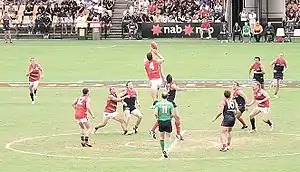
The Gold Coast, where a hole had been left once the Brisbane Bears moved away, had grown to become the 6th biggest urban area with nearly half a million people, many of which had migrated from states where Australian Rules is popular. Several bids were made for a new AFL franchise by the powerhouse Southport Sharks Australian Football Club, including attempts to lure a Melbourne-based club in 2004.[75] Many of these attempts were knocked back due to the city's many failed sporting franchises. However demographic trends suggested a growing demand for Australian rules football and in 2005 a pre-season practice match between the Brisbane Lions and Essendon drew a healthy audience of 16,591. Following the match, the Australian Football League stepped up efforts to expand into the Gold Coast market. A series of pre-season games and a home and away match was scheduled at Carrara for 2006. In response, the rival NRL competition admitted a Gold Coast Titans franchise. Despite an average crowd of around 10,000 (comparatively low by AFL standards), the AFL officially announced a strategy to include a Gold Coast side in the next 5 years.[76] A bitter turf war with the National Rugby League resulted over the use of Carrara stadium.[77] In the same year, AFL CEO Andrew Demetriou was quoted to declare that the league would compete directly with the NRL for marketshare in Queensland.
In July 2006, with the backing of the local government and the AFL, the Kangaroos did a deal which saw them move their home games scheduled at Manuka Oval in Canberra to play a number of home games at Carrara Stadium on the Gold Coast in 2007.[78] The AFL began a heavily subsidised grassroots participation program and pushed for the number of AFL games, including pre-season matches to steadily increase to ready the region for its own side. Relocation of the Kangaroos was seen by many to be the safest option for the AFL, and an existing Queensland Government deal prevented use of the Brisbane Cricket Ground for a second Queensland side until 2010. The AFL's plans were further complicated by growing competition in the market. The entry of several licences from other sports into the market as well as the proposed expansion of A-League put additional pressure on the league to fast-track the relocation of the Kangaroos.
In December 2007, after two years of resisting the AFL's push for their relocation, the Kangaroos finally officially rejected the AFL's $100 million proposal.[79] This was despite threats from the league to pull financial assistance from the club and cancel the Gold Coast home game agreement if they don't move. The failure of the AFL to secure a stadium deal for Carrara with the Queensland Government was seen as one of the deciding factors. A consortium was selected by the AFL in early 2008 and the GC17 set out to make an official bid for the licence with criteria defined by the league. The Queensland government finally committed to funding for a stadium in early 2009 after which the AFL was granted a provisional licence pending further federal government funding. In 2010 The Gold Coast Suns were created and entered a team in the NEAFL. In 2011 they made their debut playing in the AFL and vindicated the investment in creating the new AFL side by outdrawing the rival codes.
The Gold Coast Suns took to the AFL field in 2011.
2020s: COVID Impacts on Queensland football
Queensland was the first state other than Victoria to host an AFL Grand Final, the 2020 AFL Grand Final held at the Brisbane Cricket Ground.[10][80] The COVID-19 pandemic had a positive effect on the sport in Queensland, both in terms of AFL clubs being based in the state and grassroots participation.[12]
Leagues
Since 2011 Queensland based teams have competed in the northern division of the North East Australian Football League (NEAFL, also contested by teams from New South Wales, Northern Territory and Australian Capital Territory).
This competition became the first division in the region, while Queensland Australian Football League (former "AFLQ State League", first started in 1903) became the 2nd division.
Men's leagues
|
Junior leagues
|
Women's leagues
|
|
Clubs
There are two fully professional football clubs in Queensland, the Brisbane Lions and the Gold Coast Suns who both play in the main national league, the Australian Football League (AFL). They also play (with reserve teams) in the interstate competition North East Australian Football League. Other teams from the region that take part of it are Aspley, Redland and Southport.
The main competition of Queensland, Queensland Australian Football League, has 9 teams participating of it.
Representative Side
The Queensland state team, known as the "Maroons" has played interstate representative matches against all other Australian states, as well as selecting State of Origin teams as both Queensland and later as part of a combined "Allies" side.
The team debuted in 1884 at Queens Park following pressure from rugby members of the QFA to play annual representative matches and the result was a drawn series against New South Wales. After rugby split from the QFA and held its annual NSW vs QLD matches, the team did not regularly compete however in 1888 and 1890 suffered humiliating defeats at the hands of the first visiting Victorian teams. Following this, Queensland was reluctant to compete against the stronger states, and resumed tests with NSW until the 1908 Melbourne carnival. Queensland sent a team to the Jubilee carnival which saw it perform a stirring aboriginal war cry prior to its matches against New Zealand[81][82]
Colony of Queensland (Pre-Federation)
| Date | Location | Result | Attendance |
|---|---|---|---|
| 20 August, 1884 | Queens Park | Queensland drew New South Wales[38][39] | 300 |
| 30 August, 1884 | Albert Sports Ground | Queensland 3 def New South Wales 2 | 2,000 |
| 19 June, 1886 | Sydney Cricket Ground | New South Wales 4 def Queensland 1 | 1,200 |
| 26 June, 1886 | Sydney Cricket Ground | New South Wales 9 def Queensland 1 | 1,000 |
State Football Team (Post-Federation)
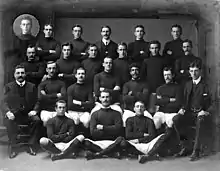
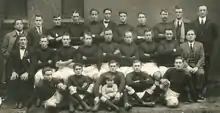
| 3 September 1904 | Brisbane Exhibition Ground | Queensland 4.15 (39) def New South Wales 3.13(31) [83] | 3.000 |
| 14 August 1905 | Brisbane Exhibition Ground | Queensland 10.16(76) def New South Wales 9.7(61)[84][85] | 2,000 |
| 15 August 1905 | Brisbane Exhibition Ground | Queensland 9.11(59) def New South Wales 7.7(49)[86] | |
| 23 June 1906 | Sydney Cricket Ground | New South Wales 11.10(76) def Queensland 3.5(23)[87] | 6,000 |
| 13 July 1907 | Brisbane Exhibition Ground | Queensland 9.22(76) def New South Wales 6.4(40)[88][89][90] | 8,000 |
| 15 July 1907 | North Ipswich Reserve | Queensland 2.10(22) def. by New South Wales 8.6(54)[91] | |
| 4 September 1909 | Brisbane Exhibition Ground | Queensland 11.12(87) def New South Wales 6.10(46)[92] | |
| 12 June 1910 | Brisbane Cricket Ground | Queensland 5.7(37) def. by New South Wales 9.15(69)[93] | |
| 20 August 1910 | Queensland 8.12(60) def. by New South Wales 10.5(65)[93] | ||
| 25 August 1910 | Erskineville Oval | Queensland 83 def Riverina 80[93] | |
| 11 July 1921 | Brisbane Exhibition Ground | Queensland 14.16(100) def New South Wales 11.10(76)[94] | |
| 13 July 1921 | North Ipswich Reserve | Queensland (65) def. by New South Wales (128)[95] | |
| 16 July 1921 | Brisbane Exhibition Ground | Queensland 12.13(85) def New South Wales 9.11(65)[96] | |
| 26 May 1947 | Trumper Oval | New South Wales 17.13(115) def Queensland 15.17(107)[97] | |
| 30 July 1948 | Brisbane Exhibition Ground | Queensland 17.13(115) def Queensland 16.18(114)[98] | |
| 30 July 1949 | Sydney Cricket Ground | New South Wales 16.14(110) def Queensland 8.15(63)[99] |
Interstate Carnivals
.jpg.webp)
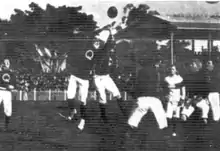
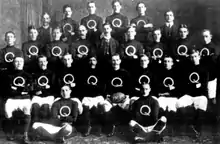
In early carnivals Queensland only made rare appearances. It broke its 20-game carnival losing streak in 1933 when it defeated the Australian Capital Territory. This was followed up by another win against the ACT in 1947 and 1950. Queensland achieved a breakthrough when it defeated New South Wales for the first time in the 1958 carnival. However, in the 1960s is was relegated to the "minor states" where it again accounted for New South Wales at the 1968 Minor States Carnival and both New South Wales and ACT at the 1974 Minor States Carnival taking its first Section 2 title. It was not to reappear in the national carnival until the 1979 Perth State of Origin Carnival when it once again accounted for the Australian Capital Territory and claimed the title. It made its last senior appearance at the 1993 State of Origin Championships as a combined Queensland-NT team defeat Tasmania and take out the Section Two title. With the AFL Commission taking over the game nationally it created a concept in which Queenslanders would compete under the banner of the AFL's The Allies along with players from New South Wales, Tasmania, Australian Capital Territory and Northern Territory and the AFL's focus on its national club competition effectively saw the end of Queensland players representing their state of origin.
- 1908 Melbourne Carnival - 0 wins
- 1914 Sydney Carnival - 0 wins
- 1924 Hobart Carnival - 0 wins
- 1930 Adelaide Carnival - 0 wins
- 1933 Sydney Carnival - 1 win
- 1947 Hobart Carnival - 1 win
- 1950 Brisbane Carnival - 1 win
- 1958 Melbourne Carnival - 1 win
- 1960 Minor States Carnival - 0 win
- 1968 Minor States Carnival - 1 win
- 1974 Minor States Carnival - 2 wins
- 1988 Adelaide Bicentennial Carnival - 0 wins
Inter-league competition
In inter-league matches since 1991, Queensland (QAFL) has defeated both Tasmania and the Australian Capital Territory, and has had some close games including a near-wins against Western Australia.
Underage teams
The Queensland Under-16, Under-17 and Under-18 representative sides are known as the Scorpions.
Regional Representative Sides
Also there are representative sides for areas within Queensland used during inter-league matches with-in Queensland itself. They include:
- North Queensland - represent North Queensland in annual matches against South Queensland since the 2010s
- South Queensland - represent Southern Queensland in annual matches against North Queensland since 2010s
- Bushrangers – representing the entire South East Queensland region Official Site
- Gold Coast Stingrays – representing the Gold Coast region
- Suncoast Power – representing the Sunshine Coast region Official Site
- Western Taipans – representing the western regions, including the cities of Ipswich and Toowoomba. Official Site
- Northern Raiders – representing the Northern Suburbs of Brisbane and Bribie Island. Official Site
Principal Venues
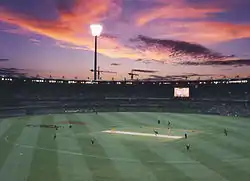
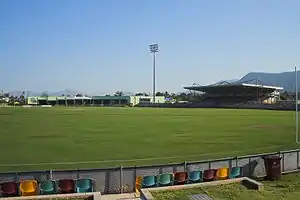
| Brisbane | Gold Coast | Cairns |
|---|---|---|
| Brisbane Cricket Ground | Carrara Stadium | Cazaly's Stadium |
| Capacity: 42,000 | Capacity: 25,000 | Capacity: 13,500 |
 |
|
 |
- 1866 – ca 1890: Queen's Park (now part of the Brisbane City Botanic Gardens); the original Cricket Ground at the 'Green Hills' (now Petrie Terrace)
- 1904 – 1912: Queen's Park
- 1905 – 1914: Brisbane Cricket Ground, Exhibition Ground
- 1920 – 1950s: Perry Park, Exhibition Ground for some games, including the 1950 interstate carnival
- 1959 – 1971: Brisbane Cricket Ground
- 1970s – 1980s: Windsor Park
- 1987 -: Carrara Stadium (Gold Coast)
- 1998 – 2004: Giffin Park
- 2005 - Brisbane Cricket Ground (Brisbane), Cazaly's Stadium (Cairns)
- 2019 - Riverway Stadium, (Townsville)
- 2022-: The Reserve, Springfield (under construction)
Audience
Attendance record
- Mens: 37,473 (2019). AFL Brisbane Lions vs Richmond (Gabba, Brisbane)[2]
- Women's: 15,610. (2017) AFLW Grand Final Brisbane Lions vs Adelaide (Metricon Stadium, Gold Coast, Queensland)[100]
Major Australian Rules Events in Queensland
- Australian Football League Premiership Season (Brisbane Lions and Gold Coast Suns home games and QClash special fixture)
- AFLW Premiership Season (Brisbane Lions and Gold Coast Suns home games)
- Queensland Australian Football League Grand Final
Players
Participation
In 2017 Queensland surpassed 250,000 players in 2017[101] (40% are female). This is more than double the number of participants in less than a decade. By contrast in 2007, there were around 3,300 senior players in Queensland, and in 2009 there were a total of 103,358 participants.[102] Although the overall participation per capita is around 2%, the sport is growing faster in Queensland than any other Australian state.[103]
Past Greats
Over the years, Queensland has produced an array of talent for elite leagues such as the Australian Football League, such as Jason Dunstall, Marcus Ashcroft, Gavin Crosisca, Scott McIvor, Danny Dickfos, Che Cockatoo-Collins, Steven Lawrence, Clark Keating, Trent Knobel, Clint Bizzell, Brett Backwell, Brett Voss, Michael Voss, Mal Michael and Robert Copeland.
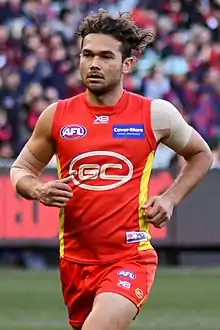 Jarrod Harbrow was from Cairns
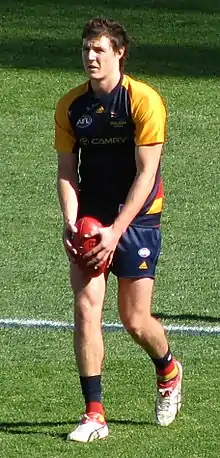 Kurt Tippett was from the Gold Coast
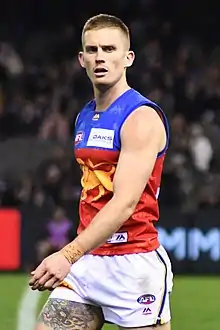 Dayne Beams premiership player was from the Gold Coast
 David Armitage was from Mackay
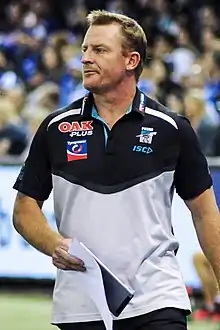 Michael Voss Brownlow Medallist and triple premiership player was from Beenleigh
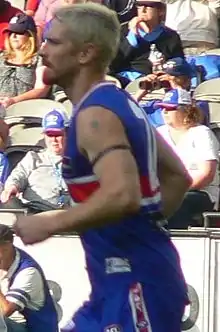 Jason Akermanis Brownlow medallist and triple premierhips player was schooled in Brisbane
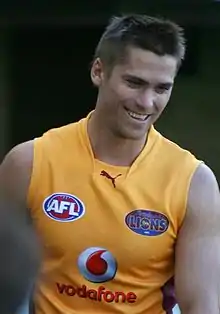 Simon Black Brownlow medallist and triple premiership player was from Mt Isa
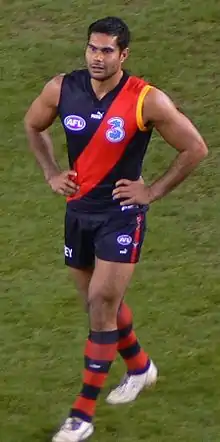 Mal Michael triple premiership player grew up in Brisbane
 Jamie Charman premiership player was from Maryborough
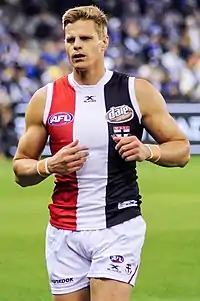 Nick Riewoldt was from the Gold Coast
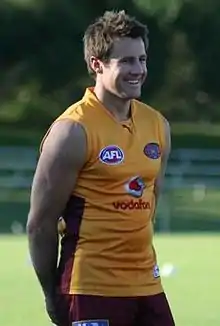 Tim Notting dual premiership player was from Cairns
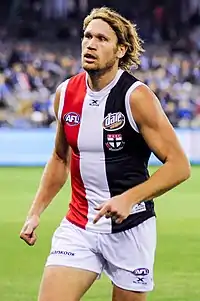 Sam Gilbert was from the Gold Coast
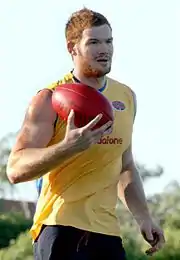 Daniel Merrett was from the Gold Coast
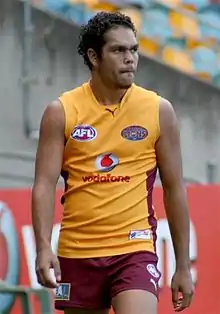 Rhan Hooper was from Cunnamulla and Ipswich
 Ben Hudson was from the Gold Coast
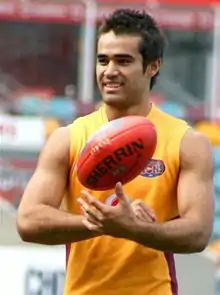 Scott Harding was from Thursday Island
.jpg.webp) Luke McGuane was from Brisbane
Luke McGuane was from Brisbane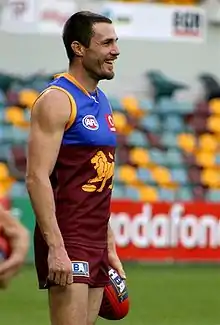 Robert Copeland dual premiership player was from Brisbane
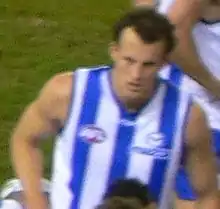 David Hale Triple premiership player was from the Gold Coast
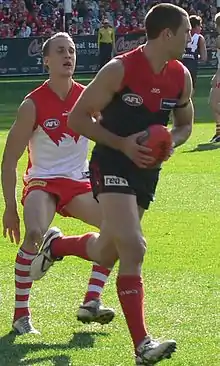 Brad Miller was from Brisbane
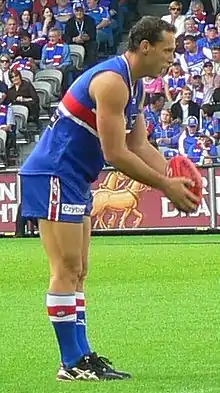 Mitch Hahn was from Brisbane
AFL Recruitment Zones
Queensland based AFL clubs have priority development access to the Northern Academy Recruitment Zone. As a result, many of the players from these areas end up playing in the AFL with the designated club.
| QLD AFL Club | Zones |
|---|---|
| Brisbane Lions | Brisbane (Logan, Brisbane, Ipswich, Moreton Local Government Areas), Sunshine Coast, Darling Downs, Wide Bay-Burnett, Outback Queensland |
| Gold Coast | Gold Coast region, Northern Queensland (Cairns, Townsville, Rockhampton, Mackay, Mt. Isa, Cape York) |
List of Queenslanders who played in the AFL & AFLW
Since the first Queensland player to make the VFL, Erwin Dornau in 1948[67] more than 180 Queenslanders as at 2020 had played in the VFL/AFL, well over half of them made their debuts in the 21st century.
Men's
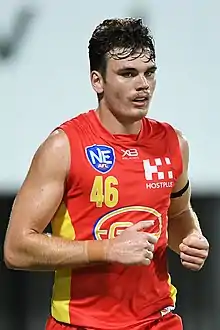 Caleb Graham is from Cairns
_16.04.21.jpg.webp) Samson Ryan is from Toowoomba
Samson Ryan is from Toowoomba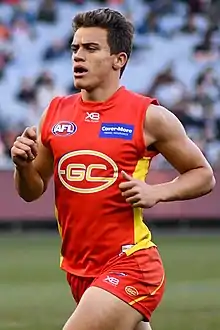 Jacob Heron is from Cairns
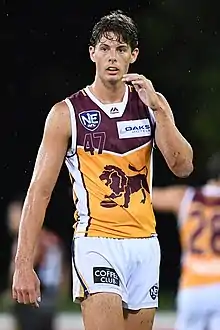 Tom Fullarton is from the Sunshine Coast
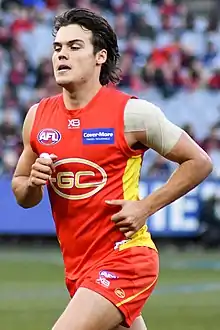 Jack Bowes is from Cairns
.jpg.webp) Mabior Chol was raised in Acacia Ridge in Brisbane
Mabior Chol was raised in Acacia Ridge in Brisbane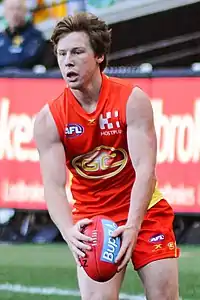 Jesse Joyce is from the Gold Coast
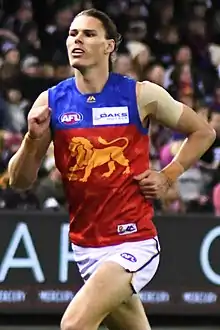 Eric Hipwood was raised on the Sunshine Coast
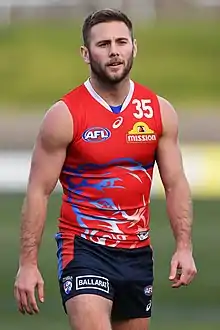 Caleb Daniel All-Australian is from Beaudesert
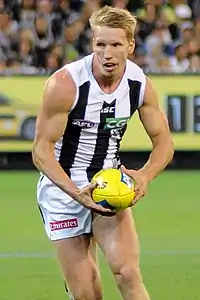 Josh Smith is from Brisbane
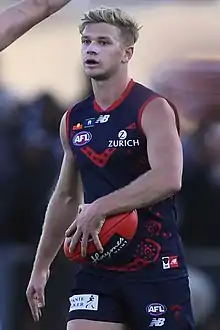 Corey Wagner is from Brisbane
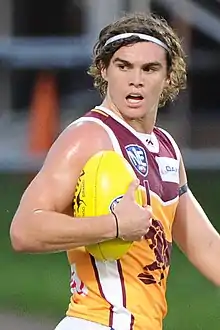 Ben Keays is from Brisbane
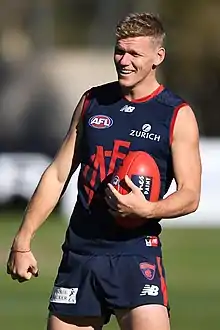 Josh Wagner is from Brisbane
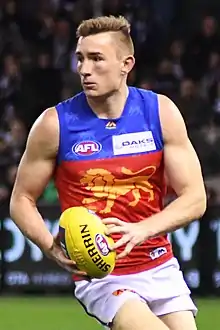 Harris Andrews was raised in Brisbane
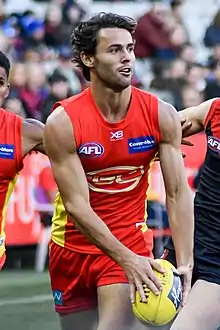 Lachie Weller was raised on the Gold Coast
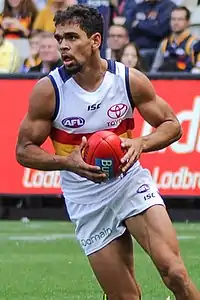 Charlie Cameron is from Mt Isa and Mornington Island
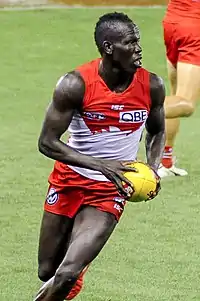 Aliir Aliir All-Australian was schooled in Brisbane
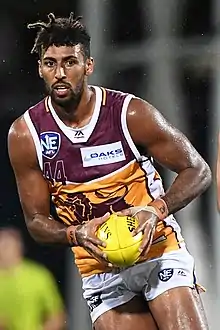 Archie Smith is from Brisbane
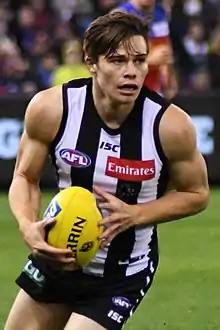 Josh Thomas is from the Gold Coast
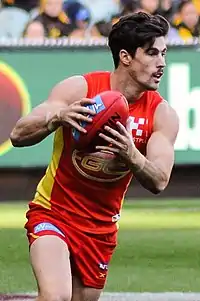 Alex Sexton is from Logan City
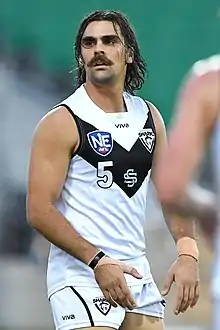 Andrew Boston is from the Gold Coast
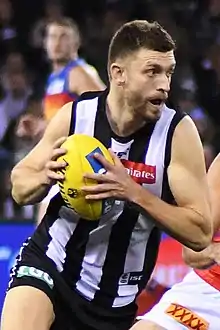 Adam Oxley is from Redland City
 Dayne Zorko is from the Gold Coast
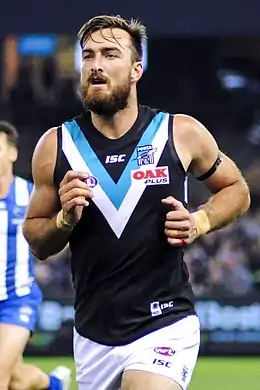 Charlie Dixon is from Cairns
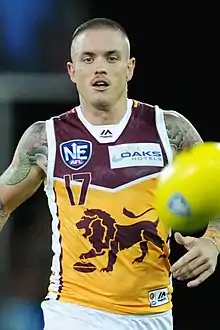 Claye Beams is from the Gold Coast
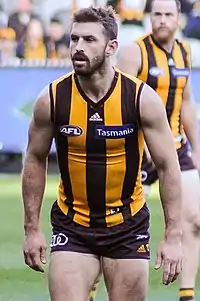 Brendan Whitecross is from Brisbane
_2017.jpg.webp)
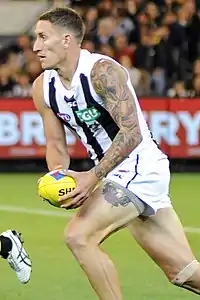 Jesse White is from the Gold Coast
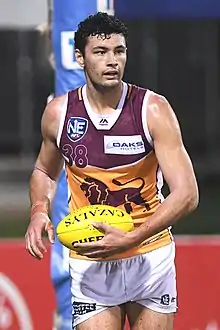 Connor Ballenden was raised in Brisbane
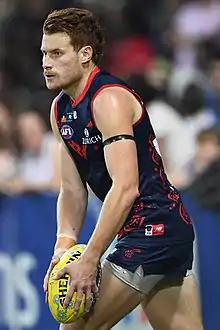 Oskar Baker is from Brisbane
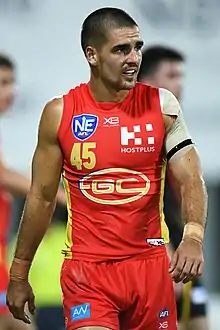 Jacob Dawson is from the Gold Coast
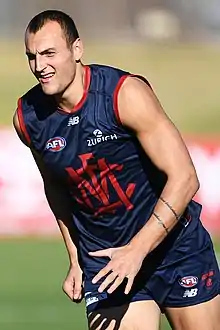 Braydon Preuss is from Townsville
.jpg.webp) Lachlan Keefe is from Gympie
Lachlan Keefe is from Gympie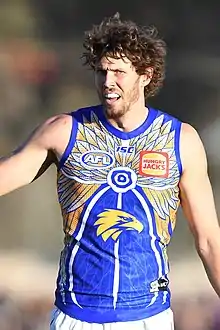 Tom Hickey is from Brisbane
| Currently on an AFL senior list |
| Player | QLD junior/senior club | Representative honours | VFL/AFL Years | VFL/AFL Games | VFL/AFL (Goals) | Connections to Queensland, Notes & References |
|---|---|---|---|---|---|---|
| Alex Davies | Manunda Hawks | U16 (2018) | 2020- | 1 | 0 | Raised in Cairns |
| Samson Ryan | Sherwood Districts/Redland | U18 (2018) | 2021- | 1 | 0 | Raised in Toowoomba |
| Caleb Graham | Cairns Saints | U16 (2016), U17 (2017) | 2019- | 20 | 0 | Born and raised in Cairns. |
| Tom Fullarton | - | U16 (2015) | 2019- | 6 | 2 | Born and raised on Sunshine Coast. Former Brisbane Bullets player |
| Bailey Scott | Broadbeach | U16 (2016) | 2019- | 26 | 15 | Raised on the Gold Coast |
| Jacob Heron | Cairns Saints | U16 (2015) | 2018- | 13 | 2 | Born and raised in Cairns.[104] |
| Connor Ballenden | Kenmore | U16 (2015), U18 (2016) | 2018- | 2 | 0 | Raised in Brisbane |
| Brayden Crossley | Palm Beach Currumbin | U16 (2015), U18 (2016) | 2018- | 10 | 5 | Born and raised on Gold Coast |
| Jack Payne | Noosa | U16 (2015) | 2018- | 13 | 0 | Raised on the Sunshine Coast |
| Oskar Baker | Aspley | QLD (2017) | 2018- | 15 | 4 | Raised in Brisbane |
| Jacob Dawson | Palm Beach Currumbin | 2018- | 9 | 1 | Raised on the Gold Coast | |
| Jack Bowes | Cairns Saints | U18 (2016 c) | 2017- | 74 | 14 | Born and raised in Cairns. |
| Brad Scheer | Palm Beach Currumbin | U18 (2016) | 2017- | 13 | 2 | Raised on the Gold Coast |
| Max Spencer | Palm Beach Currumbin | 2017 | 8 | 0 | Born and raised on the Gold Coast | |
| Josh Williams | Hermit Park Tigers | 2017 | 2 | 1 | Raised in Townsville | |
| Mabior Chol | Yeronga | 2016- | 31 | 24 | Raised in Brisbane (Acacia Ridge)[105] | |
| Wylie Buzza | Mount Gravatt | 2017 | 9 | 6 | Raised in Gatton, Queensland | |
| Eric Hipwood | Caloundra/Aspley | U18 (2015) | 2016- | 110 | 163 | Raised on Sunshine Coast |
| Jesse Joyce | Palm Beach Currumbin | 2016- | 64 | 2 | Raised on the Gold Coast | |
| Josh Smith | Redland | 2016- | 34 | 7 | Raised in Brisbane | |
| Corey Wagner | Aspley | 2016-2020 | 19 | 6 | Raised in Brisbane | |
| Ben Keays | Morningside/Redland | U18 (2014, 2015 c) | 2016- | 68 | 25 | Raised and schooled in Brisbane |
| Reuben William | Zillmere | 2016-2017 | 3 | 0 | Raised in Brisbane | |
| Josh Wagner | Aspley | U18 (2012) | 2016-2020 | 40 | 2 | Raised in Brisbane |
| Caleb Daniel | - | 2015 | 132 | 37 | Born and raised in Beaudesert.[106] | |
| Harris Andrews | Aspley | U18 (2014) | 2015 | 136 | 10 | Raised in Brisbane, attended Padua College[107] |
| Liam Dawson | Redcliffe/Aspley | U18 | 2015–2018 | 18 | 6 | Raised in Redcliffe |
| Matthew Hammelmann | Morningside | 2015-2017 | 12 | 2 | Raised in Brisbane | |
| Lachie Weller | Broadbeach | 2015- | 116 | 42 | Raised on Gold Coast | |
| Charlie Cameron | Marist College Ashgrove | 2014 | 150 | 244 | Born and raised in Mt Isa.[108] | |
| Aliir Aliir | Aspley | 2014 | 88 | 5 | Raised in Brisbane[109] | |
| Archie Smith | Mount Gravatt | 2014 | 16 | 4 | Born and raised in Brisbane[110] | |
| Alex Sexton | Springwood, Redland | U16 (2010), U18 (2011) | 2013- | 26 | 11 | Raised and schooled in Logan.[111][112] |
| Sam Michael | Redland | 2013–2016 | 5 | 0 | Raised in Brisbane | |
| Clay Cameron | Mount Gravatt | 2013–2016 | 23 | 5 | Born and raised in Brisbane | |
| Jonathan Freeman | Noosa Tigers | 2013–2015 | 14 | 16 | Raised on the Sunshine Coast | |
| Jordon Bourke | Morningside | U18 (2011) | 2013–2015 | 6 | 2 | Raised in Brisbane |
| Andrew Boston | Palm Beach | U18 (2012) | 2013 | 8 | 7 | Raised on the Gold Coast |
| Adam Oxley | Redland | U18 (2011, 2012) | 2013 | 4 | 0 | Raised in Brisbane |
| Peter Yagmoor | Morningside | 2012-2014 | 2 | 0 | Raised in Brisbane | |
| Piers Flanagan | 2012 | 3 | 0 | Raised and schooled on the Gold Coast | ||
| Dayne Zorko | Broadbeach | U18 (2007 c), QLD (2011) | 2012- | 208 | 210 | Born and raised on Gold Coast. |
| Lee Spurr | Morningside | 2012–2018 | 120 | 5 | Raised in Brisbane | |
| Josh Hall | Curra Swans | 2012-15 | 7 | 3 | Born and raised in Townsville. Also professional NRL player | |
| Stephen Wrigley | Labrador | 2012–2013 | 3 | 0 | Raised on the Gold Coast | |
| Jackson Allen | Morningside | 2012–2013 | 4 | 0 | Raised in Brisbane | |
| Joel Wilkinson | Broadbeach | U18 (2010 c) | 2011-2013 | 26 | 1 | Raised on the Gold Coast |
| Rory Thompson | Southport | 2011 | 55 | 7 | Raised on the Gold Coast | |
| Charlie Dixon | Redland | U18 (3 caps) | 2011 | 49 | 53 | Raised in Cairns |
| Zac Smith | Zillmere | 2011 | 44 | 27 | Born Biloela | |
| Rex Liddy | North Cairns/Kenmore | 2011 | 4 | 0 | Raised in Cairns | |
| Bryce Retzlaff | Labrador | 2011 | 11 | 6 | Raised on the Gold Coast | |
| Claye Beams | Labrador | U18 (2010) | 2011 | 30 | 21 | Raised on the Gold Coast |
| Josh Thomas | Redland | U18 (2009) | 2010-2021 | 123 | 101 | Born and raised in Queensland and raised |
| Rohan Bail | Mount Gravatt | 2010-2012 | 71 | 28 | Raised in Brisbane | |
| Broc McCauley | Surfers Paradise/Southport | QLD (2009) | 2010-2012 | 6 | 1 | Born and raised on the Gold Coast |
| Lachlan Keefe | - | 2009 | 76 | 15 | Born and raised in Gympie[113] | |
| Dayne Beams | Southport | U18 (2008 c) | 2009 | 112 | 118 | Raised on the Gold Coast. 2010 Collingwood Premiership player. 2012 All Australian team. |
| Brendan Whitecross | Kedron District Junior Football Club, Zillmere | U12 (2002), U16 (2005) (2006 c), U18 (2007 c) | 2009 | 97 | 38 | Born and raised in Brisbane |
| Sam Reid | Zillmere | 2008 | 101 | 31 | Born and raised in Bundaberg and Sunshine Coast[114] | |
| Jake Spencer | Redland | 2008–2017 | 38 | 8 | Raised in Townsville | |
| Jesse White | Southport | U18 (2006) | 2008 | 91 | 97 | Raised on the Gold Coast |
| Scott Clouston | University of Queensland/Morningside | 2008 | 2 | 1 | Raised in Brisbane | |
| Shaun Hampson | Mount Gravatt | 2007-2018 | 98 | 38 | Raised in Brisbane | |
| Albert Proud | Mount Gravatt | 2007-2010 | 29 | 10 | Born Torres Strait Islands, raised in Brisbane | |
| Karmichael Hunt | Anglican Church Grammar School | 2007-2014 | 44 | 6 | Raised in Brisbane. Rugby league convert | |
| Ricky Petterd | Broadbeach | 2007-2015 | 84 | Raised in Brisbane | ||
| David Armitage | Morningside | U18 (?) | 2007 | 150 | 89 | |
| Jarrod Harbrow | South Cairns Cutters | U16 (2004), U18 (2006) | 2007 | 120 | 34 | Born in Cairns raised in Cairns and Townsville |
| Daniel Dzufer | Caloundra/Zillmere Eagles/Suncoast Lions/Aspley | 2007–2009 | 1 | 0 | Raised on the Sunshine Coast | |
| Kurt Tippett | Southport | U18 (2006) | 2007 | 111 | 209 | Raised on the Gold Coast |
| Brent Renouf | Surfers Paradise/Southport | 2007 | 68 | 13 | Raised on the Gold Coast | |
| Will Hamill | Southport | U18 (2004 c) | 2007 | 3 | 1 | Raised in Brisbane |
| Joel Tippett | Southport | 2007 | 8 | 0 | Raised on the Gold Coast | |
| Tom Williams | Morningside | 2007–2014 | 85 | 14 | Raised and schooled in Brisbane | |
| Brad Howard | Redland | 2007 | 2 | 0 | Raised in Toowoomba | |
| Rhan Hooper | Ipswich Eagles | U18 (2005) | 2006 | 54 | 56 | Born in Charleville, Queensland raised in Ipswich |
| Jason Roe | Cairns City Cobras | 2006–2009 | 50 | 7 | Raised in Brisbane | |
| Marty Pask | Western Magpies | 2006 | 8 | 4 | Raised in Brisbane | |
| Courtenay Dempsey | Morningside | QLD (4 caps) | 2006 | 133 | 35 | Born Mt Isa, raised in Cairns |
| Wayde Mills | Coolangatta Tweed Heads/ Southport | U18 (?) | 2006-2008 | 16 | 3 | Born and raised on the Gold Coast |
| Cheynee Stiller | Northern Eagles | 2006 | 100 | 21 | Raised in Brisbane | |
| Scott Harding | Morningside | 2006 | 50 | 15 | Born on Thursday Island, raised and schooled in Brisbane | |
| Sam Gilbert | Coolangatta Tweed Heads / Southport Sharks | U18 (?) | 2006 | 208 | 38 | Raised on the Gold Coast |
| Daniel Merrett | Southport | 2005 | 200 | 70 | Raised on the Gold Coast | |
| Josh Drummond | Northern Eagles | 2005-2012 | 94 | 35 | Born and raised on the Sunshine Coast | |
| Leigh Ryswyk | Southport | U18 (2003) | 2005 | 1 | 0 | Raised on the Gold Coast |
| Luke McGuane | Broadbeach | 2005 | 93 | 19 | Born in Queensland, raised on the Gold Coast | |
| Marcus Allan | Northern Eagles | 2004-2007 | 5 | 1 | Raised in Brisbane | |
| Ben Hudson | University of Queensland Australian Football Club | 2004 | 168 | 19 | Raised in Brisbane | |
| Joel Macdonald | Mt Gravatt | 2004 | 124 | 6 | Raised in Brisbane | |
| Daniel Pratt | Northern Eagles | 2004 | 119 | 10 | Raised in Brisbane | |
| Andrew Raines | Southport | 2004 | 111 | 12 | Born and raised on Gold Coast | |
| David Hale | Broadbeach | U18 (2001) | 2003 | 237 | 217 | Raised on the Gold Coast raised. Triple premiership player. |
| Shane Morrison | Northern Eagles | 2002-2005 | 13 | 3 | Raised in Cairns and Brisbane | |
| Brad Miller | Mt Gravatt | 2002 | 157 | 120 | Born and raised in Brisbane | |
| Nick Riewoldt | Southport | 2001 | 319 | 689 | Raised on the Gold Coast | |
| Jamie Charman | Sandgate | 2001 | 129 | 55 | Born in Maryborough and raised in Brisbane | |
| Robert Copeland | Northern Eagles | 2001 | 143 | 39 | Born and raised in Brisbane | |
| Nathan Clarke | Maroochydore | 2000-2002 | 6 | 4 | Raised on Sunshine Coast | |
| Trent Knobel | Broadbeach | 2000-2007 | 75 | 12 | Born and raised on the Gold Coast | |
| Mitch Hahn | Zillmere | 2000 | 181 | 164 | Born and raised in Brisbane | |
| Brett Backwell | Northern Eagles | 1999-2001 | 18 | 12 | Raised in Brisbane. | |
| Jason Akermanis | Mayne | 1996 | 325 | 421 | Raised in Brisbane. Triple premiership player. Brownlow medallist. QLD Team of the Century member. | |
| Simon Black | - | 1998 | 320 | 170 | Born in Mount Isa. Triple premiership player. Brownlow medallist. | |
| Hamish Simpson | Kedron Grange | 1998-2000 | 18 | 0 | Raised and schooled in Brisbane | |
| Tim Notting | - | 1998 | 208 | 138 | Born and raised in Cairns | |
| Mal Michael | Morningside | 1997 | 238 | 33 | Raised in Brisbane. QLD Team of the Century member | |
| Brett Voss | Morningside | 1997-2007 | 170 | 67 | Born and raised | |
| Danny Dickfos | Windsor-Zillmere | QLD/NT (1993) | 1996-1999 | 65 | 0 | Born and raised in Brisbane |
| David Cockatoo-Collins | Cairns City Cobras | 1995–1997 | 2 | 0 | Born and raised in Cairns | |
| Don Cockatoo-Collins | Cairns City Cobras | 1996–1998 | 9 | 3 | Born and raised in Cairns | |
| Clint Bizzell | Wilston Grange | 1996 | 163 | 79 | Born and raised in Brisbane | |
| Clark Keating | Surfers Paradise AFC | 1996 | 139 | 83 | Born and raised on Gold Coast | |
| Derek Wirth | Springwood/Mt Gravatt | 1996-1999 | 1 | 2 | Raised in Brisbane | |
| Brent Green | Southport | 1995-1998 | 12 | 8 | Raised on the Gold Coast | |
| Steven Lawrence | Southport | QLD/NT (1993) | 1995 | 120 | 60 | Raised on the Gold Coast |
| Chris Scott | - | 1994 | 215 | 79 | Raised and schooled in Brisbane | |
| Che Cockatoo-Collins | Cairns City Cobras | QLD/NT (1993) | 1994 | 160 | 215 | Born in Brisbane, raised in Cairns |
| Rudi Frigo | Mayne | QLD/NT (1993) | 1994-1995 | 8 | 1 | Raised in Brisbane |
| Michael Voss | Morningside | QLD, QLD/NT (1993) | 1992 | 289 | 245 | Raised in Brisbane. Brownlow Medallist and Australian Football Hall of Famer. QLD Team of the Century member. Triple premiership captain of Brisbane Lions. |
| Steven Handley | Southport | QLD | 1992–1997 | 73 | 28 | Raised on the Gold Coast |
| Steven McLuckie | Southport | QLD/NT (1993) | 1992–1993 | 20 | 8 | Raised in Brisbane |
| Simon Luhrs | Western Districts | QLD/NT (1993) | 1991–1992 | 12 | 0 | Raised in Brisbane |
| Corey Bell | Southport | QLD | 1991 | 8 | 2 | Raised on Gold Coast |
| Matthew Kennedy | Southport | QLD/NT (1993) | 1990 | 188 | 30 | Raised on Gold Coast |
| Ray Windsor | Western Districts | QLD, QLD/NT (1993) | 1990 | 23 | 22 | Raised in Brisbane |
| David Wearne | Coorparoo | QLD/NT (1993) | 1990-1993 | 18 | 2 | Raised in Brisbane |
| Marcus Ashcroft | Southport | QLD/NT (1993) | 1989 | 318 | 145 | Raised on Gold Coast. First Queenslander to play 300 AFL games. Triple premiership Brisbane Lions player. QLD Team of the Century member. |
| Tony Lynn | Morningside | QLD/NT (1993) | 1988-1996 | 33 | 19 | Raised in Brisbane |
| Stephen Lawrence | Southport | QLD | 1988 | 146 | 30 | Raised on the Gold Coast |
| Gavin Crosisca | Western Districts AFC | QLD (1998) | 1987 | 246 | 64 | Born and raised in Brisbane. QLD Team of the Century member |
| Darren Carlson | Southport | QLD (1988), QLD/NT (1993) | 1987 | 25 | 7 | Raised on the Gold Coast |
| Stuart Glascott | Southport | QLD (1988) | 1987 | 4 | 0 | Raised on the Gold Coast |
| Tony Beckett | Mayne | QLD (18 caps) | 1987 | 6 | 2 | Raised in Brisbane |
| Allan Giffard | Sherwood | QLD (12 caps) | 1987 | 1 | 0 | Raised in Brisbane |
| Dean McRae | Sandgate | 1987 | 141 | 55 | Raised on Bribie Island, Sunshine Coast | |
| Troy Clarke | South Cairns Cutters | QLD (1991), QLD/NT (1993) | 1987 | 68 | 31 | Raised in Cairns |
| Tony Smith | Morningside | QLD (1988) | 1986–1988 | 17 | 1 | Raised in Brisbane |
| Jason Dunstall | Coorparoo | QLD (1988), QLD/NT (1993) | 1985 | 269 | 1254 | Born and Raised in Brisbane. Represented Queensland four times in State of Origin. Australian Football Hall of famer. QLD Team of the Century member. |
| Michael Gibson | Coorparoo | QLD (15 caps: 1988) | 1985 | 55 | 3 | Born and raised in Brisbane |
| Trevor Spencer | Jindalee | QLD (1988) | 1985 | 44 | 29 | Raised in Brisbane |
| Craig Potter | Western Districts | QLD/NT (1993) | 1984-1992 | 55 | 19 | Raised in Brisbane |
| Craig Brittain | Windsor-Zillmere | U18 (?) | 1984 | 5 | 2 | Raised in Cairns |
| Scott McIvor | Wilston Grange | QLD | 1985-1997 | 200 | 96 | Born and raised in Brisbane. QLD Team of the Century member. |
| Zane Taylor | Southport | QLD (26 caps: 1988) | 1980-1983 | 27 | 12 | Raised in Brisbane. Represented QLD 27 times. Queensland Team of the Century member. |
| Carl Herbert | Mayne | QLD (1988) | 1983 | 3 | 0 | Raised in Brisbane |
| Gary Shaw | Western Districts | 1983-1987 | 38 | 38 | Raised in Brisbane | |
| Frank Dunell | Zillmere Eagles Australian Football Club | QLD (7 caps: 1988) | 1979-1988 | 115 | 61 | Raised in Brisbane. Represented QLD Seven times. Premiership player. |
| Warren Jones | Morningside | 1978-1988 | 123 | 36 | Raised in Brisbane. Premiership player. | |
| Barry Denny | South Brisbane/Morningside | 1977–1979 | 22 | 3 | Raised in Brisbane. | |
| Erwin Dornau | Kedron Football Club | QLD (1946, 1947) | 1948–1952 | 54 | 8 | Born and raised in Brisbane.[67] |
Women's
 Tayla Harris is from Brisbane
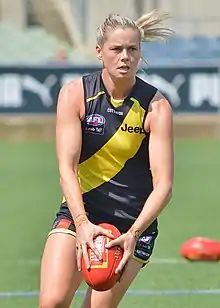 Katie Brennan is from Brisbane
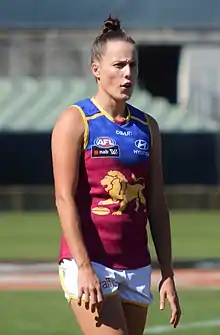 Emma Zielke is from Bundaberg
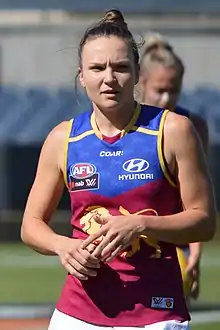 Emily Bates is from Brisbane
.jpg.webp) Tahlia Randall is from Buderim
Tahlia Randall is from Buderim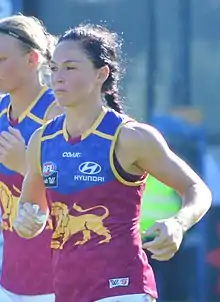 Leah Kaslar if from Cairns
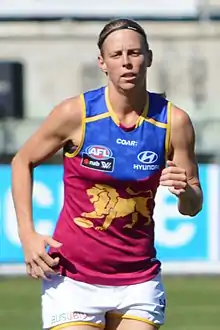 Kate Lutkins is from Brisbane
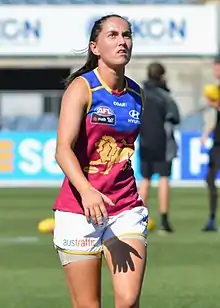 Sharni Webb is from the Sunshine Coast
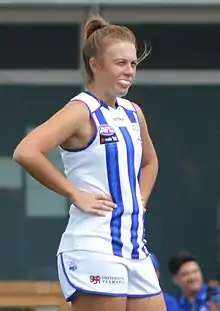 Jamie Stanton is from the Gold Coast
.jpg.webp) Lauren Bella is from Mackay
Lauren Bella is from Mackay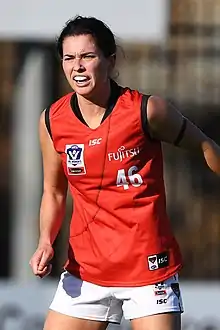 Lauren Ahrens is from the Gold Coast
| Currently on an AFLW senior list |
| Player | QLD junior/senior club | ALFW Years | AFLW Games | AFLW (Goals) | Connections to Queensland, Notes & References |
|---|---|---|---|---|---|
| Ellie Hampson | Hermit Park | 2020- | 7 | 0 | From Townsville |
| Belle Dawes | Maroochydore | 2020- | 18 | 3 | From Sunshine Coast |
| Dakota Davidson | University of Queensland | 2020- | 17 | 18 | Born and raised in Ipswich |
| Maria Moloney | University of Queensland | 2020- | 8 | 0 | Brisbane raised |
| Jade Pregelj | Logan City Cobras/Yeronga | 2020- | 16 | 0 | Born and raised in Logan |
| Charlotte Hammans | Bond University | 2020- | 3 | 0 | From the Gold Coast |
| Dee Heslop | Southport/Yeronga | 2020- | 16 | 0 | Schooled on Gold Coast |
| Greta Bodey | Cairns Saints/University of Queensland | 2020- | 17 | 11 | Raised in Cairns |
| Cathy Svarc | Wilston Grange | 2020- | 18 | 4 | Raised in Brisbane |
| Taylor Smith | Bond University | 2020- | 12 | 5 | From the Gold Coast |
| Selina Priest | Coolangatta | 2020- | 8 | 0 | Born and raised on Gold Coast |
| Tahlia Hickie | Coorparoo | 2020- | 12 | 1 | From Brisbane |
| Serene Watson | Broadbeach/Bond University | 2020- | 16 | 0 | Raised on Gold Coast |
| Lily Postlethwaite | Moreton Bay/Maroochydore | 2020- | 11 | 1 | From Sunshine Coast |
| Kate Surman | Maroochydore | 2020- | 16 | 5 | From Sunshine Coast |
| Tarni White | Coorparoo | 2020- | 13 | 0 | Born and raised in Mackay |
| Nat Grider | Jindalee Jags/University of Queensland | 2019- | 19 | 0 | Raised in Brisbane |
| Jesse Wardlaw | Coorparoo | 2019- | 25 | 16 | Raised in Brisbane |
| Jade Ellenger | Coorparoo | 2019- | 13 | 3 | Raised in Brisbane |
| Paige Parker | Coorparoo | 2019- | 17 | 2 | Raised in Brisbane |
| Gabby Collingwood | Forest Lake Dragons/Jindalee Jags/University of Queensland | 2018- | 13 | 0 | Raised in Brisbane |
| Kalinda Howarth | Southport/Coolangatta | 2018- | 16 | 12 | Born and raised on Gold Coast |
| Molly Ritson | Surfers Paradise/Southport/Bond University | 2018- | 9 | 0 | From Gold Coast |
| Sophie Conway | Zillmere | 2018- | 24 | 8 | Raised in Brisbane |
| Lauren Bella | Bakers Creek /Bond University | 2017- | 19 | 0 | Born and raised in Mackay |
| Tayla Harris | Zillmere | 2017- | 37 | 29 | Born and raised in Brisbane |
| Ally Anderson | Zillmere | 2017- | 41 | 4 | Born and raised in Brisbane |
| Kate McCarthy | Yeronga | 2017- | 33 | 18 | Raised in Brisbane |
| Katie Brennan | Logan City Cobras/Yeronga | 2017- | 26 | 30 | Born and raised in Logan |
| Emma Zielke | Morningside/University of Queensland | 2017- | 41 | 4 | Born and raised in Bundaberg |
| Emily Bates | Yeronga | 2017- | 41 | 3 | Born and raised in Brisbane |
| Tahlia Randall | Kawana/Nambour/Maroochydore/Wilston Grange | 2017- | 39 | 1 | Born and raised on Sunshine Coast |
| Leah Kaslar | Centrals Trinity Beach/Coolangatta Tweed Heads | 2017- | 36 | 3 | Raised in Cairns |
| Kate Lutkins | Wilston Grange | 2017- | 41 | 3 | Born and raised in Brisbane |
| Sharni Webb | Caloundra/Zillmere/University of Queensland | 2017- | 27 | 1 | Born and raised in Nambour, Sunshine Coast |
| Jordan Membrey | Carrara Saints/Coolangatta Tweed Heads | 2017- | 18 | 11 | Raised on Gold Coast |
| Shannon Campbell | Wilston Grange | 2017- | 38 | 2 | Born and raised on Sunshine Coast |
| Jamie Stanton | Coolangatta Tweed Heads | 2017- | 36 | 5 | Raised on the Gold Coast |
| Breanna Koenen | Magnetic Island/North Cairns/University of Queensland | 2017- | 39 | 1 | Born and raised in Townsville (Magnetic Island) |
Bibliography
- John Morton's Queensland Australian Rules Year Book 1960 by John Morton, 1960
- Queensland Team of the Century Football Record Official Programme, AFL Queensland, 2003
- Official Souvenir Programme of Collingwood v South Melbourne, Queensland Australian National Football League, 1935
See also
References
- Ausplay Queensland Australian Football participation report 2019
- Gaskin, Lee (7 September 2019). "Tigers send finals warning by feasting on wayward Lions". AFL.com.au. Archived from the original on 9 September 2019. Retrieved 7 September 2019.
- Club creations dates
- From Carrara to the Gabba Dec 29, 2019
- AFL Tables Cararra
- AFL Tables The Gabba
- "Queensland participation tops 250,000". AFL Queensland. 30 November 2017. Retrieved 24 August 2021.
- AFL club signs huge deal with Mackay Council
- Mackay deal excites Bella
- "AFL clubs rush to leave Victoria after premier's announcement". 7 News. 5 July 2020.
- "AFL News: AFL Shake-Up Victoria Out For 2020 Season". So Perth. 15 July 2020.
- Cross, Neil (23 October 2020). "Footy in Queensland reaping the benefits of a season as the AFL's home". ABC News.
- afl.com.au
- Brisbane Courier 25 May 1866
- {{cite news |url=http://nla.gov.au/nla.news-article147935305 |title=PROGRESS OF QUEENSLAND. |newspaper=Maryborough Chronicle, Wide Bay And Burnett Advertiser |volume=V, |issue=316 |location=Queensland, Australia |date=1 November 1865 |accessdate=17 December 2021 |page=4 |via=National Library of Australia}
- "TELEGRAPHIC". The Brisbane Courier. XX (2, 596). Queensland, Australia. 23 May 1866. p. 2. Retrieved 3 December 2021 – via National Library of Australia.
- "THE CRICKETERS". The Queenslander. I (45). Queensland, Australia. 8 December 1866. p. 6. Retrieved 25 November 2021 – via National Library of Australia.
- "CRICKET". The Queenslander. I (17). Queensland, Australia. 26 May 1866. p. 7. Retrieved 25 November 2021 – via National Library of Australia.
- Brisbane Courier 16 June 1866
- "Week ending July 7". Queensland Times, Ipswich Herald And General Advertiser. V (645). Queensland, Australia. 19 July 1866. p. 6. Retrieved 26 November 2021 – via National Library of Australia.
- "News of the Week". The Queenslander. I (24). Queensland, Australia. 14 July 1866. p. 5. Retrieved 26 November 2021 – via National Library of Australia.
- "TELEGRAPHIC". The Brisbane Courier. XXII (3, 057). Queensland, Australia. 29 July 1867. p. 2. Retrieved 26 November 2021 – via National Library of Australia.
- "WEEKLY SUMMARY". Rockhampton Bulletin. XII (1751). Queensland, Australia. 24 May 1873. p. 2. Retrieved 26 November 2021 – via National Library of Australia.
- FOOTBALL MATCH AT WARWICK Warwick Examiner and Times 5 Aug 1876 Page 2
- The Darling Downs Gazette and General Advertiser Toowoomba, Qld. 5 Jul 1876 Page 3
- Toowoomba Chronicle and Darling Downs General Advertiser 21 May 1881 Page 2
- The Queenslander (Brisbane, Qld. : 1866 - 1939) View title info Sat 1 Jul 1876 Page 15 Football
- The Week 8 Jul 1876 Page 13 SPORTS.
- "Football. South Australian Football Association". Adelaide Observer. XXXVI (1966). South Australia. 7 June 1879. p. 5. Retrieved 30 October 2020 – via National Library of Australia.
- Maryborough Chronicle, Wide Bay and Burnett Advertiser 9 Jun 1882 Page 2 LOCAL NEWS.
- The Queenslander at 22 Jul 1882 Page 111 FIELD SPORTING
- Queensland Figaro 26 May 1883 Page 10 Football.
- The Brisbane Courier Mon 17 Jul 1882 Page 3 FOOTBALL NOTES.
- "Melbourne". The Brisbane Courier. XXXIV (4, 039). Queensland, Australia. 1 May 1880. p. 4. Retrieved 30 November 2021 – via National Library of Australia.
- "Melbourne". The Brisbane Courier. XXXIV (4, 039). Queensland, Australia. 1 May 1880. p. 4. Retrieved 30 November 2021 – via National Library of Australia.
- "Football". The Week. Brisbane. 10 November 1883. p.6, col. 3. Retrieved 21 August 2016.
- The Brisbane Courier 25 Apr 1884 Page 5 FOOTBALL
- The Brisbane Courier 4 Aug 1884 Page 6 FOOTBALL
- The Brisbane Courier 11 Aug 1884 Page 6 FOOTBALL
- Queensland Figaro 3 May 1884 Page 15 Football
- Darling Downs Gazette 7 May 1884 Page 3 Occasional Notes from Brisbane
- RUGBY UNION V. MELBOURNE ASSOCIATION The Brisbane Courier 10 May 1884 Page 6
- "TOWN TALK". Queensland Times, Ipswich Herald And General Advertiser. XXVII (3735). Queensland, Australia. 18 May 1886. p. 4. Retrieved 30 November 2021 – via National Library of Australia.
- Sean Fagan, RugbyAustralis.com (Archive, 10 August 2011)
- Ronald Lawson, University of Queensland Press, 1973, page 203
- Mon 18 Jun 1888 Page 3 Intercolonial Football Match
- "FOOTBALL". The Brisbane Courier. XLIV (9, 493). Queensland, Australia. 18 June 1888. p. 6. Retrieved 1 December 2021 – via National Library of Australia.
- "FOOTBALL". The Brisbane Courier. XLIV (9, 493). Queensland, Australia. 18 June 1888. p. 6. Retrieved 1 December 2021 – via National Library of Australia.
- "FOOTBALL". Queensland Times, Ipswich Herald And General Advertiser. XXXI, (4367). Queensland, Australia. 17 June 1890. p. 5. Retrieved 8 December 2021 – via National Library of Australia.CS1 maint: extra punctuation (link)
- 'Queensland Australian National Football League Official Souvenir Programme of Collingwood v South Melbourne', dated Saturday 27 July 1935
- "AUSTRALIAN GAME". Queensland Times, Ipswich Herald And General Advertiser. XXXI (4385). Queensland, Australia. 29 July 1890. p. 4. Retrieved 26 November 2021 – via National Library of Australia.
- "Advertising". Queensland Times, Ipswich Herald And General Advertiser. XXXIV, (4848). Queensland, Australia. 26 July 1892. p. 1. Retrieved 8 December 2021 – via National Library of Australia.CS1 maint: extra punctuation (link)
- "Football". Queensland Times, Ipswich Herald And General Advertiser. XXXIV, (4854). Queensland, Australia. 9 August 1892. p. 5. Retrieved 8 December 2021 – via National Library of Australia.CS1 maint: extra punctuation (link)
- "Australian Football". The Telegraph (6, 190). Queensland, Australia. 19 August 1892. p. 2. Retrieved 8 December 2021 – via National Library of Australia.
- "AUSTRALIAN FOOTBALL". The Brisbane Courier. LVII, (13, 273). Queensland, Australia. 27 July 1900. p. 7. Retrieved 8 December 2021 – via National Library of Australia.CS1 maint: extra punctuation (link)
- "MISCELLANEOUS". The Brisbane Courier. LX (14, 212). Queensland, Australia. 1 August 1903. p. 11. Retrieved 25 November 2021 – via National Library of Australia.
- "FOOTBALL". The Herald (7882). Victoria, Australia. 7 August 1903. p. 4. Retrieved 25 November 2021 – via National Library of Australia.
- "Victorian Game". The Telegraph (9591). Queensland, Australia. 17 August 1903. p. 5 (SECOND EDITION). Retrieved 25 November 2021 – via National Library of Australia.
- "AUSTRALIAN FOOTBALL". Queensland Times, Ipswich Herald And General Advertiser. XLVII (6933). Queensland, Australia. 18 July 1905. p. 3. Retrieved 27 October 2021 – via National Library of Australia.
- "THE AUSTRALASIAN GAME OF FOOTBALL". Queensland Times, Ipswich Herald And General Advertiser. XLVII (7036). Queensland, Australia. 22 March 1906. p. 10. Retrieved 27 October 2021 – via National Library of Australia.
- "AUSTRALIAN FOOTBALL". Queensland Times, Ipswich Herald And General Advertiser. XLVII (7057). Queensland, Australia. 10 May 1906. p. 9. Retrieved 27 October 2021 – via National Library of Australia.
- "Saturday's Pastimes". Queensland Times, Ipswich Herald And General Advertiser. XLVII (7060). Queensland, Australia. 17 May 1906. p. 6. Retrieved 27 October 2021 – via National Library of Australia.
- "IPSWICH AND WEST MORETON". The Brisbane Courier. LXII (15, 085). Queensland, Australia. 18 May 1906. p. 2. Retrieved 27 October 2021 – via National Library of Australia.
- "THE IPSWICH (AUSTRALIAN) FOOTBALL CLUB". Queensland Times, Ipswich Herald And General Advertiser. XLVII (7076). Queensland, Australia. 23 June 1906. p. 11. Retrieved 27 October 2021 – via National Library of Australia.
- "AUSTRALIAN FOOTBALL". Queensland Times, Ipswich Herald And General Advertiser. XLVII (7071). Queensland, Australia. 12 June 1906. p. 13. Retrieved 27 October 2021 – via National Library of Australia.
- "AT MOUNT ISA "Aussie" Rules Played". Sporting Globe (1042). Victoria, Australia. 3 August 1932. p. 8 (Edition1). Retrieved 26 September 2021 – via National Library of Australia.
- ERWIN DORNAU – THE FIRST QUEENSLANDER TO PLAY IN THE VFL 150 YEARS OF AUSTRALIAN FOOTBALL IN QUEENSLAND
- "V.F.L. GAMES SCHEME ABANDONED". The Mercury. CLXIX (25, 018). Tasmania, Australia. 24 February 1951. p. 35. Retrieved 26 November 2021 – via National Library of Australia.
- The untold story of how the VFL sent the Bombers and Cats to the Ekka in 1952
- [AFL came to town back in 1970 and stayed https://www.couriermail.com.au/news/queensland/sunshine-coast/community/afl-came-to-town-back-in-1970-and-stayed/news-story/4f568f1ba52a7c22bf2d8b338819facc]
- "Brisbane, WA in 14-team VFL next season". The Canberra Times. 61 (18, 628). Australian Capital Territory, Australia. 2 October 1986. p. 24. Retrieved 25 November 2021 – via National Library of Australia.
- Dale, Mitchell (17 August 2006). "Talented trio in scout sights". Archived from the original on 20 August 2006.
- Wealth of Maroon Talent article from the Courier Mail
- Queensland dominates Draft – record 11 players chosen
- Demons' Gold Coast link prods league to act from the Sydney Morning Herald
- "AFL News, Scores, Stats, Transfers | Real Footy". Realfooty.theage.com.au. 24 March 2012.
- "NRL complains of Carrara turf war" theage.com.au 7 August 2006 URL accessed 7 September 2006
- Canberra fans get a free kick in the guts after AFL drops the ball Archived 7 January 2007 at archive.today from the Canberra Times
- Kangaroos say no to Gold Coast couriermail.com.au
- "AFL News: AFL Shake-Up Victoria Out For 2020 Season". So Perth. 15 July 2020.
- Follower, "Football Jubilee Carnival: A Successful Opening", The Age, (Thursday, 20 August 1908), p.11.
- Old Boy, "Football Jubilee: Australasian Championships: A Fine Display", The Argus, (Thursday, 20 August 1908), p.7.
- "AUSTRALIAN FOOTBALL". The Brisbane Courier. LXI (14, 554). Queensland, Australia. 5 September 1904. p. 6. Retrieved 27 October 2021 – via National Library of Australia.
- "Australian Football". Truth (288). Queensland, Australia. 13 August 1905. p. 8. Retrieved 27 October 2021 – via National Library of Australia.
- "Australian Football". Day Dawn Chronicle. 4 (27). Western Australia. 16 August 1905. p. 2. Retrieved 27 October 2021 – via National Library of Australia.
- "AUSTRALIAN FOOTBALL". Maryborough Chronicle, Wide Bay and Burnett Advertiser (10, 182). Queensland, Australia. 16 August 1905. p. 3. Retrieved 27 October 2021 – via National Library of Australia.
- "UNDER AUSTRALIAN RULES". The Daily Telegraph (8443). New South Wales, Australia. 25 June 1906. p. 5. Retrieved 27 October 2021 – via National Library of Australia.
- "AUSTRALIAN RULES". Evening News (12, 509). New South Wales, Australia. 13 July 1907. p. 9. Retrieved 27 October 2021 – via National Library of Australia.
- "Australian Football". Truth (390). Queensland, Australia. 14 July 1907. p. 8. Retrieved 27 October 2021 – via National Library of Australia.
- "SPORTS AND PASTIMES". The Express and Telegraph. XLIV (13, 153). South Australia. 20 July 1907. p. 3. Retrieved 28 October 2021 – via National Library of Australia.
- "AUSTRALIAN FOOTBALL". Darling Downs Gazette. L (8, 064). Queensland, Australia. 16 July 1907. p. 8. Retrieved 28 October 2021 – via National Library of Australia.
- "INTERSTATE FOOTBALL". The Brisbane Courier. LXVI (16, 116). Queensland, Australia. 6 September 1909. p. 4. Retrieved 28 October 2021 – via National Library of Australia.
- "AUSTRALIAN-FOOTBALL". Darling Downs Gazette. LIII (9026). Queensland, Australia. 13 June 1910. p. 8. Retrieved 28 October 2021 – via National Library of Australia.
- "Australian Football". Queensland Times. LXIII (11, 028). Queensland, Australia. 11 July 1921. p. 6 (DAILY.). Retrieved 27 October 2021 – via National Library of Australia.
- "AUSTRALIAN FOOTBALL". Queensland Times. LXIII (11, 031). Queensland, Australia. 14 July 1921. p. 7 (DAILY.). Retrieved 27 October 2021 – via National Library of Australia.
- "Football". The Telegraph (15, 175). Queensland, Australia. 18 July 1921. p. 3 (SECOND EDITION). Retrieved 27 October 2021 – via National Library of Australia.
- {"Close Rules Win For N.S.W." Newcastle Morning Herald And Miners' Advocate (22, 041). New South Wales, Australia. 26 May 1947. p. 10. Retrieved 25 November 2021 – via National Library of Australia.
- "ONE-POINT WIN TO QLD". Brisbane Telegraph. Queensland, Australia. 15 May 1948. p. 18. Retrieved 25 November 2021 – via National Library of Australia.
- "RULES GAME DISAPPOINTS". The Sunday Herald (Sydney) (28). New South Wales, Australia. 31 July 1949. p. 10 (Sporting Section). Retrieved 25 November 2021 – via National Library of Australia.
- AFL Women's grand final draws in fans and does not disappoint
- "Queensland participation tops 250,000". AFL Queensland. 30 November 2017. Retrieved 24 August 2021.
- "AFL continues to shine in sunny state". 28 October 2009. Archived from the original on 23 February 2012.
- "www.afl.com.au/cp2/c2/webi/article/205058bu.pdf" (PDF). Retrieved 18 May 2006.
- Speedy Saints junior eyes Shanghai debut
- Yeronga South Brisbane junior Mabior Chol now AFL hot property AFL Queensland 1 June, 2021
- Bulldog Caleb Daniel makes short work of a big ask Peter Hanlon for The Age August 7, 2015
- "[VIDEO] My Junior Footy: Harris Andrews". Brisbane Lions. 11 May 2018. Retrieved 29 June 2019.
- Charlie Cameron reveals how Crows mentor Eddie Betts has shown him the way forward
- "Aliir's incredible journey from Kakuma to AFL". ESPN.com. 8 August 2017. Retrieved 21 April 2021.
- Heslehurst, Brayden (9 November 2016). "Brisbane Lions rising star Archie Smith says tasting AFL football in 2016 has him wanting more". The Courier Mail. Retrieved 8 December 2018.
- "Sexton wins rising star nomination". 2 June 2011.
- Happy 150th Alex Sexton! AFL Queensland 22nd July, 2021
- KEEFFE FINALLY GETS AFL CHANCE
- Former Lions fan ready to read Gabba crowd the riot act
External links
- Queensland Team of the Century (from Full Points Footy)
- QAFF – Queensland footy history group
 |
Wikimedia Commons has media related to Australian rules football in Queensland. |
| National governing bodies | |||||||||
|---|---|---|---|---|---|---|---|---|---|
| By state or territory | |||||||||
| Leagues and competitions |
| ||||||||
.svg.png.webp)