Queensland tick typhus
Queensland tick typhus[2] is a condition caused by a bacterium Rickettsia australis.[3] It is transmitted by Ixodes holocyclus and Ixodes tasmani.[4]
| Queensland tick typhus | |
|---|---|
| Other names | Australian tick typhus or Rickettsial spotted fever[1] |
| Specialty | Infectious disease |
Signs and Symptoms
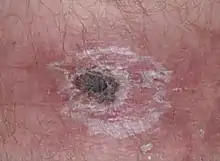
Queensland Tick Typhus is a tick-borne disease, thus making onset of the illness variable. There is an incubation period of 2 to 14 days after coming in contact with the infected tick and being bitten.[5] The clinical features of this illness include fever, headache, an eschar at the site of the tick bite, erythematous eruption[5] and satellite lymphadenopathy.[6] The Queensland tick typhus symptomatically resembles ‘Rocky mountain spotted fever,’ which is another tick-borne disease but is less severe.[6] If left untreated for longer than one to two weeks, the disease can lengthen an individual's recovery time and pose serious danger to the individual by heightening the risk of pneumonitis, encephalitis, septic shock, or even death. In some cases, even after the initial rash is cleared, the person may still experience prolonged lethargy or fatigue, which is very common in these types of rickettsial infections.[5]
Causes
Queensland Tick Typhus is caused by the bacteria Rickettsia australis from the genus Rickettsia.[7]
Tick-Life Cycle
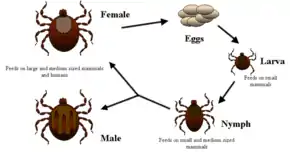
The Tick Life cycle consists of 4 stages: Egg, larva, nymph, and adult.[8] An adult female tick can lay over a thousand eggs in her lifetime.[9] Once a tick hatches from an egg, it enters the larvae stage, where it must attach to any available host and begin feeding. After they have eaten enough, they detach themselves and molt so that they can enter the larger nymph stage, which is where they must reattach to a bigger host to sustain themselves again until they are ready to detach for the last time before entering the adult stage and are able to sexually reproduce.[8] The stage when most ticks are able to transmit disease is the nymph stage. They are also the most dangerous in this stage since they are usually less than two millimeters in size and can stay virtually undetected until they are done feeding.[10]
Transmission
Queensland Tick Typhus is transmitted primarily by two types of ticks: Ixodes holocyclus and Ixodes tasmani.
Since it is transmitted to humans from animals, Queensland tick typhus would be considered a zoonosis disease.[11] After the initial attachment to a host, depending on the species and life stage of the tick, it would take anywhere from 10 minutes to 2 hours for it to begin to feed.[12] Once a tick attaches, it can stay on a host for about 12 to 18 hours and then falls off when it’s full.A tick has to be attached for a long period of time to transmit bacteria. A tick that appears flat and small probably hasn't eaten yet.[13]
Pathogenesis
After transmission from the infected tick, the bacterium Rickettsia Australias enters the body via the bloodstream. The first sign of developing this disease is the development of damage to the skin's microcirculation which results in a rash.[14] Then from here, the damage continues further into vital organs and can ultimately result in sepsis with multi-organ failure if left untreated.[15]
Diagnosis
This disease can be very challenging to diagnose due to the initial stages being so non-descriptive and relatively common.[5] Analyzing recent travel history can be vital in the beginning stages of treatment. Although the best means for diagnosing this disease is to use serological assays. Currently, indirect microimmunofluorescence assay (IFA) is considered the best assay for diagnosis. Still, it has its limitations, especially regarding people with underlying illnesses present, such as rheumatologic disorders and immune-mediated disorders, since these can lead to false positives.[15] To combat these limitations, PCR tests may also be utilized since it has the ability to look for rickettsial DNA. A sample can be taken from an eschar or blood and can be very sensitive to detection with PCR during the first few days of infection.[5]
Prevention
Unfortunately, there is currently no vaccine available for this disease, so to prevent infection of this disease, individuals should practice personal safety when venturing out into known areas with ticks. The following are based on CDC recommendation.
Before going into these areas, the following preparations should be followed for personal safety:
- Wear protective clothing that will cover your arms and legs with closed-toed shoes. Wearing long socks that you can tuck your pants into will provide an extra layer of safety, especially if you are walking in areas with tall grass for an extended period of time.[16]
- Use strong insect repellent such as DEET on your body and Permethrin on your clothes[16]
- If you are taking a pet with you, they should also be updated on all preventative medications, and a veterinarian should be consulted for any extra precautions that you can take.[16]
After you return from these areas, the following precautions should be taken to prevent ticks from entering your home:
- Check clothes and gear used for any ticks. Dry clothes should be put into a dryer on high heat for 10 minutes to effectively kill any small ticks that may not be visible to the naked eye. If the clothes are wet, then they should be washed with hot water then dried on high hear[16]
- Each individual should shower within two hours of returning home since this can help wash off any unattached ticks.[16]
- Finally, a full-body check should be performed to ensure that there is no attached tick.[16]
- If a pet was taken with you, they should also receive a bath and a full-body tick check as well to ensure that they are not carrying anything into the home.[16]
Treatment
Early treatment for Queensland Tick Typhus is relatively simple. It would include a course of oral antibiotics doxycycline or chloramphenicol.[5] If a patient cannot take the medication orally, then the antibiotics would be given intravenously by a medical professional.
Epidemiology
Queensland Tick Typhus is endemic to Australia.[17] Unfortunately, since a diagnosis of any rickettsial infection does not require compulsory reporting in Australia, it can become difficult to monitor the geographical distribution of this disease adequately and have an accurate account of the number of cases present each year.[18] Due to current epidemiology tracking estimates that the present of Queensland Tick Typhus is prevalent along the east coast line of Australia and holds the highest number of cases seen worldwide. The high number of cases seen in Australia, unlike other locations, is due to the distribution of the main carries of this disease which would be the ticks themselves, Ixodes holocyclus, and Ixodes tasmani.[18]
History
This disease arose during World War II among Australian soldiers training on the Atherton Tableland.[19] Soldiers going through basic training began to be affected by it since it is predominately found on the coast of Australia. This is how this disease earned its name since the east coast of Australia is predominately made up of the Queensland coast line.[5]
References
- Spotted fevers, Department of Medical Entomology, University of Sydney
- "Archived copy". Archived from the original on December 6, 2010. Retrieved 2011-01-09.CS1 maint: archived copy as title (link) CS1 maint: bot: original URL status unknown (link), (unattributed material, possibly unedited translation)
- Rapini, Ronald P.; Bolognia, Jean L.; Jorizzo, Joseph L. (2007). Dermatology: 2-Volume Set. St. Louis: Mosby. p. 1130. ISBN 978-1-4160-2999-1.
- "MerckMedicus : Dorland's Medical Dictionary".
- Thomas, Stephen (June 2018). "Queensland tick typhus (Rickettsia australis) in a man after hiking in rural Queensland". Australian Journal of General Practice. 47 (6).
- "Medical Definition of Queensland tick typhus". MedicineNet. Retrieved 2021-12-09.
- Bechelli, Jeremy; Vergara, Leoncio; Smalley, Claire; Buzhdygan, Tetyana P.; Bender, Sean; Zhang, William; Liu, Yan; Popov, Vsevolod L.; Wang, Jin; Garg, Nisha; Hwang, Seungmin. "Atg5 Supports Rickettsia australis Infection in Macrophages In Vitro and In Vivo". Infection and Immunity. 87 (1): e00651–18. doi:10.1128/IAI.00651-18. PMC 6300621. PMID 30297526.
- Aug 20, Erika Mansourian; Aug 20, 2015 | 2 Minutes; Minutes, 2015 | 2. "The Life Cycle of the Tick from Eggs to Ambush". American Kennel Club. Retrieved 2021-12-09.CS1 maint: numeric names: authors list (link)
- "Understanding The Tick Life Cycle". Mosquito Control | Mosquito Joe | Eliminate Mosquitos. Retrieved 2021-12-09.
- "4 Reasons Poppyseed-Sized Ticks Are More Dangerous Than Adult Ones". Healthline. 2018-05-16. Retrieved 2021-12-09.
- Stewart, Adam; Armstrong, Mark; Graves, Stephen; Hajkowicz, Krispin (2017-04-15). "Epidemiology and Characteristics of Rickettsia australis (Queensland Tick Typhus) Infection in Hospitalized Patients in North Brisbane, Australia". Tropical Medicine and Infectious Disease. 2 (2): 10. doi:10.3390/tropicalmed2020010. ISSN 2414-6366. PMC 6082070. PMID 30270868.
- CDC (2020-09-21). "How ticks spread disease | CDC". Centers for Disease Control and Prevention. Retrieved 2021-12-09.
- "Tick-Borne Illnesses". Yale Medicine. Retrieved 2021-12-09.
- Department of Health. Victoria, Australia. "Rickettsial infections". www.health.vic.gov.au. Retrieved 2021-12-09.
- Stewart, Adam; Armstrong, Mark; Graves, Stephen; Hajkowicz, Krispin (2017-07-12). "Rickettsia australis and Queensland Tick Typhus: A Rickettsial Spotted Fever Group Infection in Australia". The American Journal of Tropical Medicine and Hygiene. 97 (1): 24–29. doi:10.4269/ajtmh.16-0915. ISSN 0002-9637. PMC 5508907. PMID 28719297.
- CDC (2020-07-01). "Preventing tick bites on people | CDC". Centers for Disease Control and Prevention. Retrieved 2021-12-09.
- Wang, Jin-Mei; Hudson, Bernard J.; Watts, Matthew R.; Karagiannis, Tom; Fisher, Noel J.; Anderson, Catherine; Roffey, Paul (June 2009). "Diagnosis of Queensland Tick Typhus and African Tick Bite Fever by PCR of Lesion Swabs". Emerging Infectious Diseases. 15 (6): 963–965. doi:10.3201/eid1506.080855. ISSN 1080-6040. PMC 2727311. PMID 19523304.
- Stewart, Adam; Armstrong, Mark; Graves, Stephen; Hajkowicz, Krispin (2017-07-12). "Rickettsia australis and Queensland Tick Typhus: A Rickettsial Spotted Fever Group Infection in Australia". The American Journal of Tropical Medicine and Hygiene. 97 (1): 24–29. doi:10.4269/ajtmh.16-0915. ISSN 0002-9637. PMC 5508907. PMID 28719297.
- "Rickettsial Diseases of Military Importance: An Australian Perspective - JMVH". jmvh.org. Retrieved 2021-12-09.