Avanti!
Avanti! is a 1972 American comedy film produced and directed by Billy Wilder, and starring Jack Lemmon and Juliet Mills. The screenplay by Wilder and I. A. L. Diamond is based on Samuel A. Taylor's play, which had a short run for the 1968 Broadway.[1] The film follows a businessman attempting to deliver the body of his father from Italy. It premiered on December 17, 1972. Lemmon won the Golden Globe Award for Best Actor – Motion Picture Musical or Comedy. The film was nominated for five Golden Globe Awards, including Best Motion Picture – Musical or Comedy, Best Director, Best Actress – Motion Picture Comedy or Musical and Best Screenplay.
| Avanti! | |
|---|---|
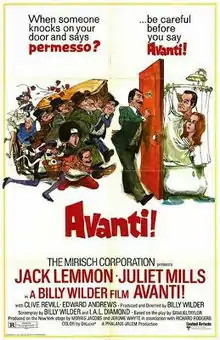 Original film poster by Sandy Kossin | |
| Directed by | Billy Wilder |
| Screenplay by | Billy Wilder I. A. L. Diamond |
| Based on | Avanti! by Samuel A. Taylor[1] |
| Produced by | Billy Wilder Alberto Grimaldi Jack Lemmon |
| Starring | Jack Lemmon Juliet Mills |
| Cinematography | Luigi Kuveiller |
| Edited by | Ralph E. Winters |
| Music by | Carlo Rustichelli |
Production companies | |
| Distributed by | United Artists |
Release date |
|
Running time | 140 minutes |
| Countries | United States Italy |
| Languages | English Italian |
| Budget | $2.75 million |
| Box office | $1,500,000 (rentals)[2] |
Plot
Ten years ago, Baltimore industrialist Wendell Armbruster, Sr. spent a month at the Grand Hotel Excelsior in the Island of Ischia on the Bay of Naples, allegedly to soak in the therapeutic mud baths in a resort island. After dying in an automobile accident, his straitlaced son Wendell Armbruster, Jr. arrives there to claim his father's body. He meets Pamela Piggott, a London traveler in the Fiat, though she knew of their parents' clandestine. Hotel manager Carlo Carlucci plans a funeral arrangement and the delivery for three days. After knowing the bodies disappear from the morgue, Pamela asks Wendell to bury them in Ischia. However, it is stolen by the family brothers of Trotta, whose vineyard was damaged by the accident. They hid it from the morgue, holding them for a two million lire ransom. Bruno, the hotel valet, plans to return for America, after being deported and has compromising photo of Wendell's father and Pamela's mother. As Wendell and Pamela swim naked, Bruno take a snapshot on them and tries to blackmail his way to American visas. However, the pregnant maid Anna, kills Bruno. Carlucci moves Pamela's property into Wendell's room to prevent the incident, and the two are thrown out. State Department Agent J.J. Blodgett, appoints Wendell to an embassy post and recovers the body. Carlucci, Wendell and Pamela buried their parents near Ischia, whilst Bruno takes his place in the repatriated coffin for America. Wendell and Blodgett leave Italy on the U.S. Navy helicopter.
Cast
- Jack Lemmon as Wendell Armbruster Jr.
- Juliet Mills as Pamela Piggott
- Clive Revill as Carlo Carlucci
- Edward Andrews as J. J. Blodgett
- Gianfranco Barra as Bruno the valet
- Franco Angrisano as Arnoldo Trotta
- Franco Acampora as Armando Trotta
- Giselda Castrini as Anna the maid
- Pippo Franco as Matarazzo
- Giacomo Rizzo as the Barman
- Antonino Faà di Bruno as the Concierge
- Yanti Somer and Janet Agren as the Nurses
- Raffaele Mottola as Passport Officer
- Harry Ray as Dr. Fleischmann
- Ty Hardin as Helicopter Pilot
- Sergio Bruni as Himself
Production
Development
Although Taylor's play had closed on Broadway after twenty-one performances in early 1968,[3] (it was profiled in the William Goldman book The Season: A Candid Look at Broadway) talent agent Charles Feldman, who previously had interested Wilder in filming The Seven Year Itch, had purchased the screen rights and offered the property to him. He began working on The Private Life of Sherlock Holmes, and it was not until the film was completed that he focused on Avanti! Though Diamond was absent, Wilder collaborated first with Julius J. Epstein and Norman Krasna, but he was unhappy with them. Diamond became free, and with the ultimately uncredited assistance of Luciano Vincenzoni, he and Wilder adapted the play. Wilder determined to create "a bittersweet love story, a little like Brief Encounter, which I always admired," he later recalled.[4] After viewing a number of Italian films, Wilder selected cinematographer Luigi Kuveiller, based on his work on Elio Petri's film A Quiet Place in the Country (1969).
Casting
Early in the writing period, Wilder showed Jack Lemmon some of the completed script, and he agreed to play Wendell Armbruster, Jr. "Knowing pretty early on Jack was going to be in our film made it more comfortable writing his dialogue," said Diamond, who preferred to tailor a screenplay to a specific actor.[4] Wilder was a fan of Mills from the television sitcom Nanny and the Professor. He disliked the series, but he enjoyed watching the show to see her, for he considered her a good actress with a lot of appeal. He contacted her and personally offered her the role of Pamela Piggott. "I loved Billy Wilder just calling me and asking me to be in his film," the actress recalled, "no lawyer or agent, his voice, not asking for an audition or a screen test."[4] Wilder told her the role required her to gain twenty-five pounds, and Mills readily agreed. She also agreed to a nude scene, although Diamond was opposed to including one in the film. "I think nudity hurts laughs", he stated. "I mean if you're watching somebody's boobs, you're not listening to the dialogue."[4]
Filming
The film is set on the island of Ischia, where some of the exterior scenes were shot, including a brief scene outside the morgue (the interior of which, as with all the interior sets, was designed by Italian production designer Ferdinando Scarfiotti), at and around the port of Ischia, where Lemmon and Mills visit the island, and on a small rock jutting out of the water just off the shore of Ischia, where nudity scenes occurred. But most of the exteriors were shot in Sorrento, including the exterior of Lemmon's hotel,[5] on Capri, notably the hilltop heliport overlooking the Tyrrhenian Sea, and along the Amalfi Coast, and interiors were filmed on Scarfiotti's sets (including the interior lobby and hotel rooms) at the Safa Palatino Studios in Rome following location shooting during the summer of 1972. Principal photography was completed on schedule and $100,000 under budget.[4] Wilder was disappointed with the film. "Maybe we went overboard with some of the comic relief, because Avanti! is not a comedy", he stated. "If this film had worked the way we wanted it to, it would have had more of the quality of The Apartment. I always feel sorry for the disappointment of the actors, and all those dear technical people who do so much, when the picture doesn't make it the way they hoped . . . I went much farther with forbidden themes than I had with Kiss Me, Stupid, but nobody cared. Audiences thought it was too long and too bland. I guess they would have liked it better if it turned out the father was having the affair with one of the bellboys at the hotel."[4]
Music
The film's musical score was composed and arranged by Carlo Rustichelli, and conducted by Gianfranco Plenizio. The score incorporates and adapted several classic Italian songs, including “Palcoscenico” (Sergio Bruni, composers E. Bonagura, Chianese), “Senza Fine” (Ornella Vanoni, composer G. Paoli), “Un’ora sola ti vorrei” (Nuccia Natali, composers P. Marchetti and U. Bertini) and "La Luna" (Milva, composers Detto Mariano and Don Backy)[6]
Critical reception
A.H. Weiler of The New York Times thought the film was "intermittently funny, charming, cute and, unfortunately, over-long." He continued, "Wilder, Lemmon and I.A.L. Diamond . . . fitfully charm us but they haven't moved forward at any great comic clip. They have warped some parts of the playwright's plot to give us a fairly reasonable flow of giggles and an occasional guffaw." He cited "a fine job turned in by Clive Revill."[7]
Roger Ebert of the Chicago Sun-Times called the film "a pleasant, civilized comedy" and added, "Avanti! isn't a laugh-a-minute kind of a movie, and it's too long by maybe half an hour. It also suffers from the problem that the audience has everything figured out several minutes before Jack Lemmon does. Still, the movie has a certain charm, some of which seeps in along with the locations, and there is in most of the many Wilder/Lemmon collaborations a cheerful insouciance, as if life is best approached with a cheerful, if puzzled, grin."[8]
Jay Cocks of Time observed, "The topical dialogue by Wilder and I.A.L. Diamond — Kissinger jokes, Billy Graham jokes, etc. — gives this passingly pleasant movie the sound of a Bob Hope TV special. But Miss Mills is fresh and winning, and there is a deft performance by Clive Revill."[9]
The British television network Channel 4 has called the film "a rare instance of the travel comedy - never an easy thing to pull off - succeeding without recourse to old racial stereotypes . . . As a love story, it's full of Wilder's biting satire . . . Taken at face value, it's simply a travel comedy about funny foreigners and love in the Mediterranean. Yet what stands out is how uncomfortable Wilder seems to be with making a sex comedy in the 1970s. Forced to take on board the aftershocks of the summer of love but saddled with an old man's attitude and an old man's cast, Wilder seems perilously out of his depth. As Lemmon and Mills strip off to reveal pale white skin and flabby fat, you can't help feeling that the resolutely misanthropic director is somewhat appalled by the realities of his characters' bedroom antics."[10]
Awards and honors
Lemmon won the Golden Globe Award for Best Actor – Motion Picture Musical or Comedy, and nominations went to Billy Wilder for Best Director, Wilder and I.A.L. Diamond for Best Screenplay, Juliet Mills for Best Actress, Clive Revill for Best Supporting Actor, and the film itself for Best Motion Picture (Musical or Comedy). However, there were no Academy Award nominations. Wilder and Diamond were nominated for the Writers Guild of America Award for Best Comedy Adapted from Another Medium but lost to Jay Presson Allen for Cabaret.
Golden Globe Awards
- Best Actor – Motion Picture Musical or Comedy: Jack Lemmon (won)
- Best Actress – Motion Picture Comedy or Musical: Juliet Mills (nominated)
- Best Supporting Actor – Motion Picture: Clive Revill (nominated)
- Best Motion Picture – Musical or Comedy (nominated)
- Best Director: Billy Wilder (nominated)
- Best Screenplay: Billy Wilder & I.A.L. Diamond (nominated)
Writers Guild of America Awards
- Best Adapted Screenplay: Billy Wilder & I.A.L. Diamond (nominated)
Home media
MGM Home Entertainment released the Region 1 DVD on July 15, 2003. It is in anamorphic widescreen format with audio tracks, and subtitles in English, French and Spanish.

References
- Avanti! on the Internet Broadway Database
- "Big Rental Films of 1973", Variety, 9 January 1974, pg 60.
- Avanti! at the Internet Broadway Database
- Chandler, Charlotte, Nobody's Perfect: Billy Wilder, A Personal Biography. New York: Simon & Schuster 2002. ISBN 0-7432-1709-8, pp. 274-277
- Movieloci - Filming locations
- "Avanti!". Quartet Records. Retrieved 2020-06-23.
- New York Times review
- Chicago Sun-Times review
- Time review
- Channel 4 review
External links
- Avanti! at the American Film Institute Catalog
- Avanti! at IMDb
- Avanti! at the TCM Movie Database
- Avanti! at Rotten Tomatoes