Magnesian Conglomerate
The Magnesian Conglomerate is a geological formation in Clifton, Bristol in England (originally Avon), Gloucestershire and southern Wales, present in Durdham Down and Cromhall Quarry. It dates back to the Rhaetian stage of the Late Triassic,[1][2] although it may be as old as the Norian stage of the Late Triassic and as young as the Hettangian stage of the Early Jurassic. This formation was first discovered in autumn 1834 and was studied in 1836 by Henry Riley and Samuel Stutchbury.[3]
| Magnesian Conglomerate Stratigraphic range: Rhaetian ~ | |
|---|---|
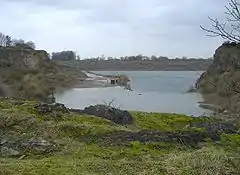 Cromhall Quarry, where an outcrop of the Magnesian Conglomerate is present | |
| Type | Geological formation, fissure fill |
| Lithology | |
| Primary | Breccia |
| Other | Limestone |
| Location | |
| Coordinates | 51.5°N 2.6°W |
| Approximate paleocoordinates | 35.9°N 0.8°E |
| Region | South West England & South Wales |
| Country |  England England |
| Extent | Bristol |
| Type section | |
| Named by | Henry Riley & Samuel Stutchbury |
| Year defined | 1836 |
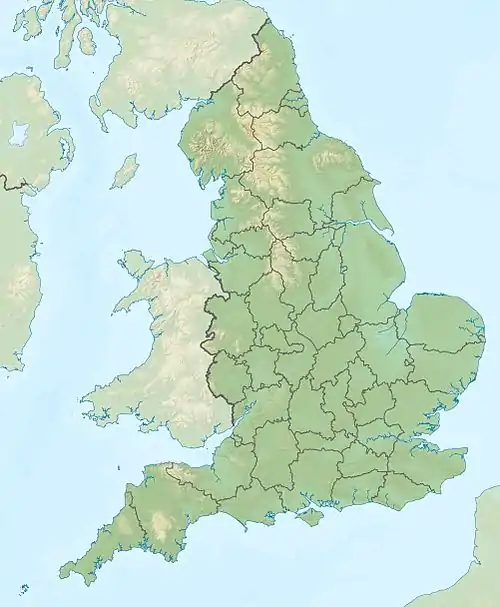  Magnesian Conglomerate (England) | |
The Avon Fissure Fill is probably the same formation as the Magnesian Conglomerate.
Vertebrate paleofauna
| Taxon | Species | Presence | Notes | Images |
|---|---|---|---|---|
| Agnosphitys[2][4] | A. cromhallensis[2][4] | Geographically present in Avon, England (now Bristol).[2] | Its remains include a left ilium (holotype) and a left maxilla, astragalus and humerus (referred specimen).[2] | 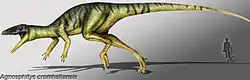 |
| Agrosaurus[5][2] | A. macgillivrayi[5][2] | Geographically present in Avon, England (now Bristol). Originally believed to have been found in Cape York Peninsula, Queensland (Australia).[2] | A tibia, a claw and some other fragments.[2] | |
| Asylosaurus[2][6] | A. yalensis[2][6] | Geographically present in Avon, England (now Bristol).[2][7] | Dorsal vertebrae, ribs, gastralia, a shoulder girdle, humeri, a partial forearm, and a hand; additional bones from the neck, tail, pelvis, arm and legs that may represent the same individual.[6][2] | 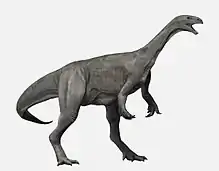 |
| Chimaeriformes[8] | Indeterminate[8] | Geographically present in Bristol.[2] | ||
| Clevosaurus[9] | C. hudsoni[9] | Geographically present in Gloucestershire.[2] | Partial cranial and post-cranial skeleton (holotype).[9] | 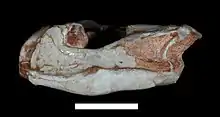 |
| Crinoidea[8] | Indeterminate[8] | Geographically present in Bristol.[2] | ||
| Diphydontosaurus[8] | D. avonensis[8] | Geographically present in Bristol.[2] | Complete to near-complete specimens.[8] | 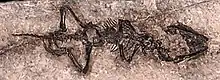 |
| Hybodontiformes?[10] | Indeterminate[10] | Geographically present in Bristol.[2] | Indeterminate remains.[10] | |
| Gyrolepis[11] | Indeterminate[11] | Geographically present in Bristol.[2] | Indeterminate remains.[11] | 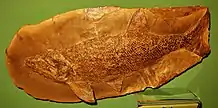 |
| Lissodus[10] | L. minimus[10] | Geographically present in Bristol.[2] | Teeth.[10] | 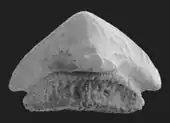 |
| Palaeosaurus[2][6] | P. cylindrodon[2][6] | Geographically present in Avon, England (now Bristol) and Bristol.[2] | Two teeth (one destroyed in 1940).[2] | 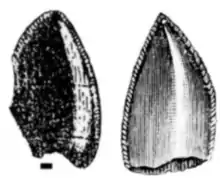 |
| Planocephalosaurus[12][13] | P. robinsonae[12][13] | Geographically present in Bristol.[2] | Skull (holotype).[12] | |
| Rhomphaiodon[10] | R. minor[10] | Geographically present in Bristol.[2] | Teeth.[10] | |
| Rileyasuchus[2][14][15] | R. bristolensis[2][14][15] | Geographically present in Bristol.[2] | Two vertebrae and a humerus.[2] | |
| Terrestrisuchus?[10][8] | Indeterminate[10][8] | Geographically present in Bristol.[2] | 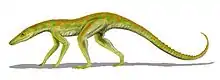 | |
| Theropoda[2] | Indeterminate[2] | Geographically present in Avon, England (now Bristol) and Bristol.[2] | Indeterminate remains.[2] Possibly similar to Pendraig milnerae.[16] | |
| Thecodontosaurus[2] | T. antiquus[2] | Geographically present in Avon, England (now Bristol) and Bristol.[2] | Partial cranial and postcranial remains (holotype is a lower jaw).[2] | 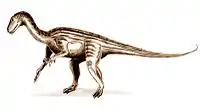 |
See also
References
- Magnesian Conglomerate in the Paleobiology Database
- Weishampel et al., 2004, pp. 521–525
- Riley & Stutchbury, 1836
- Nicholas C. Fraser, Kevin Padian, Gordon M. Walkden and A. L. M. Davis, 2002. Basal dinosauriform remains from Britain and the diagnosis of the Dinosauria. Palaeontology. 45(1), 79-95.
- H. G. Seeley. (1891). On Agrosaurus macgillivrayi (Seeley), a saurischian reptile from the N.E. coast of Australia. Quarterly Journal of the Geological Society of London 47:164-165
- Galton, Peter (2007). "Notes on the remains of archosaurian reptiles, mostly basal sauropodomorph dinosaurs, from the 1834 fissure fill (Rhaetian, Upper Triassic) at Clifton in Bristol, southwest England". Revue de Paléobiologie. 26 (2): 505–591.
- Riley H and Stutchbury S (1836a) "A description of various remains of three distinct saurian animals discovered in the autumn of 1834, in the Magnesian Conglomerate on Durdham Down, near Bristol". Geological Society of London, Proceedings, 2 (45): 397-399.
- Mussini, G.; Whiteside, D. I.; Hildebrandt, C.; Benton, M. J. (2020). "Anatomy of a Late Triassic Bristol fissure: Tytherington fissure 2". Proceedings of the Geologists' Association. 131 (1): 73–93. doi:10.1016/j.pgeola.2019.12.001.
- W. E. Swinton. (1939). A new Triassic rhynchocephalian from Gloucestershire. ''Annals and Magazine of Natural History: Zoology, Botany, and Geology'' '''4''':591-59
- ; ; , and . 2014. Vertebrates from the Late Triassic Thecodontosaurus-bearing rocks of Durdham Down, Clifton (Bristol, UK). Proceedings of the Geologists' Association 125. 317–332.
- Romano, Carlo; Koot, Martha B.; Kogan, Ilja; Brayard, Arnaud; Minikh, Alla V.; Brinkmann, Winand; Bucher, Hugo; Kriwet, Jürgen (February 2016). "Permian-Triassic Osteichthyes (bony fishes): diversity dynamics and body size evolution". Biological Reviews. 91 (1): 106–147. doi:10.1111/brv.12161. PMID 25431138. S2CID 5332637.
- Fraser, N.C. (November 1982). "A New Rhynchocephalian from the British Upper Trias" (PDF). Palaeontology. 25 (4): 709–725.
- Fraser, N.C.; Walkden, G.M. (August 1984). "The postcranial skeleton of the Upper Triassic sphenodontid Planocephalosaurus robinsonae" (PDF). Palaeontology. 27 (3): 575–595.
- von Huene, F. (1902). Überischt über die Reptilien der Trias. Geologische und Paläontologie Abhandlungen, Neu Folge 8:97-156. [German]
- Kuhn, O. (1961). Die Familien der rezenten und fossilen Amphibien und Reptilien. Meisenbach:Bamberg, 79 p.
- Spiekman SN, Ezcurra MD, Butler RJ, Fraser NC, Maidment SC (2021). "Pendraig milnerae, a new small-sized coelophysoid theropod from the Late Triassic of Wales". Royal Society Open Science. 8 (10): Article ID 210915. doi:10.1098/rsos.210915.
Bibliography
- ; ; , and . 2014. Vertebrates from the Late Triassic Thecodontosaurus-bearing rocks of Durdham Down, Clifton (Bristol, UK). Proceedings of the Geologists' Association 125. 317–332.
- ; , and . 2004. The Dinosauria, 2nd edition, 1–880. Berkeley: University of California Press. Accessed 2019-02-21. ISBN 0-520-24209-2
- , and . 1836. A description of various fossil remains of three distinct saurian animals discovered in the autumn of 1834 in the Magnesian Conglomerate on Durdham Down near Bristol. Proceedings of the Geological Society 2. 397–399.
Further reading
- Riley, H. and Stutchbury, S. 1840. A description of various fossil remains of three distinct saurian animals recently discovered in the Magnesian Conglomerate near Bristol Transactions of the Geological Society of London 5, 349–357
- W. Buckland. 1824. Reliquiæ Diluvianæ; or, Observations on the Organic Remains Contained in Caves, Fissures, and Diluvial Gravel, and on Other Geological Phenomena, Attesting the Action of an Universal Deluge. Second Edition. John Murray, London 1-303
External links
This article is issued from Wikipedia. The text is licensed under Creative Commons - Attribution - Sharealike. Additional terms may apply for the media files.