Barha Tegin
Barha Tegin (665 - 680 CE) was the first ruler of the Turk Shahis. He is only known in name from the accounts of the Muslim historian Al-Biruni and reconstructions from Chinese imperial sources, and the identification of his coinage remains conjectural.
| Barha Tegin | |
|---|---|
| Majestic Sovereign | |
 An early Turk Shahi ruler, possibly Barha Tegin,[1] with inscription "Lord Ranasrikari" (Brahmi script: 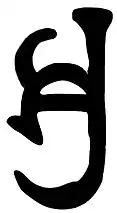     Sri Ranasrikari), with tamgha of the Turk Shahis: Sri Ranasrikari), with tamgha of the Turk Shahis:  . In this realistic portrait, he wears the double-lapel Turkic caftan, and a crown with three crescents (one hidden from view) surmounted by the head of a wolf, a Turkic symbol.[2] The Turks had a Mongoloid appearance.[3] Late 7th to early 8th century CE.[4][5][6] . In this realistic portrait, he wears the double-lapel Turkic caftan, and a crown with three crescents (one hidden from view) surmounted by the head of a wolf, a Turkic symbol.[2] The Turks had a Mongoloid appearance.[3] Late 7th to early 8th century CE.[4][5][6] | |
| Turk Shahi King | |
| Reign | 665 - 680 CE |
| Predecessor | Nezak Huns |
| Successor | Tegin Shah, Rutbil |
Chinese accounts
According to the Chinese chronicles, the previous rulers of Kapisi were twelve mostly anonymous kings, forming a "Kingil dynasty", also known as the Nezak Huns from their coinage. Only the first and last are known from Chinese sources: the last local king of Kapisi was the Nezak ruler known in the Chinese annals of 658 CE as "Hexiezhi" (Chinese: 曷撷支, reconstructed from Old Chinese: *γarγär-tśiě < *ghar-ilči), reconstructed as the Turkic "Ghar-ilchi" (*Qarγïlacï, 653-c.665 CE), 12th king of his dynasty from the founder "Xinnie" (馨孽, reconstructed from Old Chinese: *xäŋ-ŋär < *henger < Khingar/Khingal):[7][8][9]
The Turk Shahis, who were already ruling in Zabulistan, vanquished the last Nezak ruler "Hexiezhi" and took control of Kabulistan, sometime after 661 CE, last date when Hexiezhi was re-confirmed as local ruler by the Chinese court.[10] The Turk Shahi under Barha Tegin took over the region of Jibin, and moved the capital from Kapisa to Kabul.[10]
Conflicts with the Arabs
During their rule, the Turk Shahi were in constant conflict against the eastward expansion of the Abbasid Caliphate.[11]
Arab troops attacked and plundered Kabul in 665 CE, but the Turk Shahis soon managed to chase them out.[10] Barha Tegin defeated the Arabs in 665-666 CE.[10][12] The Turk Shahis were able to mount a counter-offensive and repulsed the Arabs, taking back the areas of Kabul and Zabulistan (around Ghazni), as well as the region of Arachosia as far as Kandahar.[11]
Account by al-Tabari
Al-Biruni in his Tārīkh al-Hind ("History of India") describes the rule of the Turk Shahis, followed by that of the Hindu Shahi.[13][14] He relates the story of the rise of the first ruler of the Turk Shahi, Barha Tegin:[13]
The Hindus had kings residing in Kabul, Turks who were said to be of Tibetan origin. The first of them, Barhatakin, came into the country and entered a cave in Kabul, which none could enter except by creeping on hands and knees. [...] Some days after he had entered the cave, he began to creep out of it in the presence of the people, who looked on him as a newborn baby. He wore Turkish dress, a short tunic open in front, a high hat, boots and arms. Now people honoured him as a being of miraculous origin, who had been destined to be king, and in fact he brought those countries under his sway and ruled them under the title of a Shahiya of Kabul. The rule remained among his descendants for generations, the number of which is said to be about sixty. [...] The last king of this race was Lagatarman, and his Vizir was Kallar, a Brahman.
From 680 CE, Tegin Shah, son of Barha Tegin, became the king of the Turk Shahis.[12] Barha Tegin had a second son named Rutbil, who seceded, and founded the Zunbil dynasty in Zabulistan.[16]
Coinage
._After_679_in_the_style_of_the_Nezak_Huns.jpg.webp)
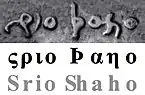
The initial coinage of the Turk Shahi initially adopted the Nezak Hun types, with the bull-head crown, but with blundered Pahlavi legends.[10] Still the minting quality was fine, and the metal of the coins was of a higher quality.[10] Some completely new types of copper coins soon appear, with a ruler in Central Asian caftan on the front, and an animal such as an elephant or a bull on the back, in place of the traditional Sasanian fire altar, together with the Turk Shahis tamgha.[10]
According to Kuwayama,[16] the coinage of Barha Tegin corresponds to the early silver coins marked "Shri Shahi" [lower-alpha 1], and to the copper coinage depicting a Turkic ruler with three-crescent crown and wolf-head with the legend "Sri Ranasrikari".[16]
References
- Kuwayama 1993s, p. 394, Coin E.254.
- Kuwayama 1993, p. 394, For a clear example of the wolf, see .
- Millward, James A. (2007). Eurasian Crossroads: A History of Xinjiang. Columbia University Press. p. 31. ISBN 978-0-231-13924-3.
- Göbl 1967, 254 ; Vondrovec type 254
- Alram, Michael; Filigenzi, Anna; Kinberger, Michaela; Nell, Daniel; Pfisterer, Matthias; Vondrovec, Klaus. "The Countenance of the other (The Coins of the Huns and Western Turks in Central Asia and India) 2012-2013 exhibit: 13. The Turk Shahis in Kabulistan". Pro.geo.univie.ac.at. Kunsthistorisches Museum Vienna. Retrieved July 16, 2017.
- See coin 3 from the same ruler in Alram, Michael; Filigenzi, Anna; Kinberger, Michaela; Nell, Daniel; Pfisterer, Matthias; Vondrovec, Klaus. "The Countenance of the other (The Coins of the Huns and Western Turks in Central Asia and India) 2012-2013 exhibit: 14. Kabulistan and Bactria at the Time of "Khorasan Tegin Shah"". Pro.geo.univie.ac.at. Kunsthistorisches Museum Vienna. Retrieved July 16, 2017.
- Rezakhani 2017, p. 164.
- Petrie, Cameron A. (28 December 2020). Resistance at the Edge of Empires: The Archaeology and History of the Bannu basin from 1000 BC to AD 1200. Oxbow Books. p. 137. ISBN 978-1-78570-304-1.
- Journal asiatique (in French). Société asiatique. 1991. pp. 276–277.
- Alram, Michael (1 February 2021). Sasanian Iran in the Context of Late Antiquity: The Bahari Lecture Series at the University of Oxford. BRILL. pp. 14–15. ISBN 978-90-04-46066-9.
- Kim, Hyun Jin (19 November 2015). The Huns. Routledge. pp. 58–59. ISBN 978-1-317-34090-4.
- Vondrovec, Klaus. Coins, Art and Chronology II - The First Millennium C.E. in the Indo-Iranian Borderlands (Coinage of the Nezak). p. 183.
- Kuwayama, Shoshin (1976). "The Turki Śāhis and Relevant Brahmanical Sculptures in Afghanistan". East and West. 26 (3/4): 403. ISSN 0012-8376. JSTOR 29756318.
- "The Countenance of the other (The Coins of the Huns and Western Turks in Central Asia and India) 2012-2013 exhibit: Kabulistan and Bactria at the time of "Khorasan Tegin Shah" Digitaler Ausstellungskatalog". pro.geo.univie.ac.at. Kunsthistorisches Museum Vienna.
- Kuwayama, Shoshin (1976). "The Turki Śāhis and Relevant Brahmanical Sculptures in Afghanistan". East and West. 26 (3/4): 403. ISSN 0012-8376. JSTOR 29756318.
- Kumayama 1993s, pp. 395–397.
- Alram 2014, p. 282.
- Kumayama 1993s, pp. 395–397, type E.236.
Notes
- Vondrovec Types E.236,237,238,239,252-253,257,258
Sources
- Alram, Michael; Filigenzi, Anna; Kinberger, Michaela; Nell, Daniel; Pfisterer, Matthias; Vondrovec, Klaus (2012–2013). "The Countenance of the other (The Coins of the Huns and Western Turks in Central Asia and India) 2012-2013 exhibit". Vienna, Austria: Kunsthistorisches Museum, Coin Cabinet. Retrieved 1 November 2020.
- Alram, Michael (2014). "From the Sasanians to the Huns New Numismatic Evidence from the Hindu Kush". The Numismatic Chronicle. 174: 261–291. JSTOR 44710198. (registration required)
- Grenet, Frantz (2002). "Nēzak". Encyclopædia Iranica, online edition.
- Kuwayama, Shōshin (桑山正進) (1976s). "The Turki Śāhis and Relevant Brahmanical Sculptures in Afghanistan". East and West. 26 (3/4): 375-407. ISSN 0012-8376. JSTOR 29756318.
- Kuwayama, Shōshin (桑山正進) (1993s). "6-8 世紀 Kapisi-Kabul-Zabul の貨幣と發行者" (PDF). 東方學報 (in Japanese). 65: 371-430.
- Martin, Dan (2011). "Greek and Islamic Medicines' Historical Contact with Tibet". In Akasoy, Anna; Burnett, Charles; Yoeli-Tlalim, Ronit (eds.). Islam and Tibet: Interactions Along the Musk Routes. Farnham, Surrey: Ashgate Publishing. pp. 117–144. ISBN 978-0-7546-6956-2.
- Payne, Richard (2016). "The Making of Turan: The Fall and Transformation of the Iranian East in Late Antiquity". Journal of Late Antiquity. Johns Hopkins University Press. 9: 4–41. doi:10.1353/jla.2016.0011.
- Rezakhani, Khodadad (2017). ReOrienting the Sasanians: East Iran in Late Antiquity. Edinburgh University Press. pp. 1–256. ISBN 9781474400305.
- Martin, Dan (2011). "Greek and Islamic Medicines' Historical Contact with Tibet". In Akasoy, Anna; Burnett, Charles; Yoeli-Tlalim, Ronit (eds.). Islam and Tibet: Interactions Along the Musk Routes. Farnham, Surrey: Ashgate Publishing. pp. 117–144. ISBN 978-0-7546-6956-2.