Batería de la de la Reina
In the esplanade that today occupies the Antonio Maceo park, directly in front in front of the La Casa de Beneficencia y Maternidad de La Habana orphanage and the Hospital de San Lázaro, opposite Marcos Lucio's Torreón de San Lázaro and next to the Caleta de San Lazaro, built between 1856 y 1861, was a colonial military defense fortress that had accommodations for a garrison of 250 men and 44 pieces of artillery.[1] The bateria-fortification consisted of a circular building with a battery facing the sea of 44 pieces that crossed its fires with the “Santa Clara Battery” - where the Hotel Hotel Nacional de Cuba is currently located - and the “Castillo de la Punta”. It also had accommodation for a garrison of 250 men and a relief house.[1]
| Batería de la de la Reina | |
|---|---|
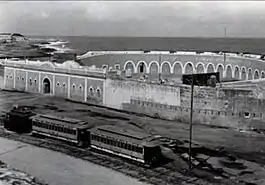 Batería de la de la Reina | |
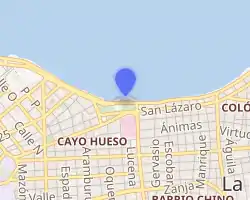
| |
| General information | |
| Status | Demolished |
| Type | Defense |
| Architectural style | Fortress |
| Location | Next to Caleta de San Lazaro |
| Town or city | Havana |
| Country | Cuba |
| Coordinates | 23.141832°N 82.371513°W |
| Groundbreaking | ca. 1856 |
| Estimated completion | 1661 |
| Destroyed | ca. 1900 |
| Dimensions | |
| Diameter | 100 metres (330 ft) |
| Technical details | |
| Structural system | Load bearing |
| Material | Brick |
| Floor count | 1 |
| Known for | 44 pieces of artillery |
Demolition


Taking into account the dates, it is possible that its demolition was linked to the building of the Malecon (1901), because the presence of this fortification hindered its passage through this area. The rubble from this demolition was used to fill the Caleta de San Lazaro.[1] In 1898 this battery was the main communications center on the Sotavento seafront, for which reason it had been equipped with rangefinders, telegraphs, telephones, and numerous means of observation. At the end of the Spanish-Cuban-American war, the fortification lost its function, at the beginning of the 20th century, its dismantling and later its demolition began.[1] EcuRed writes: "The historical richness of the territory is incalculable through the times, dates from the sixteenth century, when the French corsair Jacques de Sores, on July 10, 1555, penetrated through the cove of Juan Guillen (later Caleta de San Lazaro) between the Torreón de San Lázaro and the Parque Maceo, who took, looted and burned Villa de San Cristobal de La Habana, which was defended by Mayor Juan de Lobera. The Cabildo of September 26, 1664, determined to build a fortress next to the cove, one league from the Villa. He himself served as a lookout by placing a lit torch to warn of the presence of an enemy ship. Today, this monument represents the Municipality of Centro Habana. On July 26, 1912, the Cayo Hueso part of Barrio de San Lázaro was officially recognized as a neighborhood."[2]
Gallery
 Map of the Caleta de San Lazaro showing the Batería de la Reina.
 Batería de la de la Reina.4 demolition.
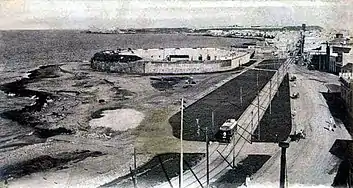 Batería de la de la Reina
 Batería de la de la Reina.2 demolition.
 Batería de la de la Reina.3 demolition.
See also
References
- "MALECON – BATERIA DE LA REINA". Retrieved 2021-11-09.
- "Cayo Hueso (Centro Habana)". Retrieved 2018-11-03.
 |
Wikimedia Commons has media related to Architecture of Havana. |
 |
Wikisource has original text related to this article: |