Battle of Cove Mountain
The Battle of Cove Mountain occurred in Wythe County, Virginia, on May 10, 1864, during the American Civil War. A small Union division commanded by Brigadier General William W. Averell was prevented from moving to Wytheville by Confederate forces commanded by Brigadier General John Hunt Morgan and a detachment of a brigade of cavalry belonging to William E. "Grumble" Jones. Morgan stopped Averell at Cove Gap, which is adjacent to Crockett's Cove and Cove Mountain. Averell and a larger force commanded by Brigadier General George Crook were part of a Union plan to damage the Virginia and Tennessee Railroad. The railroad was used by the Confederacy to transport soldiers and supplies, and served important lead and salt mines in southwestern Virginia. It was part of a rail network that connected the Confederate capital in Richmond, Virginia, to Tennessee, and had telegraph wires along its line.
| Battle of Cove Mountain | |||||||
|---|---|---|---|---|---|---|---|
| Part of American Civil War | |||||||
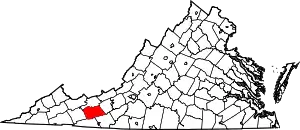 Wythe County in Virginia | |||||||
| |||||||
| Belligerents | |||||||
.svg.png.webp) United States (Union) United States (Union) |
.svg.png.webp) Confederate States Confederate States | ||||||
| Commanders and leaders | |||||||
|
William W. Averell |
John Hunt Morgan | ||||||
| Units involved | |||||||
| |||||||
| Strength | |||||||
| 2,019 | 4,000 | ||||||
| Casualties and losses | |||||||
| 114 | 50 | ||||||
Although the battle ended in a standoff, Union forces had several narrow escapes and General Averell was grazed by a bullet. Averell's cavalry escaped during the night using a difficult route through the mountains, and deceptions were used to make the Confederates believe the Union soldiers were still near the cove and being reinforced. On the next day, Averell reached a Virginia and Tennessee Railroad bridge over the New River that had already been destroyed by Crook. He escaped enemy pursuers by fording a rising river that became too dangerous for the Confederate troops to cross. Eventually, he reunited with Crook's force in Union, West Virginia after destroying some railroad line near Christiansburg, Virginia.
The National Park Service lists the result of this battle as "indecisive". Confederate accounts call the battle a victory for Morgan. Confederate troops prevented Averell from destroying rail line at Wytheville and a nearby lead mine used to make bullets for the Confederate Army. The same Confederate troops also prevented Averell from attacking an important Confederate salt mine. However, because Averell occupied this Confederate force, most of the forces commanded by Jones and Morgan could not assist at the Battle of Cloyd's Mountain where Crook's 6,000-man legion had a significant victory. Crook was able to complete his objective to destroy a large railroad bridge across the New River, and railroad infrastructure important to the Confederacy was damaged.
Background and plan
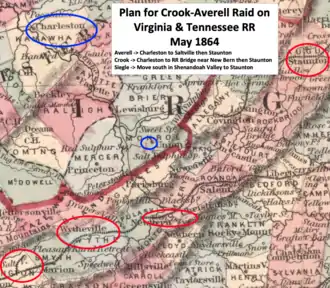
During March 1864, Lieutenant General Ulysses S. Grant became commander of all Union armed forces.[1] Grant's strategy was to attack the strongest Confederate Army, Robert E. Lee's Army of Northern Virginia, from multiple fronts. One target was the Virginia and Tennessee Railroad, which helped connect the Confederate capital of Richmond with Tennessee.[2] The railroad was used to carry supplies and troops, and served important lead and salt mines.[3] Brigadier General George Crook was assigned the task of attacking the railroad.[4] His force was three brigades of infantry and dismounted cavalry, plus two batteries, that totaled to 6,155 men. Four hundred more men were added shortly thereafter. Crook sent a smaller force, commanded by Brigadier General William W. Averell, to attack a salt mine and railroad line further west from Crook.[4] A Union Army commanded by Major General Franz Sigel in the Shenandoah Valley would move south to Staunton, Virginia, where it would threaten the Virginia Central Railroad—and all three commands would meet at Staunton.[5]
Averell's target salt mine was located in Saltville, Virginia. During 1864, this salt mine produced an estimated two thirds of the salt used by the Confederacy.[6][Note 1] Saltville is located along the border of Washington and Smyth counties in southeastern Virginia, and is served by a spur line from the Virginia and Tennessee Railroad. Further east along the rail line, Wytheville, the regional Confederate Army headquarters at the Dublin Depot near New Bern, and a huge railroad bridge across the New River were Union targets.[7] Wytheville had a strategic significance because of a nearby lead mine that was the source for much of the lead used by the Confederacy to produce bullets for its army.[8]
Opposing forces
Union
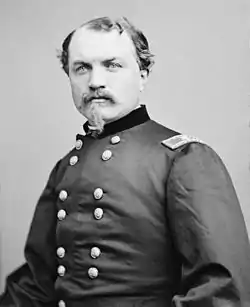
Averell departed from a camp near Charleston, West Virginia, in early May with two brigades totaling to 2,019 officers and men.[9] His brigade commanders were Brigadier General Alfred N. Duffié and Colonel James M. Schoonmaker. Duffié's brigade consisted of the 2nd West Virginia Cavalry Regiment, the 34th Ohio Mounted Infantry Regiment, and a detachment of the 3rd West Virginia Cavalry Regiment commanded by Major Seymour B. Conger.[10] Colonel William H. Powell was the commander of the 2nd West Virginia, while Major John W. Shaw commanded the 34th Ohio. Schoonmaker's brigade consisted of the 1st West Virginia Cavalry Regiment, commanded by Colonel Henry Capehart; and the 14th Pennsylvania Cavalry Regiment, commanded by Major John M. Daily.[9][11] Union cavalry typically had Colt's navy revolvers, sabers, and single-shot carbines.[12] The 1st West Virginia Cavalry was armed with Spencer repeating rifles (seven shot) during the spring of 1863.[13] The 14th Pennsylvania Cavalry was also armed with seven-shot carbines since December 1863, but the 2nd West Virginia Cavalry did not receive repeating rifles until September 1864.[14][15]
Confederate
.jpg.webp)
The Confederate Army knew that Union forces were on the move as early as May 2, and moved Brigadier General John Hunt Morgan with two brigades to Saltville from East Tennessee.[16] His First Brigade was commanded by Colonel Henry Giltner, and consisted of the 4th Kentucky Cavalry Regiment, the 10th Kentucky Cavalry Regiment, and the 10th Kentucky Mounted Rifles. The Second Brigade was commanded by Lieutenant Colonel Robert A. Alston, and consisted of the 1st and 2nd Kentucky Cavalry battalions, and the 6th and 7th Confederate battalions.[17][Note 2] A few days later, Morgan used the railroad to send his cavalry men who did not have mounts, totaling to about 400, east to the Dublin Depot to assist Brigadier General Albert G. Jenkins against Crook. Morgan focused the remaining portion of his command on Averell. Most of Morgan's men were from Kentucky or Tennessee, but Giltner's brigade was familiar with the area because it had spent two years serving there previously.[19]
Confederate troops that were not part of Morgan's command also fought at Cove Mountain, although there is a lack of clarity for all the participants. A force known as Jones' Brigade arrived before Morgan.[19] The brigade was commanded by Colonel George B. Crittenden, and included regiments commanded by Colonel Henry Bowen (22nd Virginia Cavalry Regiment) and Colonel A.F. Cook (8th Virginia Cavalry Regiment).[20] The 16th Virginia Cavalry Regiment, commanded by Lieutenant Colonel William L. Graham, also arrived in Wytheville to assist Morgan.[21][22] Although some sources credit Brigadier General William E. "Grumble" Jones with being at the battle, two major newspaper accounts do not mention him, and a report by Colonel John McCausland mentions Morgan but not Jones.[23][24][Note 3]
Saltville to Wytheville
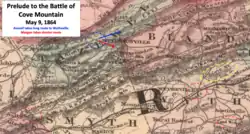
Averell departed from near the Logan County courthouse on May 5, 1864. His men had rations for four days, while the horses had considerably less. They moved south to Oceana in Wyoming County on May 6, and arrived at Abb's Valley in Virginia's Tazewell County on May 7. Here, they skirmished with enemy scouts and captured one company from the 8th Virginia Cavalry. On the next day, they moved to Jeffersonville (a.k.a. Tazewell Courthouse) in Tazewell County—skirmishing with Confederate troops from Kentucky on the way.[9] From deserters and prisoners, Averell learned that the Confederate Army was aware of his Saltville objective and the size of his force. He also learned that 4,500 Confederate troops led by John Hunt Morgan and William "Grumble" Jones were waiting for him at Saltville. Given that information, Averell decided to attack the railroad further east at Wytheville, occupying Morgan and Jones so they could not intercept Crook.[25] As Averell moved east, Morgan began following him.[26]
At the junction of the Jeffersonville, Crab Orchard, and Wytheville roads, Averell continued moving east in the mountains toward Crab Orchard—a rugged road and a longer route to Wytheville.[26] If Morgan had followed Averell, the terrain could have been used to Averell's advantage to hold off Morgan while a detachment attacked Wytheville. However, Morgan was aware of the dangerous terrain, and took the southeast direct route to Wytheville (through Burke's Garden). He arrived at Wytheville ahead of his command, and ordered Confederate troops already there to move north and guard the gap passing through Cove Mountain—the gap necessary for Averell to pass through to get to Wytheville.[Note 4] The people of Wytheville were relieved to see Morgan, as they remembered the destruction of the town in 1863 in the Wytheville Raid. The town had an old 6-pounder cannon and some powder, but no ammunition. A blacksmith cut up horseshoes and other pieces of iron that could be used as canister.[21]
Battle
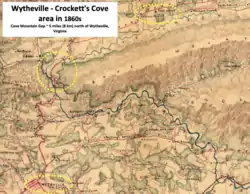
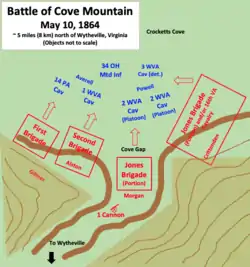
When Averell arrived at the small mountain gap near Crockett's Cove, it was already occupied by the Confederate detachment sent from Wytheville by Morgan—and Morgan's men were moving there. Morgan's force was said to be about 4,000, although that could be an exaggeration.[28] [Note 5] Schoonmaker's 14th Pennsylvania and 1st West Virginia cavalries opened the battle by driving back the advanced guard of the Confederate force that occupied the gap. When the Union cavalry got too close to the gap, dismounted Confederate cavalry on both sides of the gap drove them back.[21] The 2nd West Virginia Cavalry waited nearby with sabers drawn, intending to take the gap in what their Colonel Powell regarded as a suicidal charge.[31] While the regiment was waiting, a member of the regiment's Company H climbed up a tree and observed the Confederate position being reinforced. This was reported to Duffié, and the charge was cancelled. Although not known by Averell at the time, reinforcements (including Morgan's brigades) were positioning on both sides of the gap, and a cannon masked by brush was positioned in the road. To lure the Confederates out into the cove, Averell's command fell back and formed a line of battle. A large Confederate force came out of the gap, and more fighting began.[31]
Morgan's command had reached Wytheville around 3:00 pm.[20] Colonel Giltner's First Brigade and Lieutenant Colonel R.A. Alston's Second Brigade, with Giltner in overall command, were deployed in the woods of the mountain in an effort to circle around to Averell's right flank.[32] After getting into position on Morgan's left side of the pass, the two brigades were dismounted, formed in line of battle, and attacked with a shout. Morgan commanded Jones' Brigade in person, in front of Averell's left, and made use of the Wytheville cannon. A third Confederate force attacked Averell's left flank.[32] A soldier from the 1st West Virginia Cavalry, which faced Morgan's First and Second Brigades, said the Confederate battle cry was "We are Morgan's men and will give you hell".[33]
Averell's forehead was grazed by a bullet early in the fighting—a slight wound that bled profusely.[31] He was forced to temporarily relinquish command, and with Duffié nowhere to be found, field command fell to Colonel Powell.[34] Powell divided the 2nd West Virginia Cavalry into platoons, and gradually moved it back with the precision of what Averell called a "dress parade that continued without disorder under heavy fire".[31][35] Averell later credited the 2nd West Virginia Cavalry with saving the left of the division.[36] Although the 2nd West Virginia was nearly surrounded three or four times during the four hours of fighting, the only break in the Union line was made by the 14th Pennsylvania Cavalry.[37][31] The 34th Ohio Mounted Infantry quickly filled the gap, and the 14th Pennsylvania reformed and resumed their position.[31] Averell's force was pushed back a considerable distance, and fighting ended at dusk. Averell's report listed losses of 114 officers and men.[38] Most estimates of Confederate losses range from 40 to 60 men.[Note 6] One Union soldier, who said Averell's force was almost surrounded, believed that the Confederates had more casualties than Averell's men because the Confederates did all the charging while the Union soldiers were on defense.[33]
Withdrawal

A private in the Union cavalry believed that if the fighting had not stopped, half of the force would have been captured.[33] Morgan believed that he could have captured Averell's entire force if he had two more hours of daylight.[25] Averell used an elaborate deception to save his command. First, he told a staff officer that if they could hold Morgan's men until dark, Crook's force would arrive. This was said in front of a local woman from the pro-Confederate community. Second, he had an officer notify him that Crook arrived. Third, he ordered his men to give three cheers for General Crook.[33] It is unknown if the deception or darkness caused the fighting to stop, but Morgan's men returned to the gap.[29] Averell had his men build one fire for every two men—about one thousand fires—to make it appear that Crook had arrived.[33]
Averell's withdrawal was during the night. The severely wounded were left behind at Crockett's Cove Presbyterian Church.[40] The men had to ascend and descend a mountain that did not have a good road, leading their horses while on foot.[41] By dawn, the command was at the bottom of the mountain with 30 miles (48 km) of difficult terrain between them and the cove.[42] Here, they rested for half a day before continuing to the Dublin Rail Depot.[29] They reached the Dublin Depot on the evening of May 11, and spent the night in soaking rain.[43] By then Crook had destroyed the large railroad bridge over the New River, and the river itself was rising rapidly because of recent rains. The river grew to about one third of a mile (0.54 km) wide and rising, with a rapid current and rocky riverbed. They forded the New River about three miles (4.8 km) west of Christiansburg, and several men and horses drowned.[29] After the command arrived at Christiansburg, the 2nd West Virginia Cavalry was sent back to guard the ford, and witnessed the forces of Morgan and Jones unable to cross the still–rising river.[29] At Christiansburg, the command found a small Confederate force that they drove away with drawn sabers.[44] They also captured two 3-inch guns.[38]
From Christiansburg, Averell was able to communicate with Crook, and was ordered to destroy rail line eastward. The rail depot and four miles (6.4 km) of line were destroyed.[45] Averell's after-action report said that ammunition was nearly exhausted, so a return to the safety of West Virginia was then started.[38] Some of the ammunition was rendered useless from the river and rain.[46] Omitted from his report was that by a ruse on the telegraph, he learned that Confederate troops were coming from the east by rail—and he thought it was in his best interest to join Crook's column that was in Blacksburg, although Crook did not wait for Averell.[45]
On the return trip, troops under the command of Brigadier General John D. Imboden, Colonel William E. "Mudwall" Jackson, and Colonel William H. French pursued the Union cavalry.[47] They were unable to catch Averell at Blacksburg, so they tried again further north. On the morning of May 13, Jackson tried to intercept Averell at Salt Pond Mountain and Gap Mountain.[48] Rain made the terrain slippery, and mountain streams became dangerous. Imboden's report said that at Gap Mountain, Jackson "intercepted Averell's command, and scattered it in the mountains. Owing to the darkness and the swollen streams no further pursuit was made with the infantry...." A soldier from the 2nd West Virginia Cavalry wrote that they were fired upon by Confederate artillery near Gap Mountain, so two companies of skirmishers occupied the enemy while the column crossed the mountain dismounted on a narrow and dangerous path. The mountain was steep enough that the men used one hand to lead their horses by the bit and their other hand held the tail of the horse in front of them. The command continued north using "narrow and unfrequented paths and roads".[46] On May 15, Averell met Crook near Union, West Virginia.[46]
Aftermath
The Battle of Cove Mountain is declared "indecisive" by the National Park Service.[49] Averell praised his command, saying it "attacked and held a superior force of the enemy near Wytheville on the 10th instant, thereby enabling another column to accomplish its purpose without the opposition of overwhelming numbers". The New York Times wrote that the "cavalry raid of that dashing and gallant officer, Gen. Averill [sic]...was undoubtedly one of the most hazardous and brilliant of the war. It was, too, successful." This contrasts with a Confederate newspaper in Richmond, which called the battle "a very important victory" for the Confederacy. A report by Colonel McCausland that "Averell had been defeated by Morgan near Wytheville".[24] Another source says "Morgan caught Averell at Crockett's Cove near Wytheville and drubbed him severely".[8]
Numerous changes happened to the leaders of the battle during the remaining portion of the year. Before and after the battle, Duffié and Averell did not get along. Duffié moved to another division as the replacement for General Julius Stahel, who was wounded on June 5 at the Battle of Piedmont.[50] Duffié was captured in October, and Major General Philip Sheridan requested his dismissal from the service.[51] Schoonmaker was awarded the Medal of Honor for actions on September 19 in the Third Battle of Winchester.[52] Powell became a brigade commander and on September 23 replaced Averell as division commander.[53] On the Confederate side, Jones was killed in Virginia on June 5 in the Battle of Piedmont.[54] Graham was captured at the Battle of Moorefield in August.[55] Morgan was killed in a surprise attack in eastern Tennessee on September 4.[56]
Grant's plan to put pressure on Lee's Army of Northern Virginia was only partially successful. Crook had a major victory at the Battle of Cloyd's Mountain, and completed an objective of destroying the large New River bridge of the Virginia and Tennessee Railroad. However, Averell was unable to damage the salt mines or lead mines, and Sigel was defeated on May 15 at the Battle of New Market. Thus, the three forces did not meet at Staunton.[50] Although there are various interpretations of the outcome of the Battle of Cove Mountain, one strategic result cannot be disputed—the Wythe County lead mines continued to supply ammunition for the Confederate Army for another seven months.[30] During December, Major General George Stoneman conducted a raid eastward from Tennessee that severely damaged Virginia and Tennessee Railroad infrastructure in western Virginia. The Wytheville County lead mines were damaged on December 17, and the Saltville saltworks severely damaged after the Second Battle of Saltville on December 20.[8][6]
Notes
Footnotes
- Salt, an essential part of the diet for humans and livestock, was also used for preserving meat during the American Civil War.[6]
- A second source describes this brigade as two battalions, commanded by Captain Jacob Cassell and Captain John D. Kirkpatrick, combined into a brigade commanded by Lieutenant Colonel Alston.[18]
- A New York Times article published in June after the battle mentions Morgan but not Jones.[11] A Richmond Enquirer article published shortly after the battle mentions Morgan, and Crittenden commanding "the forces of Colonel Bowen and Lieutenant Colonel Cook".[20]
- Sources disagree on the Confederate force first ordered into the gap. Some sources say it was Colonel Graham and the 16th Virginia Cavalry.[21][22] Other sources say it was Colonel Crittenden and a portion of Jones' Brigade.[27][20]
- A soldier from the 2nd West Virginia Cavalry described the battle location as "Cove Gap, of Grassy Lick".[29] The Richmond Enquirer called the location "Crockett's Gap".[20] Author Whisonant calls the fight "The Battle of the Cove".[30]
- Whisonant says Confederate casualties were 40.[30] Johnson & Buel say "fifty or sixty".[19] Duke says "about fifty".[39]
Citations
- "Ulysses S. Grant". American Battlefield Trust – Civil War Trust. Retrieved 2019-10-25.
- Whisonant 2015, p. 80
- Whisonant 2015, p. 157
- Scott 1891, pp. 9–13
- Starr 2007, pp. 208–209
- "Geology and the Civil War in Southwest Virginia: The Smyth County Salt Works" (PDF). Commonwealth of Virginia, Division of Mineral Resources (August 1996). Retrieved 2021-05-30.
- "Geology and the Civil War in Southwest Virginia: Union Raiders in the New River Valley, May 1864" (PDF). Commonwealth of Virginia, Division of Mineral Resources (November 1997). Retrieved 2021-05-30.
- "Geology and the Civil War in Southwest Virginia: The Wythe County Mines" (PDF). Commonwealth of Virginia, Division of Mineral Resources (May 1996). Retrieved 2015-03-14.
- Scott 1891, p. 41
- Scott 1891, pp. 41–42
- Barnes, D.M. (1864-06-10). "Gen. Averill'S Operations; Spirited Account of the Great Southern Virginia Raid. Its Object—Destruction of Railroads, Bridges and Medical Stores—A Gallant and Obstinate Fight—Gen. Averill Wounded—Incidents". New York Times. Retrieved 2021-06-02.
- "Small Arms of the Civil War". American Battlefield Trust. Retrieved 2021-06-03.
- Lang 1895, p. 164
- Slease & Gancas 1999, p. 114
- Sutton 2001, p. 160
- Duncan 1998, p. 77
- Colonel Ben E. Caudill Camp No. 1629, Sons of Confederate Veterans 2013, p. 46
- Duke 1867, p. 515
- Johnson & Buel 1888, p. 423
- "From Gen. Morgan's Command (page 2 top middle columns)". Richmond Enquirer, Semi-Weekly Edition (from Chronicling America: Historic American Newspapers. Lib. of Congress). 1864-05-20.
- Duncan 1998, p. 80
- Pendleton 1920, p. 626
- Ballard 2017, p. 203
- Scott 1891, p. 48
- Starr 2007, p. 218
- Duncan 1998, p. 79
- Duke 1867, p. 516
- Whisonant 2015, p. 81
- Sutton 2001, p. 116
- Whisonant 2015, p. 82
- Sutton 2001, p. 115
- Colonel Ben E. Caudill Camp No. 1629, Sons of Confederate Veterans 2013, p. 47
- Heaton 2014, p. 69
- Lang 1895, p. 189
- Scott 1891, p. 43
- Scott 1891, p. 44
- Duncan 1998, p. 81
- Scott 1891, p. 42
- Duke 1867, p. 517
- "Crockett's Cove Presbyterian Church". Virginia Department of Historic Resources. Retrieved 2021-06-11.
- Heaton 2014, p. 70
- Slease & Gancas 1999, p. 130
- Duncan 1998, p. 82
- Slease & Gancas 1999, p. 131
- Duncan 1998, p. 83
- Sutton 2001, p. 117
- Scott 1891, p. 45
- Scott 1891, p. 65
- "Battle Detail – Cove Mountain". National Park Service, U.S. Department of the Interior. Retrieved 2021-06-08.
- Starr 2007, p. 220
- Ainsworth & Kirkley 1902, p. 35
- "James M. Schoonmaker". Congressional Medal of Honor Society. Retrieved 2021-03-07.
- Sutton 2001, p. 161
- "Battle of Piedmont, June 5, 1864". National Park Service, U.S. Department of the Interior. Retrieved 2021-06-05.
- "Death of Colonel William Leander Graham". Tazewell Republican. 1908-04-23. p. 1.
- Duke 1867, p. 539
References
- Ainsworth, Fred C.; Kirkley, Joseph W., eds. (1902). The War of the Rebellion: A Compilation of the Official Records of the Union and Confederate Armies Series I Volume XLIII Part 1. Washington, DC: Government Printing Office. ISBN 978-0-918678-07-2. OCLC 427057.
- Ballard, James Buchanan (2017). William Edmondson "Grumble" Jones: the Life of a Cantankerous Confederate. Jefferson, North Carolina: McFarland and Company. ISBN 978-1-47662-970-4. OCLC 1004770896.
- Colonel Ben E. Caudill Camp No. 1629, Sons of Confederate Veterans (2013). 13th Kentucky Cavalry, CSA: "Caudill's Army". Whitesburg, Kentucky: Col. Ben E. Caudill Camp No. 1629, SCV. ISBN 978-0-57813-867-1. OCLC 960931851.
- Duke, Basil W. (1867). History of Morgan's Cavalry. Cincinnati, Ohio: Miami Printing and Publishing Company. ISBN 9780722281482. OCLC 1405823. Retrieved 2021-06-04.
- Duncan, Richard R. (1998). Lee's Endangered Left: The Civil War in Western Virginia, Spring of 1864. Baton Rouge, Louisiana: Louisiana State University Press. OCLC 940541407.
- Heaton, Lynda Rees (2014). War Experiences of Samuel Wheeler, Private in the First West Virginia Cavalry Regiment, Part II, West Virginia History, Vol. 8, No. 1, pp. 65–88. Morgantown, West Virginia: West Virginia University Press. JSTOR 43264984. Retrieved 2021-05-29.
- Johnson, Robert Underwood; Buel, Clarence Clough, eds. (1888). Battles and Leaders of the Civil War – Volume IV. New York, New York: The Century Company. OCLC 2048818. Retrieved 2021-05-30.
- Lang, Joseph J. (1895). Loyal West Virginia from 1861 to 1865: With an Introductory Chapter on the Status of Virginia for Thirty Years Prior to the War. Baltimore, Maryland: Deutsch Publishing Co. OCLC 779093. Retrieved 2021-06-07.
- Pendleton, William C., ed. (1920). History of Tazewell County and Southwest Virginia : 1748–1920. Richmond, Virginia: W.C. Hill Printing Company. ISBN 9780722266342. OCLC 1029863310. Retrieved 2021-05-29.
- Scott, Robert N., ed. (1891). The War of the Rebellion: a Compilation of the Official Records of the Union and Confederate Armies Series I Volume XXXVII Part I. Washington, DC: Government Printing Office. OCLC 318422190. Retrieved 2021-05-28.
- Slease, William Davis; Gancas, Ron (1999) [1915]. The Fourteenth Pennsylvania Cavalry in the Civil War: A History of the Fourteenth Pennsylvania Volunteer Cavalry from its Organization until the Close of the Civil War, 1861–1865. Pittsburgh, Pennsylvania: Soldiers' & Sailors' Memorial Hall and Military Museum. ISBN 978-0-96449-529-6. OCLC 44503009.
- Starr, Stephen Z. (2007). The Union Cavalry in the Civil War – Vol. 2 – The War in the East, from Gettysburg to Appomattox. Baton Rouge, Louisiana: Louisiana State University Press. OCLC 4492585.
- Sutton, Joseph J. (2001) [1892]. History of the Second Regiment, West Virginia Cavalry Volunteers, During the War of the Rebellion. Huntington, West Virginia: Blue Acorn Press. ISBN 978-0-9628866-5-2. OCLC 263148491.
- Whisonant, Robert C. (2015). Arming the Confederacy : How Virginia's Minerals Forged the Rebel War Machine. Cham, Switzerland: Springer International Publishing. ISBN 978-3-319-14508-2. OCLC 903929889.
External links
 |
Wikimedia Commons has media related to Battle of Cove Mountain. |