Battle of Haydaran
The Battle of Haydaran (Arabic: معركة حيدران) or the Battle of Jabal Haydaran (Arabic: معركة جبل حيدران) was an armed conflict which took place on 14 April 1052 between the Arab tribes of Banu Hilal and the Zirid dynasty in modern-day South-East Tunisia, it was part of the Hilalian invasion of Ifriqiya.[7][2][8]
| Battle of Haydaran | |||||||
|---|---|---|---|---|---|---|---|
| Part of the Hilalian invasion of Ifriqiya | |||||||
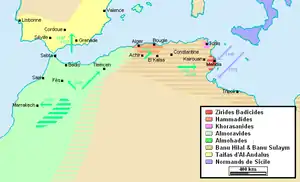 The Maghreb following the Hilalian invasion | |||||||
| |||||||
| Belligerents | |||||||
| Banu Hilal Arabs | Zirid dynasty | ||||||
| Commanders and leaders | |||||||
| Unknown | Al-Mu'izz ibn Badis | ||||||
| Strength | |||||||
| 3,000 Arab cavalry[4][5] | 30,000 Sanhaja cavalry[6] | ||||||
| Casualties and losses | |||||||
| Unknown | Unknown | ||||||
Background
Since the Zirids declared independence from the Fatimids and recognised the Abbasids as caliphs in 972, relations have been strained between the two.[9] As retaliation, the Fatimids sent devastating Hilalian invasions into the Maghreb to punish the Zirids and Hammadids.[10] On the way to Ifriqiya, the Hilalians devastated Cyrenica in 1050.[2]
Battle
The Hilalians and Zirids met in Haydaran in modern-day south-east Tunisia, it opposed 3,000 Arab cavalry of the Banu Hilal against the 30,000 Sanhaja cavalry of the Zirids of Emir Al-Mu'izz ibn Badis.[11] The Hilalians, greatly outnumbered, decisively defeated the Sanhaja Zirids, forcing them to retreat, opening the road to Kairouan for the Hilalians, which would eventually be captured in 1057.[3]
Aftermath
As a result of the Hilalian victory, the Hilalians would eventually capture Kairouan in 1057,[12] forcing the Zirids to move their capital to Mahdia. The Hilalians would even expel the Zenatas from southern Ifriqiya. By the end of the invasion, the Zirids and Hammadids would lose most of their territory, being limited to a small coastal strip on the coast of Ifriqiya. The Hammadids would be forced to pay an annual tribute, placing them under Hilalian vassalage.[13]
References
- Schuster, Gerald. "Die Beduinen in der Vorgeschichte Tunesiens. Die « Invasion » der Banū Hilāl by Gerald Schuster". JSTOR. Brill: 487–492. JSTOR 25651679.
- Idris, Hady Roger (1968). "L'invasion hilālienne et ses conséquences". Cahiers de civilisation médiévale. 11 (43): 353–369. doi:10.3406/ccmed.1968.1452. ISSN 0007-9731.
- Abun-Nasr, Jamil M.; al-Naṣr, Ǧamīl M. Abū; Abun-Nasr, Abun-Nasr, Jamil Mirʻi (1987-08-20). A History of the Maghrib in the Islamic Period. Cambridge University Press. p. 69. ISBN 978-0-521-33767-0.
- Idris, Hady Roger (1968). "L'invasion hilālienne et ses conséquences". Cahiers de civilisation médiévale. 11 (43): 353–369. doi:10.3406/ccmed.1968.1452. ISSN 0007-9731.
- Idris, H. R. (2012-04-24), "Ḥaydarān", Encyclopaedia of Islam, Second Edition, Brill, retrieved 2021-09-26
- Idris, H. R. (2012-04-24), "Ḥaydarān", Encyclopaedia of Islam, Second Edition, Brill, retrieved 2021-09-26
- Schuster, Gerald. "Die Beduinen in der Vorgeschichte Tunesiens. Die « Invasion » der Banū Hilāl by Gerald Schuster". JSTOR. Brill: 487–492. JSTOR 25651679.
- Histoire générale de l'Afrique. 3, L'Afrique du VIIe au XIe siècle / M. El Fasi, codirecteur : I. Hrbek. Muḥammad Fāsī, Ivan Hrbek, Comité scientifique international pour la rédaction d'une Histoire générale de l'Afrique (Ed. abrégée ed.). Paris: Présence africaine. 1997. ISBN 2-7087-0627-6. OCLC 38223073.CS1 maint: others (link)
- محمد كمال شبانة (1429 هـ - 2008م). الدويلات الإسلامية في المغرب: دراسة تاريخية حضارية. دار العالم العربي. Page 145.
- Abun-Nasr, Jamil M.; al-Naṣr, Ǧamīl M. Abū; Abun-Nasr, Abun-Nasr, Jamil Mirʻi (1987-08-20). A History of the Maghrib in the Islamic Period. Cambridge University Press. p. 69. ISBN 978-0-521-33767-0.
- Idris, H. R. (2012-04-24), "Ḥaydarān", Encyclopaedia of Islam, Second Edition, Brill, retrieved 2021-09-26
- Idris, Hady Roger (1968). "L'invasion hilālienne et ses conséquences". Cahiers de civilisation médiévale. 11 (43): 353–369. doi:10.3406/ccmed.1968.1452. ISSN 0007-9731.
- Jeff Huebner, "Al Qal'a of Beni Hammad (M'sila, Algeria)" in Middle East and Africa: International Dictionary of Historic Places (Vol. 4) (eds. K.A. Berney, Trudy Ring & Noelle Watson: Fitzroy Dearborn, 1996), pp. 36-39.