Battle of Poitiers
The Battle of Poitiers was a major English victory in the Hundred Years' War. It was fought on 19 September 1356 in Nouaillé, near the city of Poitiers in Aquitaine, western France. Edward, the Black Prince, led an army of English, Welsh, Breton and Gascon troops, many of them veterans of the Battle of Crécy. They were attacked by a larger French force led by King John II of France, which included allied Scottish forces. The French were heavily defeated; an English counter-attack captured King John, along with his youngest son, and much of the French nobility who were present.
| Battle of Poitiers | |||||||
|---|---|---|---|---|---|---|---|
| Part of the Hundred Years' War | |||||||
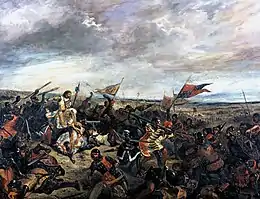 The Battle of Poitiers, by Eugène Delacroix | |||||||
| |||||||
| Belligerents | |||||||
.svg.png.webp) Kingdom of England Kingdom of England |
 Kingdom of France Kingdom of France | ||||||
| Commanders and leaders | |||||||
|
Edward, the Black Prince |
John II (POW) | ||||||
| Strength | |||||||
| 6,000 | 12,000–14,000 | ||||||
| Casualties and losses | |||||||
| Few |
More than 4,500 nobles killed or captured Many common infantry killed or wounded | ||||||
The effect of the defeat on France was catastrophic, leaving Dauphin Charles to rule the country. Charles faced populist revolts across the kingdom in the wake of the battle, which had destroyed the prestige of the French nobility. The Edwardian phase of the war ended four years later in 1360, on favourable terms for England.
Poitiers was the second major English victory of the Hundred Years' War, coming a decade after the Battle of Crécy and about half a century before the Battle of Agincourt. The town and battle were often referred to as Poictiers in contemporaneous recordings, a name commemorated by several warships of the Royal Navy.
Background
Since the Norman Conquest of 1066, English monarchs had held titles and lands within France, the possession of which made them vassals of the kings of France.[1] Following a series of disagreements between Philip VI of France (r. 1328–1350) and Edward III of England (r. 1327–1377), on 24 May 1337 Philip's Great Council in Paris agreed that the lands held by Edward III in France should be taken back into Philip's hands on the grounds that Edward III was in breach of his obligations as a vassal. This marked the start of the Hundred Years' War, which was to last 116 years.[2]
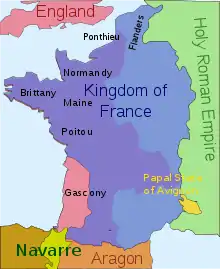
The only significant French possession still held by the English in France was Gascony in the south west. But Gascony was disproportionately important: duty levied by the English Crown on wine from Bordeaux, the capital of Gascony, was more than all other English customs duties combined and by far the largest source of state income. Bordeaux had a population of more than 50,000, greater than London's,[3] and Bordeaux was possibly richer.[4] Although Gascony was the cause of the war, Edward III was able to spare few resources for its defence. In most campaigning seasons the Gascons had to rely on their own resources and had been hard-pressed by the French.[5][6] Typically the Gascons could field 3,000–6,000 men, the large majority infantry, although up to two-thirds of them would be tied down in garrisoning their fortifications.[7] In 1345 and 1346 Henry, Earl of Lancaster, led a series of successful campaigns in Aquitaine and the Anglo-Gascons were able to push the focus of the fighting away from the heart of Gascony.[8][9][10]
The French port of Calais fell to the English in August 1347 after the Crécy campaign and shortly after this the Truce of Calais was signed.[11] This was partially the result of both countries being financially exhausted.[12] The same year the Black Death reached northern France and southern England,[13] resulting in the death of approximately 45 per cent of the population.[14] The treaty was extended repeatedly over the years; this did not stop ongoing naval clashes, nor small-scale fighting – which was especially fierce in south-west France[15] – nor occasional fighting on a larger scale.[16][17]
A treaty ending the war was negotiated at Guînes and signed on 6 April 1354. However, the French king, now John II, decided not to ratify it and it did not take effect. It was clear that from the summer of 1355 both sides would be committed to full-scale war.[18][19] In April 1355 Edward III and his council, with the treasury in an unusually favourable financial position, decided to launch offensives that year in both northern France and Gascony.[20][21] John II of France (r. 1350–1364) attempted to strongly garrison his northern towns and fortifications against the expected descent by Edward III, at the same time as assembling a field army; he was unable to, largely due to lack of money.[22]
Black Prince arrives
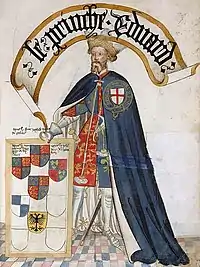
Edward III's eldest son, Edward of Woodstock, later commonly known as the Black Prince, was given the Gascon command[23][24] and began assembling men, shipping and supplies.[25] He arrived in Bordeaux on 20 September 1355 accompanied by 2,200 English soldiers.[26][27] The next day he was formally acknowledged as the king's lieutenant in Gascony, with plenipotentiary powers.[28][29] Gascon nobles reinforced him to a strength of somewhere between 5,000 and 6,000 and provided a bridging train[30] and a substantial supply train.[31][32]
Edward set out on 5 October on a chevauchée, which was a large-scale mounted raid. The Anglo-Gascon force marched from Bordeaux in English-held Gascony 300 miles (480 km) to Narbonne and back to Gascony, devastating a wide swathe of French territory and sacking many French towns on the way. John, Count of Armagnac, who commanded the local French forces, avoided battle, and there was little fighting. While no territory was captured, enormous economic damage was done to France; the modern historian Clifford Rogers concluded that "the importance of the economic attrition of the chevauchée can hardly be exaggerated."[33] The expedition returned to Gascony on 2 December having marched 675 miles (1,100 km).[34]
1356
The English component resumed the offensive after Christmas[35] to great effect, and more than 50 French-held towns or fortifications were captured during the following four months.[36] including strategically important towns close to the borders of Gascony,[37] and others over 80 miles (130 km) away.[38] Local French commanders attempted no countermeasures.[39][40] Several members of the local French nobility went over to the English; the Black Prince received homage from them on 24 April 1356.[41][42]
Money and enthusiasm for the war were running out in France. The modern historian Jonathan Sumption describes the French national administration as "fall[ing] apart in jealous acrimony and recrimination".[43] A contemporary chronicler recorded that "the King of France was severely hated in his own realm". Arras rebelled and killed loyalists. The major nobles of Normandy refused to pay taxes. On 5 April 1356 John arrested the notoriously treacherous Charles II, king of Navarre, one of the largest landholders in France[44][note 1] and nine more of his more outspoken critics; four were summarily executed.[44] The Norman nobles who had not been arrested turned to Edward for assistance.[47]
Seeing an opportunity, Edward diverted an expedition planned for Brittany under Henry, Earl of Lancaster to Normandy in late June. Lancaster set off with 2,300 men[48] and pillaged and burnt his way eastward across Normandy.[49] King John moved to Rouen with a much stronger force, hoping to intercept Lancaster.[50] After relieving and re-victualling two besieged fortifications the English stormed and sacked the important town of Verneuil.[51][52] John pursued, but bungled several opportunities to bring the English to battle and they escaped. [53][54]In three weeks the expedition had seized a large amount of loot, including many horses, damage had been done to the French economy and prestige, new alliances had been cemented, there had been few casualties and the French King had been distracted from the English preparations for a greater chevauchée from south-west France.[55][56]
Prelude
Edward's forces met little resistance, sacking numerous settlements, until they reached the Loire river at Tours. They were unable to take the castle or burn the town due to a heavy rainstorm. This delay allowed King John to attempt to pin down and destroy Edward's army. John, who had been besieging Breteuil in Normandy, organised the bulk of his army at Chartres to the north of Tours. In order to increase the speed of his army's march, he dismissed between 15,000 and 20,000 of his lower quality infantry, just as Edward turned back to Bordeaux.[57] The French rode hard and cut in front of the English army, crossing the bridge over the Vienne at Chauvigny. Learning of this, the Black Prince quickly moved his army south. Historians disagree over whether the outnumbered English commander was seeking battle or trying to avoid it.[58]
Battle
.jpg.webp)
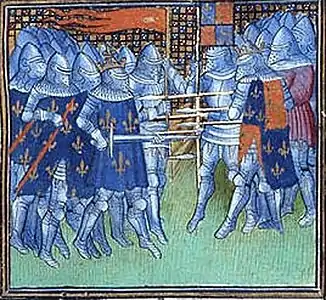
Preparations
Edward arrayed his army in a defensive posture among the hedges and orchards of the area, in front of the forest of Nouaillé. He deployed his front line of longbowmen behind a particularly prominent thick hedge, through which the road ran at right angles. The Earl of Douglas, commanding the Scottish division in the French army, advised King John that the attack should be delivered on foot, with horses being particularly vulnerable to English arrows. John heeded this advice, his army leaving its baggage behind and forming up on foot in front of the English. The English gained vantage points on the natural high ground in order for their longbowmen to have an advantage over the heavily armoured French troops.
English army
The English army was led by Edward, the Black Prince, and composed primarily of English and Welsh troops, though there was a large contingent of Gascon and Breton soldiers with the army. Edward's army consisted of approximately 2,000 longbowmen, 3,000 men-at-arms, and a force of 1,000 Gascon infantry.
Like the earlier engagement at Crécy, the power of the English army lay in the longbow, a tall, thick self-bow made of yew. Longbows had demonstrated their effectiveness against massed infantry and cavalry in several battles, such as Falkirk in 1298, Halidon Hill in 1333, and Crécy in 1346. Poitiers was the second of three major English victories of the Hundred Years' War attributed to the longbow, though its effectiveness against armoured French knights and men-at-arms has been disputed.[59][60][61]
Geoffrey the Baker wrote that the English archers under the Earl of Salisbury "made their arrows prevail over the [French] knights' armour",[62] but the bowmen on the other flank, under Warwick, were initially ineffective against the mounted French men-at-arms who enjoyed the double protection of steel plate armour and large leather shields.[63] Once Warwick's archers redeployed to a position where they could hit the unarmored sides and backs of the horses, however, they quickly routed the cavalry force opposing them. The archers were also unquestionably effective against common infantry, who could not afford plate armour.[64][65]
The English army was an experienced force; many archers were veterans of the earlier Battle of Crécy, and two of the key commanders, Sir John Chandos, and Captal de Buch were both experienced soldiers. The English army's divisions were led by Edward, the Black Prince, the Earl of Warwick, the Earl of Salisbury, Sir John Chandos and Jean III de Grailly, the Captal de Buch.
French army
The French army was led by King John, and was composed largely of native French soldiers, though there was a contingent of German knights, and a large force of Scottish soldiers. The latter force was led by the Earl of Douglas and fought in the King's own division.[66] The French army at the battle comprised approximately 8,000 men-at-arms and 3,000 common infantry, though John had made the decision to leave behind the vast majority of his infantry, numbering up to 20,000, in order to outrun and overtake the English and force them into battle.
The French army was arrayed in three "battles" or divisions. The vanguard was led by the Dauphin Charles, the second by the Duke of Orléans, while the third, the largest, was led by the King himself.
Negotiations
On 18 September the Anglo-Gascons marched towards Poitiers arrayed for battle, hoping that the French would launch an impromptu assault. Instead Talleyrand rode up to negotiate. The Black Prince was initially disinclined to delay any battle. He was persuaded to discuss terms after Talleyrand pointed out that the two armies were now so close that if the French declined to attack, the Anglo-Gascons would find it almost impossible to withdraw. If they attempted to the French would attack aiming to defeat them in detail and if they stood their positions they would run out of supplies before the French. Unknown to Talleyrand the Anglo-Gascons were already unable to find sufficient water for their horses.[67]
After lengthy negotiations the Black Prince agreed extensive concessions in exchange for free passage to Gascony.[note 2] However, they were dependant on the agreement being ratified by his father, Edward III. The French discussed these proposals at length, with John in favour. However, several senior advisors felt that it would be humiliating to, as they saw it, have at their mercy the Anglo-Gascon army which had devastated so much of France and to tamely allow it to escape. John was persuaded and Talleyrand informed the Black Prince that he could expect a battle. Attempts to agree a site for the battle filed, as the French wished the Anglo-Gascons to move out of their strong defensive position and the English wished to remain there. Early on 19 September Talleyrand again attempted to arrange a truce, but as his army's supplies were already running out the Black Prince rejected this.[69]
Fighting begins
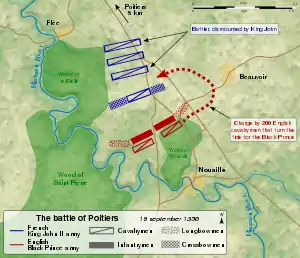
At the start of the battle, the English removed their baggage train from the field, prompting a hasty assault by the French, who believed the English to be retreating.[70] The fighting began with a charge by a forlorn hope of 300 German knights, led by Jean de Clermont. The attack was a disaster, with many of the knights shot down or killed by English soldiery. According to Froissart, the English archers then shot their bows at the massed French infantry.[71] The Dauphin's division reached the English line. Exhausted by a long march in heavy equipment and harassed by the hail of arrows, the division was repulsed after approximately two hours of combat.[72]
The retreating vanguard collided with the advancing division of the Duke of Orléans, throwing the French army into chaos. Seeing the Dauphin's troops falling back, Orléans' division fell back in confusion. The third, and strongest, division led by the King advanced, and the two withdrawing divisions coalesced and resumed their advance against the English. Believing that the retreat of the first two French divisions marked the withdrawal of the French, Edward had ordered a force under the Captal de Buch to pursue. Sir John Chandos urged the Prince to launch this force upon the main body of the French army under the King. Seizing upon this idea, Edward ordered all his men-at-arms and knights to mount for the charge, while de Buch's men, already mounted, were instructed to advance around the French left flank and rear.[73]
Capture of King John II
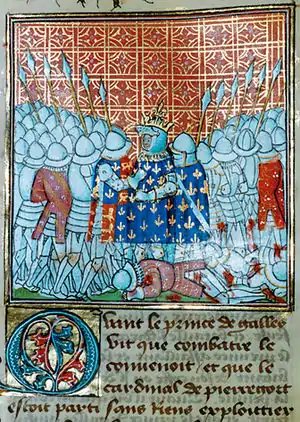
As the French advanced, the English launched their charge. With the French stunned by the attack, the impetus carried the English and Gascon forces right into their line. Simultaneously, de Buch's mobile reserve of mounted troops fell upon the French left flank and rear. With the French army fearful of encirclement, their cohesion disintegrated as many soldiers attempted to flee the field. Low on arrows, the English and Welsh archers abandoned their bows and ran forward to join the melée. Around this time, King John and his son, Philip the Bold, found themselves surrounded. As written by Froissart, an exiled French knight fighting with the English, Sir Denis Morbeke of Artois approached the king, requesting the King's surrender. The King is said to have replied, "To whom shall I yield me? Where is my cousin the Prince of Wales? If I might see him, I would speak with him". Denis replied; "Sir, he is not here; but yield you to me and I shall bring you to him". The King handed him his right gauntlet, saying; "I yield me to you".[74]
With the French King captured, and much of the French knights and soldiers having fallen trying to penetrate the barricaded English lines under constant fire with volley after volley from the thousands of long bows, and the remaining forces having pulled away and scattered in the subsequent chaotic aftermath, the battle was over that afternoon, ending in a disaster for the French and a stunning victory for the English.
Aftermath
Following the battle, Edward resumed his march back to the English stronghold at Bordeaux. Jean de Venette, a Carmelite friar, vividly describes the chaos that ensued following the battle. The demise of the French nobility at the battle, only ten years from the catastrophe at Crécy, threw the kingdom into chaos. The realm was left in the hands of the Dauphin Charles, who faced popular rebellion across the kingdom in the wake of the defeat. Jean writes that the French nobles brutally repressed the rebellions, robbing, despoiling, and pillaging the peasants' goods. Mercenary companies hired by both sides added to the destruction, plundering the peasants and the churches.[75]
Charles, to the misery of the French peasantry, began to raise additional funds to pay for the ransom of his father, and to continue the war effort. Capitalising on the discontent in France, King Edward assembled his army at Calais in 1359 and led his army on a campaign against Rheims. Unable to take Rheims or the French capital, Paris, Edward moved his army to Chartres. Later, the Dauphin Charles offered to open negotiations, and Edward agreed.
The Treaty of Brétigny was ratified on 24 October 1360, ending the Edwardian phase of the Hundred Years' War. In it, Edward agreed to renounce his claims to the French throne, in exchange for full sovereign rights over an expanded Aquitaine and Calais, essentially restoring the former Angevin Empire.[76]
Notes, citations and sources
Notes
- Known as "Charles the Bad", he had repeatedly plotted with the English and in 1354 had murdered the constable of France, one of John's closest advisors, in his bedroom and boasted of it.[45][46]
- The Black Prince agreed to return all prisoners and territory taken over the past three years, refrain from fighting the French for seven years and pay 100,000 écu.[68]
Citations
- Prestwich 2007, p. 394.
- Sumption 1990, p. 184.
- Sumption 1990, pp. 39–40.
- Rodger 2004, p. 79.
- Fowler 1961, pp. 139–140.
- Rogers 2004, p. 95.
- Fowler 1961, pp. 143–144.
- Harari 1999, pp. 385–386.
- Fowler 1969, pp. 67–71.
- Sumption 1990, pp. 541–550.
- Sumption 1990, p. 585.
- Sumption 1990, p. 584.
- Deaux 1969, p. 122.
- Lewis 2016, p. 793.
- Burne 1999, p. 225.
- Wagner 2006b, p. 74.
- Harari 2007, p. 114.
- Wagner 2006c.
- Sumption 1999, pp. 139–142.
- Sumption 1999, pp. 153, 160.
- Madden 2014, p. 6.
- Sumption 1999, pp. 171–172.
- Madden 2014, pp. 79ff.
- Sumption 1999, pp. 153–154.
- Sumption 1999, pp. 154–155.
- Curry 2002, p. 40.
- Sumption 1999, pp. 168, 175.
- Burne 1999, p. 251.
- Wagner 2006a, p. 95.
- Burne 1999, p. 252.
- Madden 2014, pp. 190, 201, 209.
- Wagner 2006a, p. 96.
- Rogers 1994, p. 101.
- Burne 1999, p. 258.
- Sumption 1999, pp. 191–192.
- Burne 1999, p. 259.
- Curry 2002, p. 43.
- Sumption 1999, pp. 191–193.
- Sumption 1999, p. 192.
- Madden 2014, p. 359.
- Sumption 1999, p. 193.
- Madden 2014, p. 347.
- Sumption 1999, pp. 102, 111, 115.
- Rogers 2014, pp. 332–334.
- Sumption 1999, pp. 124–125.
- Wagner 2006b, pp. 93–94.
- Rogers 2014, p. 334.
- Rogers 2014, p. 341, 341 n.70.
- Rogers 2014, pp. 342, 244.
- Rogers 2014, p. 345 n. 83.
- Fowler 1969, p. 152.
- Burne 1999, pp. 265–267.
- Rogers 2014, pp. 346–347.
- Burne 1999, p. 268.
- Fowler 1969, p. 153.
- Rogers 2014, pp. 342, 345.
- Jonathan Sumption, The Hundred Years' War: Vol. 2: Trial by Fire (London: Faber, 2001), pp. 223, 227–228
- Rogers, Clifford J. (2000). War Cruel and Sharp: English Strategy under Edward III. Woodbridge: Boydell and Brewwer. pp. 348–373.
- Strickland, Matthew; Hardy, Robert (2005). The Great Warbow: From Hastings to the Mary Rose. Sutton Publishing. pp. 272–278. ISBN 9780750931670.
- Kaiser, Robert E. (December 2003). "Medieval Military Surgery". Medieval History Magazine. 1 (4).
- Rogers, Clifford J. (1998). "The Efficacy of the Medieval Longbow: A Reply to Kelly DeVries". War in History. 5 (2): 233–42. doi:10.1177/096834459800500205. S2CID 161286935.
- Edward Maunde Thompson, Chronicle of Geoffrey le Baker, (Oxford at the Clarendon Press 1889) p. 147 ("coegerunt sagittas armis militaribus prevalere")
- Barber, Richard (1986). The Life and Campaigns of the Black Prince. Woodbridge: Boydell Press. p. 76. ISBN 0-85115-435-2.
- D. Green, The Battle of Poitiers 1356, (Tempus Publishing, Charleston, S.C., 2002)
- Edward Maunde Thompson, Chronicle of Geoffrey le Baker, (Oxford at the Clarendon Press 1889) p. 304
- William F. Skene, John of Fordun's Chronicle of the Scottish Nation, (Edinburgh Edmonston and Douglas 1872), p. 365
- Rogers 2014, pp. 366–368.
- Rogers 2014, p. 368.
- Rogers 2014, pp. 367–372.
- Urban, William L. (2006). Medieval Mercenaries: The Business of War. London: Greenhill Books. p. 99.
- https://www.britishbattles.com/one-hundred-years-war/battle-of-poitiers/
- Oberhofer, Tom. "Battle of Poitiers". Eckerd College. Retrieved 17 September 2018.
- This section reflects the traditional narrative of the battle, which relies to a substantial extent on the chronicle of Jean Froissart. For an alternative narrative based on the assumption that Froissart's narrative is not reliable, see Clifford J. Rogers, "The Battle of Poitiers, 1356" (English-language version of "La batalla de Poitiers (1356)", Desperta Ferro. Revista de historia militar y política. Antigua y medieval 38 (2016), 28–38)
- Froissart, Jean (1910). "The Battle of Poitiers". In Eliot, Charles (ed.). Chronicle and Romance: Froissart, Malory, Holinshed. p. 52. Retrieved 17 September 2018.
- Jean Birdsall, Richard A. Newhall, The Chronicles of Jean de Venette (Columbia University Press 1953) p. 6
- Hersch Lauterpacht, "Volume 20 of International Law Reports, Cambridge University Press, 1957, ISBN 0-521-46365-3, p. 118
Sources
- Burne, Alfred (1999) [1955]. The Crecy War. Ware, Hertfordshire: Wordsworth Editions. ISBN 978-1-84022-210-4.
- Curry, Anne (2002). The Hundred Years' War 1337–1453. Oxford: Osprey Publishing. ISBN 978-1-84176-269-2.
- Deaux, George (1969). The Black Death, 1347. London: Hamilton. OCLC 242352826.
- Fowler, Kenneth (1961). Henry of Grosmont, First Duke of Lancaster, 1310–1361 (PDF) (PhD thesis). Leeds: University of Leeds.
- Fowler, Kenneth (1969). The King's Lieutenant: Henry of Grosmont, First Duke of Lancaster, 1310–1361. New York: Barnes & Noble. ISBN 978-0-389-01003-6.
- Green, David (2011). The Black Prince. New York: History Press. ISBN 9780752473062.
- Harari, Yuval Noah (1999). "Inter-frontal Cooperation in the Fourteenth Century and Edward III's 1346 Campaign". War in History. 6 (4): 379–395. doi:10.1177/096834459900600401. JSTOR 26013966. S2CID 59055741.
- Harari, Yuval N. (2007). "For a Sack-full of Gold Écus: Calais 1350". Special Operations in the Age of Chivalry, 1100–1550. Woodbridge, Suffolk: Boydell Press. pp. 109–124. ISBN 978-1-84383-292-8.
- Hoskins, Peter (2011). In the Steps of the Black Prince: The Road to Poitiers, 1355–1356. Woodbridge, Suffolk: Boydell. ISBN 978-1-84383-611-7.
- Lewis, Carenza (June 2016). "Disaster Recovery: New Archaeological Evidence for the Long-Term Impact of the 'Calamitous' Fourteenth Century". Antiquity. 90 (351): 777–797. doi:10.15184/aqy.2016.69. ISSN 0003-598X.
- Nicolle, David (2004). Poitiers 1356: The capture of a king (PDF). Oxford: Osprey Publishing (published 25 June 2004). ISBN 978-1-84176-516-7. Archived from the original (PDF) on 5 February 2019.
- Madden, Mollie Marie (2014). The Black Prince at War: The Anatomy of a Chevauchée (PDF) (PhD thesis). Minnesota: University of Minnesota.
- Prestwich, Michael (2007). Plantagenet England 1225–1360. Oxford: Oxford University Press. ISBN 978-0-19-922687-0.
- Rodger, N.A.M. (2004). The Safeguard of the Sea. London: Penguin. ISBN 978-0-14-029724-9.
- Rogers, Clifford J. (2004). Bachrach, Bernard S.; DeVries, Kelly & Rogers, Clifford J (eds.). "The Bergerac Campaign (1345) and the Generalship of Henry of Lancaster". Journal of Medieval Military History. II. Woodbridge, Suffolk: Boydell & Brewer. ISBN 978-1-84383-040-5. ISSN 0961-7582.
- Rogers, Clifford J. (1994). "Edward III and the Dialectics of Strategy, 1327-1360". Transactions of the Royal Historical Society. 4: 83–102. doi:10.2307/3679216. JSTOR 3679216. OCLC 931311378.
- Rogers, Clifford J. (2014) [2000]. War Cruel and Sharp: English Strategy under Edward III, 1327–1360. Woodbridge, Suffolk: Boydell Press. ISBN 978-0-85115-804-4.
- Rogers, Clifford J. (2010). "Poitiers, Battle of (1356)". In Rogers, Clifford J. (ed.). The Oxford Encyclopedia of Medieval Warfare and Military Technology. Vol. 3. Oxford University Press. p. 134–136.
|volume=has extra text (help) - Rogers, Clifford J. "The Battle of Poitiers, 1356 (English-language version of "La batalla de Poitiers (1356)," Desperta Ferro. Revista de historia militar y política. Antigua y medieval 38 (2016), 28–38.)". Retrieved 26 September 2017.
- Sumption, Jonathan (1990). Trial by Battle. The Hundred Years' War. I. London: Faber and Faber. ISBN 978-0-571-20095-5.
- Sumption, Jonathan (1999). Trial by Fire. The Hundred Years' War. II. London: Faber and Faber. ISBN 978-0-571-13896-8.
- Wagner, John A. (2006a). "Chevauchée of 1355". Encyclopedia of the Hundred Years War. Woodbridge, Suffolk: Greenwood. pp. 95–96. ISBN 978-0-313-32736-0.
- Wagner, John A. (2006b). "Charles the Bad, King of Navarre (1332–1387)". Encyclopedia of the Hundred Years War. Woodbridge, Suffolk: Greenwood. pp. 93–94. ISBN 978-0-313-32736-0.
- Wagner, John A. (2006c). "Guines, Treaty of". Encyclopedia of the Hundred Years War. Woodbridge, Suffolk: Greenwood. pp. 142–143. ISBN 978-0-313-32736-0.
- Wagner, John A. (2006d). "Poitiers, Battle of". Encyclopedia of the Hundred Years War. Woodbridge, Suffolk: Greenwood. pp. 256–258. ISBN 978-0-313-32736-0.
- Witzel, Morgen; Livingstone, Marilyn (2018). The Black Prince and the Capture of a King: Poitiers 1356. Oxford: Casemate. ISBN 9781612004518.
 |
Wikimedia Commons has media related to Battle of Poitiers (1356). |
Authority control: National libraries  |
|---|