Baudouin of Belgium
Baudouin (US: /boʊˈdwæ̃/;[1][2][lower-alpha 1] 7 September 1930 – 31 July 1993), Dutch name Boudewijn, was King of the Belgians from 1951 until his death in 1993. He was the last Belgian king to be sovereign of the Congo.
| Baudouin | |||||
|---|---|---|---|---|---|
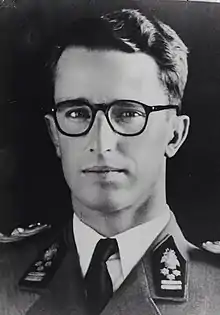 King Baudouin in 1960 | |||||
| King of the Belgians | |||||
| Reign | 17 July 1951 – 31 July 1993 | ||||
| Predecessor | Leopold III | ||||
| Successor | Albert II | ||||
| Prime ministers | |||||
| Born | 7 September 1930 Stuyvenberg Castle, Laeken, Brussels, Kingdom of Belgium | ||||
| Died | 31 July 1993 (aged 62) Villa Astrida, Motril, Kingdom of Spain | ||||
| Burial | |||||
| Spouse | |||||
| |||||
| House | Belgium | ||||
| Father | Leopold III of Belgium | ||||
| Mother | Astrid of Sweden | ||||
| Religion | Roman Catholicism | ||||
Baudouin was the elder son of King Leopold III (1901–1983) and his first wife, Princess Astrid of Sweden (1905–1935). Because he and his wife, Queen Fabiola, had no children, at Baudouin's death the crown passed to his younger brother, King Albert II.
Childhood and accession
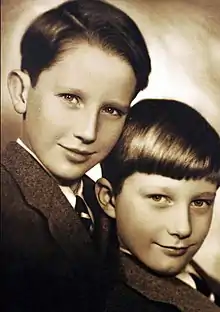
Prince Baudouin was born on 7 September 1930 in the Château du Stuyvenberg, near Laeken, Brussels, the elder son and second child of Prince Leopold, then Duke of Brabant, and his first wife, Princess Astrid of Sweden. In 1934, Baudouin's grandfather King Albert I of Belgium was killed in a rock climbing accident; Leopold became king and the three-year-old Baudouin became Duke of Brabant as heir apparent to the throne. Baudouin's mother died in 1935 in an automobile accident, when Baudouin was nearly five.[3] Later, in 1941, his father remarried to Mary Lilian Baels (later became Princess of Réthy). This marriage produced three more children: Prince Alexandre, Princess Marie-Christine (who is also Baudouin's goddaughter) and Princess Marie-Esméralda. Baudouin and his siblings had a close relationship with their stepmother and they called her "Mother".[4][5] His education began at the age of seven, his tutors taught him half his lessons in French and half in Flemish. He frequently accompanied his father to parades and ceremonies and became well known to the public.[6]
Despite maintaining strict neutrality during the opening months of the Second World War, on 10 May 1940, Belgium was invaded by Nazi Germany. Baudouin, his elder sister Princess Josephine-Charlotte and his younger brother Prince Albert, were immediately sent to France for safety and then to Spain.[7] The Belgian Army, assisted by the French and British, conducted a defensive campaign lasting 18 days, but Leopold, who had taken personal command, surrendered unconditionally on 28 May. Although the Belgian government escaped to form a Belgian government in exile, Leopold elected to remain in Belgium, and was placed under house arrest at the Palace of Laeken, from where he attempted to reach an understanding with the Germans, especially in respect of Belgian prisoners of war who were being held in Germany.[8] The children returned to Laeken from Spain on 6 August.[7]
Leopold had established a royal Scout group at the palace for his sons, whose members were drawn from the various Belgian Scout associations. In April 1943, the wearing of uniforms was banned by the occupation forces and although Leopold was told that the royal group was exempt, insisted that the ban should apply to them too. However, Baudouin was about to be invested as a Scout and persuaded his father to delay the ban for one day so that the ceremony could take place.[9]
Immediately following the Normandy landings in June 1944, the king, his new wife Princess Lilian, and the royal children, were deported to Hirschstein in Germany and then to Strobl in Austria from where they were liberated in May 1945 by the United States Army.[7] However, the royal family were prevented from returning to Belgium by the "Royal Question" over whether Leopold had collaborated with the Nazis; the surrender in 1940, his refusal to join the government-in-exile, his fruitless visit to Adolf Hitler at the Berghof in November 1940 and his unconstitutional marriage to Lilian whose father was believed to be pro-Nazi.[10] Until a political solution could be found, the king's brother, Prince Charles became regent and the royal family lived at the Château du Reposoir in Pregny-Chambésy, Switzerland. Baudouin continued his education at a secondary school in Geneva and visited the United States in 1948. In a referendum in March 1950, the public narrowly voted for the king to return and he was recalled on 4 June 1950. However, parliamentary dissent and public protests forced Leopold to delegate his powers to Baudouin on 11 August 1950, and finally to abdicate in favour of Baudouin, who took the oath of office as the fifth King of the Belgians on 17 July 1951.[7]
Marriage
On 15 December 1960, Baudouin was married in Brussels to Doña Fabiola de Mora y Aragón. Fabiola was a Spanish noblewoman who was working as a nurse. The couple announced their engagement on 16 September 1960 at the Castle of Laeken. [11]
Fabiola began undertaking official engagements immediately, accompanying the king to lay a wreath at the tomb of the unknown soldier in Brussels on 26 September 1960, [12] and remained an active Queen Consort and Queen Dowager for the rest of her life, involved in social causes particularly those related to mental health, children's issues and women's issues.
The king and queen had no children; all of the queen's five pregnancies ended in miscarriage.[13]
Notable events

During Baudouin's reign the colony of Belgian Congo became independent. During the parade following the last ceremonial inspection of the Force Publique, the royal sabre of the king was momentarily stolen by Ambroise Boimbo. The photograph, taken by Robert Lebeck, was widely published in world newspapers,[14] with some seeing the act as a humiliation for the king.[15] The next day the king attended the official reception; he gave a speech that received a blistering response by Congolese Prime Minister Patrice Lumumba.[16]
Baudouin and French President Charles de Gaulle were the two prominent world leaders at the state funerals of both John F. Kennedy in November 1963 and his predecessor General of the Army Dwight Eisenhower in March 1969, as the head of state of Belgium.[17][18] At Kennedy's, he was accompanied by Paul-Henri Spaak, the Minister of Foreign Affairs and former three-time Prime Minister of Belgium. At Eisenhower's, he was accompanied by Prime Minister Gaston Eyskens.[19]
In 1976, on the 25th anniversary of Baudouin's accession, the King Baudouin Foundation was formed, with the aim of improving the living conditions of the Belgian people.
He was the 1,176th Knight of the Order of the Golden Fleece in Spain, which was bestowed upon him in 1960, the 930th Knight of the Order of the Garter and also the last living knight of the Papal Supreme Order of Christ.[20][21]
Religious influences
Baudouin was a devout Roman Catholic. Through the influence of Leo Cardinal Suenens, Baudouin participated in the growing Renewal Movement and regularly went on pilgrimages to the French shrine of Paray-le-Monial.
Refusal to assent to abortion law
In 1990, when a law submitted by Roger Lallemand and Lucienne Herman-Michielsens that liberalised Belgium's abortion laws was approved by Parliament, he refused to give Royal Assent to the bill. This was unprecedented; although Baudouin was de jure Belgium's chief executive, Royal Assent has long been a formality (as is the case in most constitutional and popular monarchies). However, due to his religious convictions—the Catholic Church opposes all forms of abortion—Baudouin asked the Government to declare him temporarily unable to reign so that he could avoid signing the measure into law.[22] The Government under Wilfried Martens complied with his request on 4 April 1990. According to the provisions of the Belgian Constitution, in the event the king is temporarily unable to reign, the Government as a whole fulfils the role of head of state. All members of the Government signed the bill, and the next day (5 April 1990) the Government declared that Baudouin was capable of reigning again.
Baudouin and the death of Patrice Lumumba
In 1960, Baudouin declared the Belgian colony of Congo independent. During the declaration of independence, Baudouin delivered a highly contested speech in which he celebrated the acts of the first Belgian owner of the Congo, King Leopold II, whom he described as "a genius". In the same event on the day of the independence, the first democratically elected prime minister of Congo, Patrice Lumumba, answered in a speech that was very critical of the Belgian regime. Lumumba mentioned the killing of many Congolese, the insults and humiliations and the slavery they suffered.
Lumumba's speech infuriated King Baudouin and started a harsh conflict between both men. After the independence of Congo, the rich province of Katanga set up a secession that received substantial military and financial support from the Belgian government and Belgian companies with business interests in this region. King Baudouin strengthened his relationships with the Katangese politician Moise Tshombé, whom he made a knight in the order of Leopold. In the meanwhile, the Belgian government as well as the CIA supported or organized themselves plans to murder Patrice Lumumba.
In early December 1960, Patrice Lumumba and two colleagues were imprisoned in military barracks about 150 kilometres (93 mi) from Leopoldville. They were underfed and mistreated, then released in mid-January 1961. Within hours, Lumumba was again captured. He was relocated, beaten, and executed by Congolese soldiers under Belgian command; Belgian police officer Gerard Soete cut up Lumumba's body and dissolved the corpse in acid.[23]
In 2001, a parliamentary investigation set up by the Belgian government concluded that King Baudouin, amongst others, was informed of a murder plan set up by later dictator Joseph Mobutu and the Katangese rebel Moise Tshombé. Both men had agreed to the Belgian colonel Guy Weber to "neutralize Lumumba, if possible physically". The king, informed, did nothing more and this neglect was described as 'incriminating' by the parliamentary investigation, although there was no evidence found that the king ordered the set up of the plans.[23]
Death, succession, and legacy
Baudouin reigned for 42 years. He died of heart failure on 31 July 1993 in the Villa Astrida in Motril, in the south of Spain.[24] Although in March 1992 the king had been operated on for a mitral valve prolapse in Paris, his death still came unexpectedly, and sent much of Belgium into a period of deep mourning. His death notably stopped the 1993 24 Hours of Spa sportscar race, which had reached the 15-hour mark when the news broke.
Within hours the Royal Palace gates and enclosure were covered with flowers that people brought spontaneously. A viewing of the body was held at the Royal Palace in central Brussels; 500,000 people (5% of the population) came to pay their respects. Many waited in line up to 14 hours in sweltering heat to see their King one last time. Along with other members of European royalty, Queen Elizabeth II of the United Kingdom and the other Commonwealth realms attended the funeral (the only foreign state funeral ever attended by her in person as monarch). All European monarchs attended the service, as did Emperor Akihito of Japan. Non-royal guests included more than 20 presidents and leaders, such as UN Secretary General Boutros Boutros-Ghali, European Commission President Jacques Delors, French President François Mitterrand, Egyptian President Hosni Mubarak, German President Richard von Weizsacker, Polish President Lech Walesa, Bosnian President Alija Izetbegovic, Italian President Oscar Luigi Scalfaro, Canadian Governor General Ray Hnatyshyn and former American President Gerald Ford were also present at the funeral.
King Baudouin was interred in the royal vault at the Church of Our Lady of Laeken, Brussels, Belgium. He was succeeded by his younger brother, who became King Albert II.
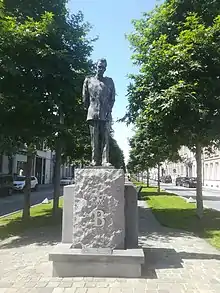
The statue of him was vandalised in Brussels on June 2020, following George Floyd protests in Belgium.[25]
Honours

National
.svg.png.webp) Belgium:
Belgium:
- Grand Master of the Order of Leopold[26]
Foreign
 Austria: Grand Star of the Decoration for Services to the Republic of Austria[27]
 Iceland: Grand Cross with Collar of the Order of the Falcon[28]
 Netherlands:
- Knight Grand Cross of the Order of the Netherlands Lion[29]
- Knight of the Collar of the Order of Charles III[30]
- Knight of the Collar of the Order of Isabella the Catholic[31]
 Serbia:
Dynastic
.svg.png.webp)
Ancestry
| Ancestors of Baudouin of Belgium |
|---|
See also
- Kings of Belgium family tree
- Crown Council of Belgium
- Royal Trust
- Herman Liebaers (Marshal of the Royal Household)
- André Molitor (private secretary)
- Jacques van Ypersele de Strihou (private secretary)
- Pierre-Yves Monette (advisor)
- King Baudouin Ice Shelf, Antarctica
Notes
- French: Baudouin Albert Charles Léopold Axel Marie Gustave, pronounced [bodwɛ̃ albɛʁ ʃaʁl leɔpɔld aksɛl maʁi ɡystav]; Dutch: Boudewijn Albert Karel Leopold Axel Maria Gustaaf, pronounced [ˈbʌudəʋɛin ˈɑlbərt ˈkaːrə ˈleːjoːpɔlt ˈɑksəl maːˈri ɣʏˈstaːf]; German: Balduin Albrecht Karl Leopold Axel Maria Gustav.
References
- "Baudouin I". The American Heritage Dictionary of the English Language (5th ed.). Boston: Houghton Mifflin Harcourt. Retrieved 6 August 2019.
- "Baudouin". Merriam-Webster Dictionary. Retrieved 6 August 2019.
- "King Baudouin". Belgian Monarchy Official Website. Retrieved 19 May 2020.
- Cleeremans, Jean. Léopold III, sa famille, son peuple sous l'occupation; Keyes, Roger. Echec au Roi, Léopold III, 1940–1951
- White, Sam (3 July 1953). "Europe's Most Slandered Princess". Pittsburgh Press. Retrieved 19 May 2020.
- Wilsford 1995, pp. 25-26
- "King Baudouin". www.monarchie.be. The Belgian Monarchy. Retrieved 15 July 2020.
- Conway 2012, p. 29
- Kroonenberg, Piet (1 May 2012). "Royal Scouts". crossoflaeken.blogspot.com. Retrieved 13 July 2020.
- Wilsford 1995, pp. 26-27
- "Baudouin Engaged 1960". British Pathé. Retrieved 7 August 2020.
- "Dona Fabiola In Brussels". Getty Images. Retrieved 2 August 2021.
- "Koningin Fabiola had vijf miskramen". Nieuwsblad.be. 21 April 2008. Retrieved 17 January 2017.
- Glasenapp, Jörn (2008) '"Der Degendieb von Léopoldville. Robert Lebecks Schlüsselbild der Dekolonisation Afrikas" In Paul, Gerhard (ed.) (2008) Das Jahrhundert der Bilder: 1949 bis heute Vandenhoeck & Ruprecht, Göttingen, pp. 242–249, ISBN 978-3-525-30012-1, in German
- "La photo du sabre du Roi Baudouin, le 30 juin 1960". Mbokamosika. 20 December 2009. Retrieved 17 January 2017.
- McIntire, Suzanne; Burns, William E. (2009). Speeches in World History. Infobase Publishing. pp. 438–40. ISBN 9781438126807.
- Grose, Peter (31 March 1969). "Nixon will Meet with De Gaulle Today". The New York Times. p. 1.
President de Gaulle arrived by plane from Paris, on his first visit to the United States since the funeral of President Kennedy in 1963.
- Belair Jr., Felix (1 April 1969). "World's Leaders Join in Services for Eisenhower". The New York Times. p. 1.
- "Partial List of Leaders From Abroad at Funeral". The New York Times. 1 April 1969. p. 32.
- Herold, Stephen. "Society of the Golden Fleece". Chevaliers De La Toison D'or – Toison espagnole (spanish fleece). La Confrérie Amicale. Retrieved 16 January 2017.
- Velde, François R. "List of the Knights of the Garter". Heraldica.
- "Belgium: Commoner for A Day, or Two". Time. 16 April 1990. Archived from the original on 16 February 2008. Retrieved 26 April 2010.
- Verslag namens de Onderzoekscommissie van de Belgische Kamer van Volksvertegenwoordigers van het parlementair onderzoek met het oog op het vaststellen van de precieze omstandigheden waarin Patrice Lumumba werd vermoord en van de eventuele betrokkenheid daarbij van Belgische politici, 16 November 2001
- Lyons, Richard D. (1 August 1993). "Baudouin I, King of Belgium, Dies at 62". The New York Times. Retrieved 27 July 2020.
- Pitiot, Christophe (12 June 2020). "A statue of former Belgian King Baudouin defaced with red paint". Euronews. Retrieved 3 October 2021.
- Annuaire administratif et judiciaire de Belgique. Brussels: E. Bruylant. 1965. p. 1.
- "Reply to a parliamentary question" (PDF) (in German). p. 53. Retrieved 4 October 2012.
- Iceland Presidency Website Archived 7 June 2013 at the Wayback Machine, Baudouin, konungur Belgíu – Belgía – 16 October 1979 – Stórkross með keðju (= Baudouin, King of Belgians, Belgium, 16 October 1979, Grand Cross with Collar)
- "Archived copy". Archived from the original on 9 March 2016. Retrieved 8 March 2016.CS1 maint: archived copy as title (link)
- "Boletín Oficial del Estado" (PDF). Retrieved 17 January 2017.
- "Boletín Oficial del Estado" (PDF). Retrieved 17 January 2017.
- Acović, Dragomir (2012). Slava i čast: Odlikovanja među Srbima, Srbi među odlikovanjima. Belgrade: Službeni Glasnik. p. 364.
- Badraie Archived 2 March 2004 at the Wayback Machine
Bibliography
- Wilsford, David, ed. (1995). Political Leaders of Contemporary Western Europe: A Biographical Dictionary. Greenwood Press. ISBN 978-0313286230.
- Conway, Martin (2012). The Sorrows of Belgium: Liberation and Political Reconstruction, 1944-1947. Oxford University Press. ISBN 978-0199694341.
Other languages
- A. Molitor, La fonction royale en Belgique, Brussels, 1979
- J.Stengers, De koningen der Belgen. Van Leopold I tot Albert II, Leuven, 1997.
- Kardinaal Suenens, Koning Boudewijn. Het getuigenis van een leven, Leuven, 1995.
- Kerstrede 18 December 1975, (ed.V.Neels), Wij Boudewijn, Koning der Belgen. Het politiek, sociaal en moreel testament van een nobel vorst, deel II, Gent, 1996.
- H. le Paige (dir.), Questions royales, Réflexions à propos de la mort d'un roi et sur la médiatisation de l'évènement, Brussels, 1994.
External links
- Official biography from the Belgian Royal Family website
- Newspaper clippings about Baudouin of Belgium in the 20th Century Press Archives of the ZBW
- Archive Baudouin of Belgium, Royal museum for central Africa
Authority control  | |
|---|---|
| General | |
| National libraries | |
| Art research institutes | |
| Other | |