Besao
Besao, officially the Municipality of Besao is a 5th class municipality in the province of Mountain Province, Philippines. According to the 2020 census, it has a population of 6,873 people. [3]
Besao | |
|---|---|
| Municipality of Besao | |
 Cordillera Central mountains in Besao | |
 Flag  Seal | |
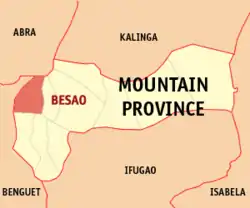 Map of Mountain Province with Besao highlighted | |
OpenStreetMap 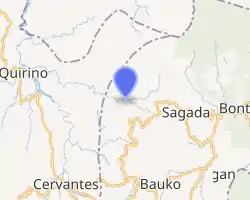
| |
.svg.png.webp)  Besao Location within the Philippines | |
| Coordinates: 17°06′N 120°49′E | |
| Country | Philippines |
| Region | Cordillera Administrative Region |
| Province | Mountain Province |
| District | Lone district |
| Founded | 1904 |
| Barangays | 14 (see Barangays) |
| Government | |
| • Type | Sangguniang Bayan |
| • Mayor | Johnson D. Bantog II |
| • Vice Mayor | June T. Lopsoten |
| • Representative | Maximo Y. Dalog Jr. |
| • Electorate | 5,118 voters (2019) |
| Area | |
| • Total | 173.62 km2 (67.04 sq mi) |
| Elevation | 1,405 m (4,610 ft) |
| Highest elevation | 2,059 m (6,755 ft) |
| Lowest elevation | 721 m (2,365 ft) |
| Population | |
| • Total | 6,873 |
| • Density | 40/km2 (100/sq mi) |
| • Households | 1,710 |
| Economy | |
| • Income class | 5th municipal income class |
| • Poverty incidence | 23.17% (2015)[4] |
| • Revenue | ₱84,366,121.39 (2020) |
| • Assets | ₱227,963,577.55 (2020) |
| • Expenditure | ₱65,528,020.12 (2020) |
| • Liabilities | ₱25,752,515.24 (2020) |
| Service provider | |
| • Electricity | Mountain Province Electric Cooperative (MOPRECO) |
| Time zone | UTC+8 (PST) |
| ZIP code | 2618 |
| PSGC | |
| IDD : area code | +63 (0)74 |
| Native languages | Kankanaey Balangao Bontoc Ilocano Tagalog |
| Website | besao |
The municipality of Besao is believed to have derived its name from the Ilocano word ”Buso”, meaning headhunter. The people then of the neighboring towns specifically those from the Ilocos Region believed that the early ”Besaos” were headhunters. The word later on evolved as it is now called – Besao.
The town is known for the Agawa people's Agricultural Stone Calendar of Gueday. The stone calendar is one of the most enigmatic artifact in the Cordillera mountains. It is a testimony to the accurate scientific outlook of the ancient Agawa people in the cycle of weathers, agriculture, and heavenly bodies.[5]
Barangays
Besao is politically subdivided into 14 barangays.
- Agawa
- Ambagiw
- Banguitan
- Besao East
- Besao West
- Catengan
- Gueday
- Lacmaan
- Laylaya
- Padangaan
- Payeo
- Suquib
- Tamboan
- Kin-iway (Poblacion)
Climate
| Climate data for Besao, Mountain Province | |||||||||||||
|---|---|---|---|---|---|---|---|---|---|---|---|---|---|
| Month | Jan | Feb | Mar | Apr | May | Jun | Jul | Aug | Sep | Oct | Nov | Dec | Year |
| Average high °C (°F) | 19 (66) |
20 (68) |
21 (70) |
23 (73) |
23 (73) |
22 (72) |
21 (70) |
21 (70) |
21 (70) |
21 (70) |
20 (68) |
19 (66) |
21 (70) |
| Average low °C (°F) | 12 (54) |
12 (54) |
13 (55) |
15 (59) |
16 (61) |
17 (63) |
17 (63) |
17 (63) |
16 (61) |
15 (59) |
14 (57) |
13 (55) |
15 (59) |
| Average precipitation mm (inches) | 35 (1.4) |
46 (1.8) |
63 (2.5) |
117 (4.6) |
402 (15.8) |
400 (15.7) |
441 (17.4) |
471 (18.5) |
440 (17.3) |
258 (10.2) |
94 (3.7) |
68 (2.7) |
2,835 (111.6) |
| Average rainy days | 9.9 | 19.5 | 13.9 | 18.9 | 26.0 | 27.3 | 28.9 | 28.5 | 26.1 | 19.7 | 14.5 | 12.8 | 246 |
| Source: Meteoblue [6] | |||||||||||||
Demographics
| Year | Pop. | ±% p.a. |
|---|---|---|
| 1918 | 4,642 | — |
| 1939 | 5,144 | +0.49% |
| 1948 | 5,799 | +1.34% |
| 1960 | 8,174 | +2.90% |
| 1970 | 9,286 | +1.28% |
| 1975 | 7,051 | −5.37% |
| 1980 | 9,093 | +5.22% |
| 1990 | 8,473 | −0.70% |
| 1995 | 9,147 | +1.44% |
| 2000 | 9,875 | +1.66% |
| 2007 | 7,295 | −4.09% |
| 2010 | 7,818 | +2.55% |
| 2015 | 7,040 | −1.98% |
| 2020 | 6,873 | −0.47% |
| Source: Philippine Statistics Authority [7] [8] [9][10] | ||
The population of the town has been decreasing due to younger generations migrating to cities seeking for work.
Religion
Besao's main religion is animism. The town is one of the few animist towns in the southern Cordillera mountains. Much of its ancestral worship intangible heritage has been preserved by the older generations. However, the younger generations have been migrating to cities, making the animist religions of Besao in great danger in the long-term. Christian groups have been surfacing in the town since the younger generations have been moving into cities.
References
- Municipality of Besao | (DILG)
- "2015 Census of Population, Report No. 3 – Population, Land Area, and Population Density" (PDF). Philippine Statistics Authority. Quezon City, Philippines. August 2016. ISSN 0117-1453. Archived (PDF) from the original on May 25, 2021. Retrieved July 16, 2021.
- Census of Population (2020). "Cordillera Administrative Region (CAR)". Total Population by Province, City, Municipality and Barangay. PSA. Retrieved 8 July 2021.
- https://psa.gov.ph/sites/default/files/City%20and%20Municipal-level%20Small%20Area%20Poverty%20Estimates_%202009%2C%202012%20and%202015_0.xlsx; publication date: 10 July 2019; publisher: Philippine Statistics Authority.
- "Secrets of the Calendar Stone of Besao in the Philippines Revealed". 4 June 2009.
- "Besao: Average Temperatures and Rainfall". Meteoblue. Retrieved 8 March 2020.
- Census of Population (2015). "Cordillera Administrative Region (CAR)". Total Population by Province, City, Municipality and Barangay. PSA. Retrieved 20 June 2016.
- Census of Population and Housing (2010). "Cordillera Administrative Region (CAR)". Total Population by Province, City, Municipality and Barangay. NSO. Retrieved 29 June 2016.
- Censuses of Population (1903–2007). "Cordillera Administrative Region (CAR)". Table 1. Population Enumerated in Various Censuses by Province/Highly Urbanized City: 1903 to 2007. NSO.
- "Province of Mountain Province". Municipality Population Data. Local Water Utilities Administration Research Division. Retrieved 17 December 2016.
- "Poverty incidence (PI):". Philippine Statistics Authority. Retrieved 28 December 2020.
- https://psa.gov.ph/sites/default/files/NSCB_LocalPovertyPhilippines_0.pdf; publication date: 29 November 2005; publisher: Philippine Statistics Authority.
- https://psa.gov.ph/sites/default/files/2003%20SAE%20of%20poverty%20%28Full%20Report%29_1.pdf; publication date: 23 March 2009; publisher: Philippine Statistics Authority.
- https://psa.gov.ph/sites/default/files/2006%20and%202009%20City%20and%20Municipal%20Level%20Poverty%20Estimates_0_1.pdf; publication date: 3 August 2012; publisher: Philippine Statistics Authority.
- https://psa.gov.ph/sites/default/files/2012%20Municipal%20and%20City%20Level%20Poverty%20Estima7tes%20Publication%20%281%29.pdf; publication date: 31 May 2016; publisher: Philippine Statistics Authority.
- https://psa.gov.ph/sites/default/files/City%20and%20Municipal-level%20Small%20Area%20Poverty%20Estimates_%202009%2C%202012%20and%202015_0.xlsx; publication date: 10 July 2019; publisher: Philippine Statistics Authority.
External links
 |
Wikimedia Commons has media related to Besao. |
- Besao Profile at PhilAtlas.com
- Official Website of Besao, Mountain Province
- Philippine Standard Geographic Code
- Philippine Census Information
Places adjacent to Besao | |
|---|---|