Betrothed numbers
Betrothed numbers or quasi-amicable numbers or reduced-amicable numbers are two positive integers such that the sum of the proper divisors of either number is one more than the value of the other number.[1][2] In other words, (m, n) are a pair of betrothed numbers if s(m) = n + 1 and s(n) = m + 1, where s(n) is the aliquot sum of n: an equivalent condition is that σ(m) = σ(n) = m + n + 1, where σ denotes the sum-of-divisors function.
The first few pairs of betrothed numbers (OEIS: A003502, OEIS: A003503) are: (48, 75), (140, 195), (1050, 1925), (1575, 1648), (2024, 2295), (5775, 6128).
The sequence of all betrothed numbers is
- 48, 75, 140, 195, 1050, 1575, 1648, 1925, 2024, 2295, 5775, 6128, 8892, 9504, 16587, 20735, 62744, 75495, 186615, 196664, 199760, 206504, 219975, 266000, 309135, 312620, ... (sequence A005276 in the OEIS)
All known pairs of betrothed numbers have opposite parity. Any pair of the same parity must exceed 1013.
Quasi-sociable numbers
Like sociable numbers, quasi-sociable numbers or reduced sociable numbers are numbers whose aliquot sums minus one form a cyclic sequence that begins and ends with the same number.[3][4] They are generalizations of the concepts of betrothed numbers and quasiperfect numbers. The first quasi-sociable sequence, or quasi-sociable chain, was discovered by Mitchell Dickerman in 1997, it has length 8: (sequence A309227 in the OEIS)
- 1215571544 = 2^3*11*13813313
- 1270824975 = 3^2*5^2*7*19*42467
- 1467511664 = 2^4*19*599*8059
- 1530808335 = 3^3*5*7*1619903
- 1579407344 = 2^4*31^2*59*1741
- 1638031815 = 3^4*5*7*521*1109
- 1727239544 = 2^3*2671*80833
- 1512587175 = 3*5^2*11*1833439
This is the only one known quasi-sociable chain, and the second quasi-sociable chain (if exists) must have all numbers >1012.
Quasi-Aliquot sequence
Like aliquot sequence, a quasi-aliquot sequence or reduced aliquot sequence is a sequence of nonnegative integers in which each term is the sum of the proper divisors except 1 of the previous term,[5][6] the term after 1 is 0 instead of −1 although is −1. If the sequence reaches the number 0, it ends, since 0 has infinitely many divisors. For example, the quasi-Aliquot sequence of 36 is 36 is 36, 54, 65, 18, 20, 21, 10, 7, 0.

Most quasi-aliquot sequences terminate at 0, all such sequences necessarily end with either a prime number followed by 0 or 1 followed by 0 (of course, only the sequence of 1 can reach 1, since is never 1).
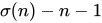
It is widely believed that every quasi-aliquot sequence ends in one of these three ways: 0, a betrothed pair, or a quasi-sociable cycle (i.e. there are no quasiperfect numbers, and there are no numbers whose quasi-aliquot sequence is infinite, note that there are some numbers like 276, whose aliquot sequence may be infinite). It is also widely believed that almost all nonnegative numbers have quasi-aliquot sequence terminate at 0.
Notes
References
- Hagis, Peter, jr; Lord, Graham (1977). "Quasi-Amicable Numbers". Math. Comput. 31 (138): 608–611. doi:10.1090/s0025-5718-1977-0434939-3. ISSN 0025-5718. Zbl 0355.10010.
- Sándor, József; Mitrinović, Dragoslav S.; Crstici, Borislav, eds. (2006). Handbook of Number Theory I. Dordrecht: Springer-Verlag. p. 113. ISBN 978-1-4020-4215-7. Zbl 1151.11300.
- Sándor, Jozsef; Crstici, Borislav (2004). Handbook of Number Theory II. Dordrecht: Kluwer Academic. p. 68. ISBN 978-1-4020-2546-4. Zbl 1079.11001.
External links
Divisibility-based sets of integers | ||
|---|---|---|
| Overview |  | |
| Factorization forms | ||
| Constrained divisor sums | ||
| With many divisors | ||
| Aliquot sequence-related | ||
| Base-dependent | ||
| Other sets | ||
Classes of natural numbers | |||||||||||||||||||||||||
|---|---|---|---|---|---|---|---|---|---|---|---|---|---|---|---|---|---|---|---|---|---|---|---|---|---|
| |||||||||||||||||||||||||
| |||||||||||||||||||||||||
| |||||||||||||||||||||||||
| |||||||||||||||||||||||||
| |||||||||||||||||||||||||
| |||||||||||||||||||||||||
| |||||||||||||||||||||||||
| |||||||||||||||||||||||||
| |||||||||||||||||||||||||
| |||||||||||||||||||||||||
| |||||||||||||||||||||||||
