Bixin
Bixin is an apocarotenoid found in the seeds of the achiote tree (Bixa orellana) from which it derives its name. It is commonly extracted from the seeds to form annatto, a natural food coloring, containing about 5% pigments of which 70-80% are bixin.[2]
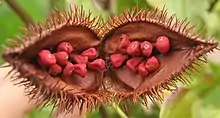 red seeds of the achiote tree
 | |
.png.webp) | |
| Names | |
|---|---|
| IUPAC name
(2E,4E,6E,8E,10E,12E,14E,16Z,18E)-20-Methoxy-4,8,13,17-tetramethyl-20-oxoicosa-2,4,6,8,10,12,14,16,18-nonaenoic acid | |
| Other names
cis-Bixin; α-Bixin; 9-cis-6,6'-Diapo-ψ,ψ-carotenedioic acid, 6-methyl ester | |
| Identifiers | |
| |
3D model (JSmol) |
|
| ChEBI | |
| ChEMBL | |
| ChemSpider | |
| ECHA InfoCard | 100.027.499  |
PubChem CID |
|
| UNII |
|
CompTox Dashboard (EPA) |
|
| |
| |
| Properties | |
| C25H30O4 | |
| Molar mass | 394.511 g·mol−1 |
| Appearance | Orange crystals |
| Insoluble | |
| Hazards | |
| NFPA 704 (fire diamond) | |
Except where otherwise noted, data are given for materials in their standard state (at 25 °C [77 °F], 100 kPa). | |
 verify (what is verify (what is  ?) ?) | |
| Infobox references | |

Bixin is chemically unstable when isolated and converts via isomerization into trans-bixin (β-bixin), the double-bond isomer.[1]
 Chemical structure of trans-bixin
Bixin is soluble in fats and alcohols but insoluble in water. Upon exposure to alkali, the methyl ester is hydrolyzed to produce the dicarboxylic acid norbixin, a water-soluble derivative.
 Chemical structure of norbixin
References
- Merck Index, 11th Edition, 1320
- Executive Summary Bixin Archived July 21, 2011, at the Wayback Machine, National Toxicology Program
This article is issued from Wikipedia. The text is licensed under Creative Commons - Attribution - Sharealike. Additional terms may apply for the media files.