Black Nazarene
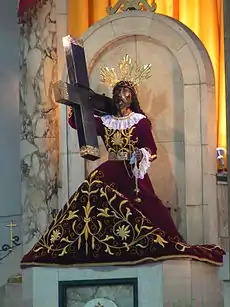
The Black Nazarene (Spanish: El Nazareno Negro, Nuestro Padre Jesús Nazareno, Filipino: Poóng Itím na Nazareno, Hesus Nazareno[1]) is a life-sized image of a dark-skinned, kneeling Jesus Christ carrying the Cross enshrined in the Minor Basilica of the Black Nazarene in the Quiapo district of the City of Manila, Philippines.[2]
| Black Nazarene Nuestro Padre Jesús Nazareno Poóng Itím na Nazareno | |
|---|---|
 | |
| Location | Quiapo, Manila, Philippines |
| Date | 1606 Acapulco, Guerrero, Mexico |
| Witness | Recollect Priests Basílio Sancho de Santa Justa y Rufina, S.P., Archbishop of Manila |
| Type | Wooden statue |
| Approval | Pope Innocent X Pope Pius VII |
| Shrine | Minor Basilica of the Black Nazarene |
| Patronage | Quiapo, Manila, Filipino people, Philippines |
| Attributes | Dark skin, maroon and gold vestments, the Cross |
The Black Nazarene was carved by an unknown Mexican artist from dark wood in the 16th century and then brought to the Philippines in 1606.[2][3] It depicts Jesus en route to his crucifixion. Pope Innocent X granted recognition to the lay Confraternity of Santo Cristo Jesús Nazareno in 1650 for the promotion of the devotion to Jesus through the icon.[3] It was housed in various churches near Manila in the early decades, arriving in Quiapo Church in 1787 where it has been enshrined ever since.[3] The icon is renowned in the Philippines and is considered by many Filipino Catholics to be miraculous; its mere touch reputed is to cure disease.[2][3] It attracts homage from numerous devotees, who bear it in mass processions.[3][4]
The image (in recent years a composite replica) is removed from its shrine in procession three times a year: January 9, the Feast of the Black Nazarene (the anniversary of the icon's translation), Good Friday (the Nazarene's proper liturgical feast, commemorating the culmination of the Passion), and December 31 (New Year's Eve, the first day of its annual novena).[3][5] The January 9 procession re-enacts the image's Traslación (literally "transfer") in 1787, or "solemn transfer" to the Minor Basilica from its original shrine inside Intramuros.[6][7] The January 9 Traslación is the largest of the three processions, drawing millions of devotees trying to touch the image and lasting 22 hours at most.[7][8][9]
The Black Nazarene is venerated by Filipino devotees every Friday. Along with the Santo Niño (Child Jesus), it is the most popular object of devotion in the Philippines.[10] A similar image called Cristo Negro is venerated in Portobelo, Panama.[11]
Terminology
The image derives its name from "Nazarene", a title of Christ identifying him as a native of Nazareth in Galilee and from its dark complexion — something uncommon amongst Philippine depictions of Jesus.
Ándas
The image's wooden base is referred to as the peana while its carriage or carroza used in processions is called the ándas (from the Spanish andar, "to move forward"). The term ándas commonly refers to the shoulder-borne palanquins of religious images, and was retained for the icon's carriage that replaced the silver palanquins used until the late 20th century.
The Original Poón and the Vicarió
There is no one Poón of the Black Nazarene; there are always already many images and replicas of the Poón. The Vicarió is the known processional image used for the Translación. The head of the original Black Nazarene is the one on the high altar of the basilica, but its body is made of Philippine molave wood. Meanwhile, the original right hand of the Poón is being kept at the office of the rector and parish priest, which is being used to bless especially those who are sick and dying. The Vicarió, on the other hand, retains the original torso, but its head is already of batikuling wood.
Callejerós
Aside from the original Poón on the high altar and the Vicarió, the basilica also possesses three replicas of the image visiting the different Roman Catholic dioceses in the country, which are called Callejerós.
History
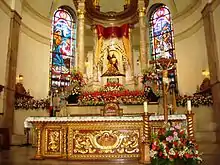
The image was made by an anonymous Mexican sculptor and arrived in Manila via galleon from Acapulco, Mexico on May 31, 1606. Folk belief attributes the colour of the image to soot from votive candles burnt before it, although the most popular legend is that it was charred by a fire on the galleon that brought it from Mexico.
Monsignor Sabino A. Vengco Jr. from Loyola School of Theology meanwhile noted that the image was not charred, but in fact dark through to its core as it was carved from mesquite wood. Vengco based this claim on personal research in Mexico, where he said mesquite wood was a popular medium in the period the image was carved. He also likened it to Our Lady of Antipolo, another popular image of similar provenance and appearance.[12]
The image was first enshrined in the Church of San Juan Bautista of the Augustinian Recollects in Bagumbayan, Luneta; the church was damaged in 1644 then finally destroyed during the 1762 British occupation of Manila. Its former site is now part of the cascade of Padre Burgos Avenue and María Orosa Avenue. In 1608, the image was transferred to the Church of San Nicolás de Tolentino (popularly known as the "Recoletos Church") inside Intramuros. It was enshrined in the retablo mayor or high altar [13] of the church until both church and the image were lost in the Allied bombardment of Manila during its liberation in 1945.
On January 9, 1787, the Augustinian Recollects donated a copy of the image to the Church of the Camisa (one of Quiapo Church's original names). This donation later on was celebrated by the faithful every January 9 by means of a procession (henceforth called the Traslación) from Intramuros (its original home, San Nicolás de Tolentino Church; later from outside Rizal Park) back to Quiapo.
A common misconception is that the icon in Quiapo Church is the original image. While the original image was always in the main altar away from the crowds, formerly leaving only for a procession on Palm Sunday, the image enshrined in Quiapo, which has withstood four centuries of fires, earthquakes, and the Second World War, was available for physical veneration by devotees who attested to its miraculous powers.
The image now enshrined above the main altar of Quiapo Church is a composite of the head of the Recollect replica and the body of a replica sculpted by renowned Filipino santero (saint-maker) Gener Maglaqui, who was commissioned by the Archdiocese of Manila. The second composite comprises the body of the Recollect replica and the head of the Maglaqui replica. Enshrined in a quieter part of the Basilica, it is this second composite that is used in the three major processions. This arrangement began in the 1990s because of security concerns and to better protect the icon; until then, the entire image donated in the 18th century was used in processions.
Description
The Black Nazarene's head wears a braided wig made of dark, dyed abacá, along with a golden Crown of Thorns. Attached to the Crown are the traditional "Tres Potencias" ("three powers") halo, variously understood as symbolising the three powers of the Holy Trinity; the faculties of will, memory, and understanding in Christ’s soul; or his exousia (authority), dunamis (power), and kratos (strength).These three rayos ("rays"), likely an angular variant of the cruciform halo, are used exclusively for and proper to images of Jesus Christ in traditional Filipino and Hispanic iconography to signify his divinity. The original image has lost several fingers over the centuries.
Jesus is shown barefoot and in a genuflecting posture, symbolising the agony and the weight of the Cross, along with the overall pain Christ endured during his Passion. The Cross itself is of black wood tipped with flat, pyramidal brass caps.
Vestments
The image is always dressed in a heavy velvet tunic of maroon, embroidered with floral and plant emblems in gold thread, and trimmed with a matching set of white lace collar and cuffs. Around the waist is a gold-plated metal belt embossed with the word "NAZARENO", while a golden chain ending in spheres is looped around the neck and held in the left hand, representing the Scourging.
The image's vestments are changed in the ritual Pabihis (Tagalog for “dressing"), which is presided over by a priest vested in an alb, red cope and stole. Devotees watching the ceremony either sit inside the Basilica, or follow along outside in Plaza Miranda. The rite comprises with several hymns, the reading of scriptural lessons, the recitation of prayers, and then the blessing of the new vestments. As a sign of modesty and reverence, a curtain is raised to shield the statue from public view as the Hijos change its vestments, and then it is dropped once the actual changing is complete. The old vestments are folded and presented to the faithful, who queue to kiss and touch these in the belief these bear the image's miraculous properties. The Pabihis is done five times a year in preparation for major religious occasions.
Papal approval
Pope Innocent X approved veneration of the image in 1650 as a sacramental, and authorised the establishment of the Confraternity of the Most Holy Jesus Nazarene (Spanish: Cofradía de Nuestro Santo Jesús Nazareno).[14][15]
For most of the Spanish Era, indigenous Filipinos were barred from Holy Orders, while confraternities were groups of laymen and thus an open option for religious life.
Pope Pius VII granted the image his Apostolic Blessing in 1880, which granted a plenary indulgence to those who piously pray before it.
Devotions
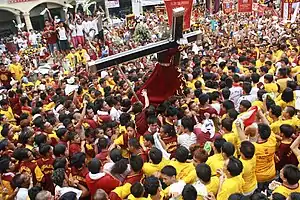
Veneration of the Black Nazarene is rooted among Filipinos who strongly identify with the passion and suffering of Christ the image depicts. Many devotees of the Black Nazarene relate their poverty and daily struggles to the Passion of Christ.
While the actual patron saint of the Basilica is John the Baptist (making its feast day 24 June, concurrent with the secular Manila Day), the Black Nazarene and its Traslación are more popular.
At the end of each Mass said in the Basilica, devotees pay homage to the image by clapping their hands. In addition to the novena, Traslación, Pahalík, and the Pabihis, the Pasindí ("lighting") or lighting of votive candles is another popular devotion, as is the decades-old, reverential custom of creeping on one's knees down the main aisle towards the altar and image.
The Friday of each week in the year (except Good Friday, the image's liturgical commemoration) is colloquially known in Metro Manila as "Quiapo Day", since the novena for the image is held on this day nationwide. As with Wednesday (which is comparably called "Baclaran Day"), this day is associated with heavy traffic around the Basilica due to the influx of devotees and pilgrims.
The attached Nazarene Catholic School (formerly the Quiapo Parochial School) reflects the devotion of school authorities; its official newsletter is likewise named "The Nazarene", with pupils called "Nazareñans."
The largest annual procession for the Black Nazarene is the January 9 Traslación procession on the Feast of the Black Nazarene, attracting millions of Catholic devotees, who try to touch or get their towel wiped by the image carriers on the image to attain its blessings and power.[7][8][16] Along with Santo Niño (Child Jesus), it is the most popular object of devotion in the Philippines.[10] In 2011, over six million Catholic devotees flocked to the Feast of the Black Nazarene.[17]
Hymn
The hymn Nuestro Padre Jesús Nazareno was composed by National Artist for Music Lucio San Pedro to honour the image. It is used by the Basilica and other churches as the official anthem to the image, its devotion, and associated rites.
Idolatry controversy
According to Jaime Laya, the devotional worship of Black Nazarene of Quiapo is idolatry, adding it may be a continuation of possibly pre-Christian local ritual practices.[18] Elizabeth Pisares also states that this is idolatry, and suggests its link with social disparities among Filipinos.[19]
In contrast, according to the Basilica’s rector Monsignor José Clemente Ignacio, the procession and overall devotion is not idolatry but a reflection of the "Filipino trait to want to wipe, touch, kiss, or embrace sacred objects if possible", and that it is belief in "the presence of the Divine in sacred objects and places".[20] According to Mariano Barbato, the debate over the icon is centred on questions of what constitutes idolatry, when an icon becomes a false god, and what makes the annual processions idolatrous.[21]
See also
References
- Sison, Antonio D. (2015). "Afflictive Apparitions: The Folk Catholic Imaginary in Philippine Cinema". Material Religion. Routledge. 11 (4): 421–442. doi:10.1080/17432200.2015.1103474. S2CID 192961308.
- John Lyden (2009). The Routledge Companion to Religion and Film. Routledge. p. 184. ISBN 978-1-135-22065-5.
- J. Gordon Melton (2011). Religious Celebrations: An Encyclopedia of Holidays, Festivals, Solemn Observances, and Spiritual Commemorations. ABC-CLIO. pp. 118–119. ISBN 978-1-59884-206-7.
- John N. Schumacher (1968), The Depth of Christianization in Early Seventeenth-Century Philippines, Philippine Studies, Vol. 16, No. 3 (JULY 1968), pages 535-539
- John Lyden (2009). The Routledge Companion to Religion and Film. Routledge. pp. 184–185. ISBN 978-1-135-22065-5.
- Jean-Guy A. Goulet; Liam D. Murphy; Anastasia Panagakos (2015). Religious Diversity Today: Experiencing Religion in the Contemporary World. ABC-CLIO. pp. 147–152. ISBN 978-1-4408-3332-8.
- Tony Twigg (2015), THE BLACK NAZARENE, A PHILIPPINE NATIONAL ETHO, TAASA Review, Volume 24, Number 2 (June 2015), pages 16-18
- Paul-François Tremlett (2008). Religion and the Discourse on Modernity. Bloomsbury Academic. pp. 1–5, 121–122. ISBN 978-0-8264-9823-6.
- Joi Barrios (2015). Intermediate Tagalog. Singapore: Tuttle. pp. 182–183. ISBN 978-1-4629-1427-2.
- Geoffrey Wainwright (2006). The Oxford History of Christian Worship. Oxford University Press. p. 674. ISBN 978-0-19-513886-3.
- J. Gordon Melton (2011). Religious Celebrations: An Encyclopedia of Holidays, Festivals, Solemn Observances, and Spiritual Commemorations. ABC-CLIO. pp. 116–119. ISBN 978-1-59884-206-7.
- De Guzman, Odi (January 8, 2015). "Black or white: The Nazarene and the Pinoy devotion". GMA News Online. Retrieved January 10, 2015.
- Inside view of Recoletos Church, Intramuros, Manila, Philippines, 1905 by John Tewell
- Michael M. Ramos (2015), POPULAR RELIGIOSITY: A FILIPINO EXPERIENCE OF AN INCULTURATED FAITH, Canadian International Journal of Social Science and Education, Volume 7, page 246; Quote: "This confraternity of the Nazarene was officially authorized by the bull of Pope Innocent X expedited in Rome on April 20, 1650, "By which the confraternity of N.P. Jesus Nazareno was erected and founded in the Church of the Agustinos Recoletos Descalzos in the city of Manila, and by virtue of which many graces and indulgences were granted to the members".
- Leonardo Mercado (2002). Jesus Christ and the Gentile Mission. Gregorian Biblical BookShop. pp. 320–321. ISBN 978-88-7652-944-3.
- Joi Barrios (2015). Intermediate Tagalog. Singapore: Tuttle. pp. 182–184. ISBN 978-1-4629-1427-2.
- Jose Alain Austria (2012), Hijos de Enero 9: Quiapo's Black Nazarene Procession as a Male Rite of Passage, Manila Journal, Volume 8, Number 1, page 15; Quote: "This year [2011] approximately 6.5 million devotees flocked to Quiapo and the Luneta, joining the longest procession on record of sixteen hours. (...) What seems to be pure mayhem in the eyes of the on-looker, or pure faith on the part of the religious, is also a complex of herculean tasks that the young male devotee must perform not only to gain graces, but also to earn the approval of both his peers, the elder male devotees, and most importantly the Nuestro Padre Jesus Nazareno.".
- Jaime C. Laya (2001). Letras Y Figuras. Manila: Anvil. pp. 89–90. ISBN 978-971-27-1143-5.
- Elizabeth H. Pisares (1999). Daly City is My Nation: Race, Imperialism and the Claiming of Pinay / Pinoy Identities in Filipino American Culture. University of California Press. p. 58. OCLC 43832108.
- Jazmin Badong Llana (2014), Inaesthetics of Performance in the Black Nazarene Procession, De La Salle University, DLSU Research Congress 2014, page 3
- Barbato, Mariano (2013). "Self: Pilgrim, Nomad, Homo Faber". Pilgrimage, Politics, and International Relations. pp. 55–82. doi:10.1057/9781137275813_3. ISBN 978-1-137-27581-3.
External links
 |
Wikimedia Commons has media related to Black Nazarene. |
- Quiapo Church Website Minor Basilica of the Black Nazarene – Parish of Saint John the Baptist • Quiapo • Manila
- GMA NEWS.TV, Emergency: Pista ng Nazareno - 01/12/2008
- GMA NEWS.TV, Gma News Research, The Black Nazarene
- Pinoys celebrate 405th anniversary of the Black Nazarene 2012
- Inquirer News | Philippine Catholic pilgrims defy terror alert
- Manila Bulletin | Devotees defy threat
Archidioecesis Manilensis | ||
| Territories |  | |
| Ordinaries |
| |
| Cathedrals |
| |
| Basilicas | ||
| Shrines | ||
| Parishes | ||
| Abbeys |
| |
| Images |
| |
| Properties | ||
| Suffragan dioceses | ||
| ||