Bunjevac dialect
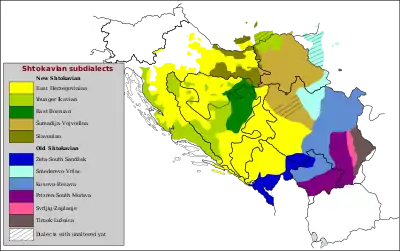
The Bunjevac dialect (bunjevački dijalekt) or Bunjevac speech (bunjevački govor)[2] is a Shtokavian–Younger Ikavian dialect of the Serbo-Croatian pluricentric language, used by members of the Bunjevac community. Their accent is purely Ikavian, with /i/ for the Common Slavic vowels yat.[3] Its speakers largely use the Latin alphabet and are living in parts of the autonomous province of Vojvodina in Serbia as well as in southern parts of Hungary.
| Bunjevac | |
|---|---|
| bunjevački | |
| Native to | Serbia (Vojvodina), Hungary |
Native speakers | 6,800 (2011)[1] |
Indo-European
| |
| Language codes | |
| ISO 639-3 | – |
| Glottolog | None |
| South Slavic languages and dialects |
|---|
| Part of a series on |
| Croats |
|---|
 |
Dialectical lexicography | Dictionary
There have been three meritorious people who preserved the Bunjevac dialect in two separate dictionaries: Grgo Bačlija[4] and Marko Peić[5] with "Ričnik bački Bunjevaca"[6] (editions 1990, 2018), and Ante Sekulić[7] with "Rječnik govora bačkih Hrvata" (2005).
Number of speakers
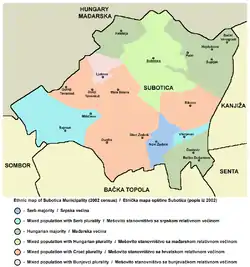
In the 2002 census results published by the Statistical Office of Serbia, Bunjevac dialect was not listed among main languages spoken in Serbia, but those that declared that their language is Bunjevac were listed in category "other languages". For example, in the municipality of Subotica, the number of those listed as speaking "other languages" (presumably Bunjevac) was 8,914.[8]
According 2011 census, 6,835 people declared Bunjevac as their mother tongue and it was listed independently.[1]
Status
Opinions on the status of the Bunjevac speech remain divided. Bunjevac speech is considered a dialect or vernacular of the Serbo-Croatian pluricentric language, by linguists. According to the 2002 census in Serbia, some members of the Bunjevac ethnic community declared that their native language to be Serbian or Croatian. This does not mean that they do not use this specific dialect, but merely that they do not consider it sufficiently distinct from the aforementioned standard languages to register as speakers of a separate language. However, those Bunjevci who declared Bunjevac to be their native language consider it a separate language.[9]
The Bunjevac speech was officially standardized in Serbia in 2018[10] and was approved as standard dialect by the Ministry of Education for learning in schools.[11][12]Theodora Vuković has provided, in 2009, the scientific methodology for the finalization of the standardization proces of the Bunjevac dialect corpus in Serbia.[13]
On March 4, 2021, the municipal council in Subotica has voted in favor of amending the city statute adding Bunjevac speech to the list of official languages in the municipality, in addition to Serbian, Hungarian, and Croatian.[14] This has created a special situation that contradicts the official position, of both the Serbian government and Matica Srpska, that classified Bunjevac speech as a dialect.[15]
History
In the old Austro-Hungarian censuses (for example one from 1910), Bunjevac was declared as a native language of numerous citizens (for example in the city of Subotica 33,247 people declared Bunjevac as their native language in 1910). During the existence of the Kingdom of Yugoslavia and the Socialist Federal Republic of Yugoslavia, members of the Bunjevac ethnic community mostly declared themselves as speaking Serbo-Croatian.
Today, there is wish among the Bunjevac ethnic community for affirmation of their dialect/mother tongue. The Bunjevačke novine is a Bunjevac dialect monthly newspaper published by the Bunjevac National Council in Subotica. The Radio Television of Vojvodina broadcasts TV programme ("Spektar" TV magazine) in Bunjevac. There are also demands for school classes in Bunjevac dialect in Serbia and Croatia.
Notes
- Republički zavod za statistiku / Statistical Office of the Republic of Serbia (2013). Veroispovest, maternji jezik i nacionalna pripadnost: Podaci po opštinama i gradovima / Religion, Mother Tongue and Ethnicity: Data by Municipalities and Cities Вероисповест, матерњи језик и национална припадност: Подаци по општинама и градовима (PDF) (in Serbian and English). Beograd. ISBN 978-86-6161-038-7. Archived from the original (PDF) on 2014-07-15.
- "Grgo Bačlija: Bunjevački je govor, a ne jezik". Hrvatska Riječ (in Croatian). 2021-03-08. Archived from the original on 2021-07-31.
- "Masumi Kameda. Language Ideologies of the Bunjevac Minority in Vojvodina: Historical Backgrounds and the Post-1991 Situation" (PDF). 2014. p. 95-119.
- "In memoriam: Grgo Bačlija (1939. – 2021.)". Hrvatska Riječ. 02-12-2021. p. Hitovi:74.
- "Masumi Kameda. Language Ideologies of the Bunjevac Minority in Vojvodina: Historical Backgrounds and the Post-1991 Situation" (PDF). 2014. p. 113 (95-119).
- "REČNIK BAČKIH BUNJEVACA".
- "Sombor: Predstavljen "Rječnik govora bačkih Hrvata" akademika dr. Ante Sekulića/".
- Republički zavod za statistiku Srbije (2003). Stanovništvo: popis stanovništva, domaćinstava i stanova u 2002 Становништво: попис становништва, домаћинстава и станова у 2002 (PDF) (in Serbian). Beograd. ISBN 86-84433-00-9. Archived from the original (PDF) on 2010-11-13. Retrieved 2009-02-20.
- Vuković, Petar (2020). "The Bunjevci of Bačka: Identities and Language Practices". Linguistic Minorities in Europe Online. Berlin: De Gruyter Mouton. doi:10.1515/lme.11420227.
- "Odluka o utvrđivanju standarda bunjevačkog jezika: 18/2018-192" Одлука о утврђивању стандарда буњевачког језика: 18/2018-192 [Decision of the National Council of Bunjevci no. 18/2018-192] (in Serbian). Archived from the original on 2021-09-02. Retrieved 2020-07-30 – via Pravno-informacioni sistem RS.
- (in Serbian) https://web.archive.org/web/20200609204421/http://www.pravno-informacioni-sistem.rs/SlGlasnikPortal/viewdoc?regactid=430473&doctype=reg&findpdfurl=true. Archived from the original on 2020-06-09. Retrieved 2020-07-30 – via Pravno-informacioni sistem RS. Missing or empty
|title=(help) - Šolaja, Dragan (2007-10-25). "Bunjevački jezik u školskom programu". Blic (in Serbian). Archived from the original on 2012-10-08. Retrieved 2011-05-25.
- "Vuković,Theodora. Izrada modela dijalekatskog korpusa bunjevačkog govora".
- Tumbas, Nikola (2021-03-04). "Podržan predlog gradonačelnika Bakića da i bunjevački postane službeni jezik u Subotici". Subotica.info (in Serbian). Archived from the original on 2021-03-09. Retrieved 2021-03-04.
- Bošnjaković, Žarko; Sikimić, Biljana (2013). Bunjevci: Etnodijalektološka istraživanja 2009 (in Serbian). Subotica and Novi Sad: Nacionalni savet bunjevačke nacionalne manjine and Matica srpska. Archived from the original on 2021-09-02. Retrieved 2021-07-26.
External links
- An opinion on the Bunjevac dialect, issued by Croatian Academy of Sciences and Arts, at the request of the Council of Vojvodina Croats
- bunjevac.com
- bunjevac.org
- Bunjevac Croatian Cultural and Educational Society in Serbia, Matija Gubec Tavankut, matijagubec.rs
- Bunjevac National Council in Serbia, bunjevci.net
- Deset godina bunjevačkog govora u osnovnim školama (2016). subotica.info
- Bunjevački jezik u školskom programu
- Bunjevci in Senj (Croatia),
- Croat National Council in Serbia (Bunjevci, Coats, Šokci), hnv.org.rs
- Croatian Cultural Centre "Bunjevačko kolo" for Croats, Bunjevci, and Sokci in Serbia
- HIC Međunarodni znanstveni skup "Jugoistočna Europa 1918.-1995."
- Hrvatska revija br. 3/2005. Proslava 250. obljetnice doseljavanja veće skupine Bunjevaca (1686.-1936.) – Bunjevci u jugoslavenskoj državi
- Ivan Ivanić: O Bunjevcima (Subotica, 1894)
- Representations of Bunjevci in Hungary
- The Croatian Bunjevci, croatianhistory.net