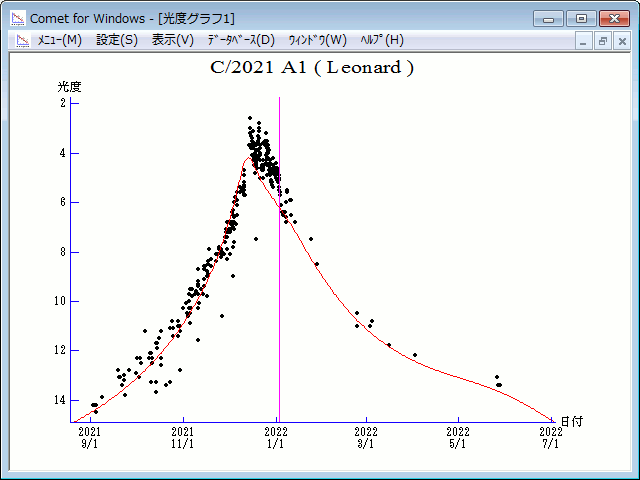
C/2021 A1 (Leonard)
C/2021 A1 (Leonard) is an inbound long period comet[4] discovered by G. J. Leonard at the Mount Lemmon Observatory on 3 January 2021 (a year before perihelion) when the comet was 5 AU (750 million km) from the Sun.[1] This is the first comet discovered in 2021 and has a retrograde orbit. On 12 December 2021 the comet will be 0.233 AU (34.9 million km) from Earth and on 18 December 2021 will be 0.028 AU (4.2 million km) from Venus.[3] It will make its closest approach to the Sun on 3 January 2022. On 10 October the comet showed a short but dense dust tail.[5] As of early December the comet has a total magnitude (coma+nucleus) of around 6.[6] The first reports of naked eye observations by experienced observers started coming in on 5 December 2021.[7] Much like observing Messier 33, the low surface brightness of the comet can make it difficult to observe near urban areas. If it reaches an apparent magnitude of 4, it should be a good binocular comet.[8]
_(51710827445).jpg.webp) Comet C/2021 A1 imaged on 28 Nov 2021 from Bayfordbury, UK (39 minutes of stacked images) | |
| Discovery | |
|---|---|
| Discovered by | Greg J. Leonard |
| Discovery date | 3 January 2021[1] |
| Alternative designations | C4AGJ62 |
| Orbital characteristics A | |
| Observation arc | 526 days |
| Orbit type | long period (inbound) hyperbolic (outbound) |
| Aphelion | ≈3700 AU (barycentric epoch 1950)[2] |
| Perihelion | 0.6151 AU |
| Eccentricity | 0.99966 (barycentric epoch 1950)[2] 1.00004 (barycentric epoch 2100) |
| Orbital period | ≈80000 yr (inbound)[2] |
| Inclination | 132.68° |
| Node | 255.86° |
| Argument of periapsis | 225.09° |
| Earth MOID | 0.231 AU (34.6 million km)[3] |
| Jupiter MOID | 0.296 AU (44.3 million km) |
| Comet total magnitude (M1) | 5.3 |
| Next perihelion | 3 January 2022 (followed by ejection) |
On the morning of 6 December 2021 the comet was about 5 degrees from the star Arcturus. On 14 December 2021 the comet will be 14.7 degrees from the Sun[9] and will quickly become better seen from the southern hemisphere. The forward scattering of light may have caused the comet to brighten to as much as magnitude 2.5,[6][10] but since the comet will be lower in the sky, atmospheric extinction will offset much of the brightening.
C/2021 A1 has been inside of the orbit of Neptune since May 2009.[11] Using an epoch of 1950 which is well before the comet entered the planetary region of the Solar System, a barycentric orbit solution suggests the comet had roughly a 80 thousand year orbital period.[2] Therefore the comet had spent the last 40 thousand years inbound from approximately 3,700 AU (550 billion km). After perihelion the comet will be ejected from the Solar System. The barycentric orbit will remain hyperbolic after September 2022.[2]

C/2021 A1 · Sun · Mercury · Venus · Earth · Mars
The nucleus is about 1 km (0.6 mi) across. It will approach Venus, passing within 4 million km (2.5 million mi) of the planet, the closest-known cometary approach to Venus.[12]
References
- "MPEC 2021-A99 : COMET C/2021 A1 (Leonard)". Minor Planet Center. Retrieved 2021-01-10.
- Horizons output. "Barycentric Osculating Orbital Elements for Comet C/2021 A1 (Leonard)". Retrieved 2021-01-13. (Solution using the Solar System's barycenter (Sun+Jupiter). Select Ephemeris Type:Elements and Center:@0) Epoch 1950 has PR= 2.91E+07 / 365.25 = 79700 years
- "JPL Small-Body Database Browser: C/2021 A1". JPL. Retrieved 2021-09-29.
- CBET 4907: original 1/a = +0.000575 (long-period) and future 1/a = -0.000030 (hyperbolic). The orbital energy is inversely proportional to negative semi-major axis. Objects in hyperbolic orbits have negative semi major axis, giving them a positive orbital energy.
- "How Bright Will Comet Leonard Get?". Sky & Telescope. 2021-10-13. Retrieved 2021-10-20.
- "C/2021 A1 (Leonard)". Gideon van Buitenen. Retrieved 2021-11-16.
- Martin McKenna naked eye
- Magnitude estimate – Seiichi Yoshida
- Horizons output. "Solar elongation Comet C/2021 A1 (Leonard) in mid-December 2021". Retrieved 2021-10-17. Sun-Observer-Target (S-O-T)
- Qiсһеng Ζһаng from Pasadena on 14 Dec 2021
- Neptune has perihelion (closest approach to the Sun) at 29.8 AU. C/2021 A1 has been inside that distance since May 2009.
- Weule, Genelle (8 December 2021). "Astronomers anxiously watch Comet Leonard to see if it will live up to predictions as a Christmas treat over Australia". ABC News. Australian Broadcasting Corporation. Retrieved 8 December 2021.
2021 in space | ||
|---|---|---|
| ||
| Space probe and telescope launches  |    | |
| Impact events | ||
| Selected NEOs | ||
| Exoplanets |
| |
| Discoveries |
| |
| Comets | ||
| Space exploration |
| |
| ||