CCIR System M
CCIR (or FCC) System M, sometimes called 525 line, is the analog broadcast television system used in the United States since July 1, 1941, and also in most of the Americas and Caribbean, South Korea, and Taiwan. Japan uses System J, which is nearly identical to System M. The systems were given their letter designations in the ITU identification scheme adopted in Stockholm in 1961. Both System M and System J display 525 lines of video at 30 frames per second using 6 MHz spacing between channel numbers, and is used for both VHF and UHF channels.
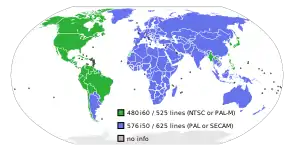
Currently (as of 2015), Systems M and J are being replaced by digital broadcasting in countries such as the Americas, Japan, South Korea, Taiwan and the Philippines.
Specifications
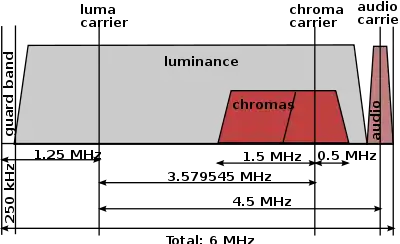
| System | Lines | Frame rate | Channel b/w | Visual b/w | Sound offset | Vestigial sideband | Vision mod. | Sound mod. | Notes |
|---|---|---|---|---|---|---|---|---|---|
| J | 525 | 60i (59.94i NTSC) | 6 | 4.2 | +4.5 | 0.75 | neg. | FM | Japan (NTSC-J) |
| M | 525 | 60i (59.94i NTSC) | 6 | 4.2 | +4.5 | 0.75 | neg. | FM | Most of the Americas and Caribbean; Myanmar, Philippines, South Korea, Taiwan (all NTSC-M) Brazil (PAL-M) |
Color standards
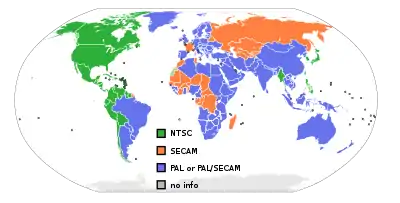
NTSC-M and NTSC-J
Strictly speaking, System M does not designate how color is transmitted. However, in nearly every System M country, NTSC is used for color television, a combination called NTSC-M, but usually referred to more recently as simply "NTSC" because of the relative lack of importance of black-and-white television. In NTSC-M and Japan's NTSC-J, the frame rate is offset slightly, becoming 30⁄1.001 frames per second, usually labeled as the rounded number 29.97.
See also
- NTSC — dominant color system used with System M, so much so that System M is often referred to as "NTSC". Much of the information in the NTSC article is actually about System M.
- Broadcast television systems — explains other types of television system standards
- Multichannel television sound — usual method for adding stereo to System M audio