Caber toss
The caber toss is a traditional Scottish athletic event in which competitors toss a large tapered pole called a "caber" (/ˈkeɪbər/). It is normally practised at the Scottish Highland Games. In Scotland, the caber is usually made from a Larch tree and it can be between 16–20 feet (4.9–6.1 m) tall and weighs between 90–150 pounds (6.4–10.7 st; 41–68 kg).[1][2] The term "caber" derives from the Gaelic word cabar, which refers to a wooden beam.[1]
 A caber being tossed at the 2000 New Hampshire Highland Games | |
| Presence | |
|---|---|
| Country or region | Scotland |
| Olympic | No |
The person tossing the caber is called a "tosser" or a "thrower".[3]
It is said to have developed from the need to toss logs across narrow chasms (in order to cross them), lumberjacks needing to transport logs by throwing them in streams,[4] or by lumberjacks challenging each other to a small contest. Although the sport is primarily associated with Scotland, a similar exercise, "casting the bar", was popular in England in the 16th century.[3]
The record for most caber tosses in three minutes is currently held by the Canadian Danny Frame. He managed to perform 16 successful caber tosses on 20 July 2018 at the Heart of the Valley Festival in Middleton, Nova Scotia, Canada.[5]
Objective and technique
The primary objective is to toss the caber so that it turns end over end, falling away from the tosser. Ideally it should fall directly away from the tosser in the "12 o'clock" position. The distance thrown is unimportant.
The tosser balances the caber upright, tapered end downwards, against his or her shoulder and neck, the caber being supported by stewards or fellow-competitors while being placed into position. The tosser then crouches, sliding their interlocked hands down the caber and under the rounded base, and lifts it in their cupped hands. The tosser must balance the caber upright; this is not easy with the heavier end at the top, and less-experienced tossers may be unable to stop the caber falling to one side after lifting it. The tosser then walks or runs a few paces forward to gain momentum, and flips the tapered end upwards so that the large end hits the ground first, and, if well tossed, the caber falls directly away from the tosser.
Weight and strength are essential for success, but technique is also important for balancing the caber when lifting it, and flipping up the held (tapered) end to promote a clean toss.
Scoring
 |
Wikisource has the text of the 1911 Encyclopædia Britannica article "Caber Tossing". |
The straightest end-over-end toss scores highest. If the caber lands on its end but falls back towards the thrower, the score is lower than for any end-over-end throw but is based upon the maximum vertical angle that the caber achieved (side-judging may involve a second judge).
End-over-end tosses are scored according to the hours on a clock, with a 12:00 score being highest (falling directly away from the thrower), down to a 9 or 3 for cabers that reach a vertical, before falling to the side.
Interesting Facts
Here are 10 interesting facts about caber toss
- Caber toss is not purely a Scottish festival of strength. It’s highly popular and celebrated in such countries as Australia, Canada, New Zealand, and the United States of America.
- Caber throwing became popular in the United States thanks to World War I. Both Scottish and American soldiers worked together. When Americans saw that enemy trenches could be breached with the help of cabers, they’ve started to use this technique as well. Competitions between Scottish and American military departments were one of the uniting factors, and eventually the Scottish caber toss experienced was taken to the United States of America.
- In 1927 the caber toss was so popular in Arkansas that many people tried to get a caber for themselves, which lead to extensive lumbering. It speeded the soil erosion, and not only that. Some thieves even stole the telephone poles, making it impossible for some parts of the state to communicate to the world outside.
- Anyone who is competing at the Highland Games event should wear a kilt. It is a national Scottish skirt of men, at a knee-length and made of tartan. Some people use underwear under the kilt, while others may not.
- The Larch tree wood, which is required for tossing the caber, may dry out. That’s why it is usually recommended soaking a caber in water for some time before the competition. It may help to add some weight to the caber, making it even heavier.
- The French caber throwers sometimes exchange the traditional caber with a large champagne cork, which is rather hilarious.
- The caber toss is a discipline, which requires you to train outside. Training indoors may lead to various traumas and is not recommended.
- There are some obvious benefits of such sport discipline. In addition to the growth of the core strength and cardiovascular workout, you will gain a strong back, upper body strength and being more hardy is always good. In addition, your focus and precision will improve, which is useful in regular life situations.
- Caber tossing is not an Olympian discipline, that’s why it may be so unpopular among most world countries.
- Despite the fact that most caber tossers are men, athletic women also make huge success in popularizing caber tossing. Among them, you can find such known persons as Heather Boundy (world record caber thrower) and Celine Freeman-Gibb. The female part of this discipline is quite underrepresented, however, it may change in the future.
Photo gallery
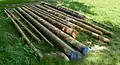 A selection of cabers of various lengths and weights
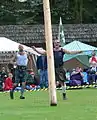
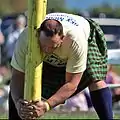 Getting ready to lift
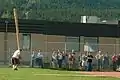 The run-up
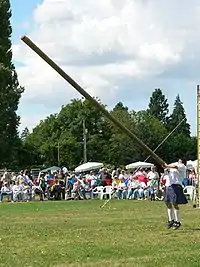 Moment of release
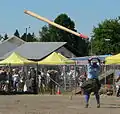 The caber in mid-flight
 The caber strikes the ground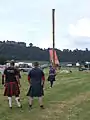
See also
References
- Donaldson, Emily Anne (20 January 2001). Scottish Highland Games in America (New ed.). Pelican Publishing Company. pp. 78–79. ISBN 9781455611713.
- Wilkins, Sally (2002). Sports and games of medieval cultures. Westport, Conn.: Greenwood Press. p. 138. ISBN 9780313360794.
- Chisholm, Hugh, ed. (1911). . Encyclopædia Britannica. 4 (11th ed.). Cambridge University Press. p. 917.
- English, Nick (8 November 2016). "Caber Tossing: Why Hurling Trees Is the Most Delicate Strength Sport". BarBend. Retrieved 20 December 2016.
- "Danny Frame sets caber toss world record with 16 flips at Middleton festival | The Casket". www.thecasket.ca. Retrieved 23 July 2018.
| Events |
|  |
|---|---|---|
| Competitions | ||
| ||
