Camisards
Camisards were Huguenots (French Protestants) of the rugged and isolated Cévennes region and the neighbouring Vaunage in southern France. In the early 1700s, they raised a resistance against the persecutions which followed Louis XIV's Edict of Fontainebleau, making Protestantism illegal. The Camisards operated throughout the religiously mixed Cévennes and Vaunage regions, including parts of the Camargue around Aigues Mortes. The revolt broke out in 1702, with the worst of the fighting continuing until 1704, then skirmishes until 1710 and a final peace by 1715. Protestantism would remain officially illegal in France until the Edict of Tolerance signed in 1787.
| War of the Camisards | |||||||
|---|---|---|---|---|---|---|---|
| Part of the French wars of religion | |||||||
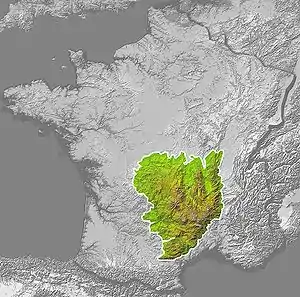 Massif Central in France, showing the Cévennes | |||||||
| |||||||
| Belligerents | |||||||
 Kingdom of France Kingdom of France |
 Huguenot Camisards Huguenot Camisards | ||||||
| Commanders and leaders | |||||||
|
Louis XIV Victor-Maurice, comte de Broglie Nicolas Auguste, maréchal de Montrevel Claude Louis Hector de Villars |
Jean Cavalier Abraham Mazel † Roland Laporte † | ||||||
Etymology
The name camisard in the Occitan language may derive from a type of linen smock or shirt known as a camisa (chemise) that peasants wear in lieu of any sort of uniform. Alternatively, it might come from the Occitan: camus, meaning paths (chemins). Camisada, in the sense of "night attack", is derived from a feature of their tactics.[2]
History
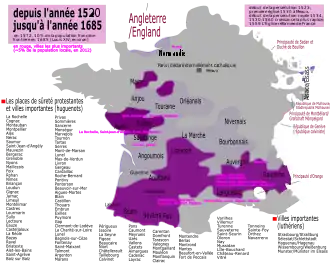
In April 1598, Henry IV had signed the Edict of Nantes and the religious wars that had ravaged France ended. Protestants had been given limited civic rights and the liberty to worship according to their convictions. This "fundamental and irrevocable law" was maintained by Henry's son, Louis XIII. In October 1685, Henry's grandson, Louis XIV (The Sun king), revoked the Edict of Nantes, issuing his own Edict of Fontainebleau. Louis was determined to impose a single religion on France: that of Rome. As early as 1681 he instituted the dragonnades which were conversions enforced by dragoons, labelled "missionaries in boots".[3]
The Edict of Fontainebleau removed all rights and protections from the Huguenots. There followed about twenty years of attempts to convert the minority Huguenots. Within weeks of the new edict several Protestant churches were closed, under the direction of Nicholas Lamoignon de Basville, the royal administrator of Languedoc. Seventy-five missionary priests under the command of Abbot François Langlade were sent to the Cévennes. Huguenots with a trade fled to neighboring countries. The King responded by closing the borders.[3]
The Protestant peasants of the Vaunage and the Cévennes, led by a number of teachers known as "prophets", notably François Vivent and Claude Brousson, resisted. Vivent encouraged his followers to arm themselves in case they were set upon by Royalist soldiers. Several leading prophets, tortured and killed innocent catholics. Since many Huguenot congregations were under the leadership of less educated and more mystically-oriented preachers, such as the wool-comber Abraham Mazel they likened The Catholic church was likened to the Beast of the Apocalypse and the clandestine prophets claimed to have seen it in the prophetic dreams. Mazel, in a dream, saw black oxen in his garden and heard a voice telling him to chase them away. From 1700 the clandestine prophets and their armed followers were hidden in houses and caves in the mountains.[3] [4]
Abraham Mazel
Open hostilities began on 24 July 1702, with the assassination at le Pont-de-Montvert of the conciliatory priest François Langlade, the Abbé of Chaila. Langlade had successfully converted several protestants back to catholicism.[5] The band of Camisards were led by Abraham Mazel, commenced the killing.[6] The abbé was recognized by the Catholics as a martyr of his faith.
The Camisards worked independently of each other and during the day most merged back into their village communities. They were predominantly agricultural workers or artisans and had no aristocratic leaders. They knew the paths and the sheep tracks intimately.
Jean Cavalier
Led by the young Jean Cavalier and Pierre Laporte (Rolland), the Camisards fought the royal army with irregular warfare methods and often failed against superior forces in several pitched battles.[7]
Violence increased as atrocities were committed by the protestants on innocent Catholics: massacres in Catholic villages such as Fraissinet-de-Fourques, Valsauve and Potelières by camisards. Basville, a government administrator protected entire catholic populations of Mialet and Saumane. Then in the autumn of 1703, with the king's consent, several camisards were exiled.[2]
Other Protestants, like those of Fraissinet-de-Lozère, under the influence of village elites, chose a loyalist attitude and fought the Camisards.[8]
White Camisards, also known as "Cadets of the Cross" ("Cadets de la Croix", from a small white cross which they wore on their coats), were Catholics from neighboring communities such as St. Florent, Senechas and Rousson who, on seeing their old enemies on the run, organized into companies in self defense.[2].
Other opponents of the Protestants included six hundred miquelet marksmen from Roussillon hired as mercenaries by the King.
In 1704, Claude Louis Hector de Villars, the royal commander, restored order. Scattered fighting went on until 1710, but the true end of the uprising was the arrival in the Cévennes of the Protestant minister Antoine Court and the reestablishment of a microscopic Protestant community that was largely left in peace, especially after the death of Louis XIV in 1715.
The people
42% of the Camisards were Cévennes peasants, and 58% were rural craftsmen, of whom 75% worked as wool-combers, wool-carders and weavers. All spoke Occitan. There were no noblemen involved, none had been trained in the art of war. There was no concept of a single army, there was no single leader but every region had its permanent organisers and occasional soldiers.[2]
The leaders of note were:
- Gédéon Laporte
- Salomon Couderc with Abraham Mazel in Le Bougès and Mont Lozère.
- Henri Castanet (1674-1705) in charge of Mont Aigoual.
- Pierre Laporte (Rolland) (1680-1704) in the Basses-Cévennes, Mialet and Lassalle.
- Jean Cavalier (1681-1704) in the plains of Bas-Languedoc between Uzès and Sauve.[2]
Religiously, ordained pastors were rounded up, and a series of prophets ministered secretly. Notable among them were:
- Esprit Séguier
- Abraham Mazel
- Elie Marion
- Jean Cavalier
The visions of the prophets inspired the operations of the war, and encouraged the peasants to feel invincible. The peasants marched singing Psalms — which unnerved the opposition.[2]
1701
- June: the Vallérargues affair, when people seized back captured prophets from priests.[5]
1702
- 24 July: assassination of François Langlade, Abbé du Chayla, two priests and Catholic family at Dévèze.
- 12 August: Execution of Esprit Séguier. Traditional start of the War.
- 11 September: Battle at Champdomergue, a hill near (Le Collet-de-Dèze) with no clear outcome.
- 22 October: Battle at Témélac. Gédéon Laporte killed and his head displayed at Barre-des-Cévennes, Anduze, Saint-Hippolyte and Montpellier.
- 24 December: Jean Cavalier took the 700 strong garrison town of Alès. He led 70 Camisards.
- 28 December: The Camisards took Sauve.[5][9]
1703
- 12 January: Jean Cavalier took Val de Barre (Nîmes) from royalist Count de Broglie.
- February: Count de Broglie relieved of his duties and replaced by Field-Marshal de Montrevel. More troops deployed.
- 26 February: The Camisards under Castenet massacred the inhabitants of Fraissinet-de-Fourques.
- 6 March: Battle of Pompignan - the Camisards lost.
- 1 April: The royalist Moulin de l'Agau massacre.
- April: the deportation of Mialet and Saumane to Perpignan in Roussillon.
- 29 April: Jean Cavalier defeated at Tour de Billot (Alès).
- 18 May: Battle of Bruyès.
- 12 September: massacre of Catholics at Potelières.
- 20 September: massacre of Catholics at Saturargues (Lunel) and Saint-Sériès .
- Autumn: The Burning of the Cévennes policy-villagers were deported from 466 villages which were then torched.
- Autumn: emergence of the Catholic Cadets of the Cross (White Camisards) who looted and pillaged.
- 20 December: Battle of the Madeleines (Tornac).[5][9]
1704
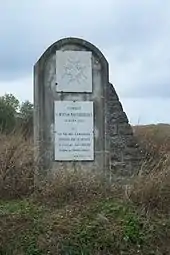
- 15 March: the battle of Devès de Martignargues (Vézénobres). Jean Cavalier defeated a Catholic regiment
- March: Field-marshal de Montrevel was relieved of his duties and replaced by Field-marshal de Villars.
- 16 April: de Montrevel defeated Cavalier at the Battle of Nages (while waiting for de Villars arrival)
- 19 April: Cavalier's stores discovered in caves at Euzet
- 20 April: de Villars assumes command and suggests negotiation
- May: negotiations start, Cavalier accepts unconditional surrender and a command in the royal army
- 13 August: Pierre Laporte (Rolland) dies at Castelnau-les-Valence
- October: Other leaders leave France.[5][9]
Heritage
Jean Cavalier later went over to the British, who made him Governor of the island of Jersey.
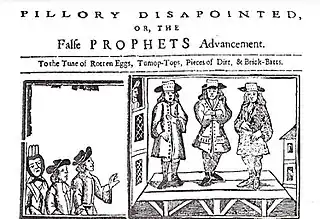
A millenarian group of ex-Camisards under the guidance of Elie Marion emigrated to London in 1706, and were said to have links with the Alumbrados. They were generally treated with scorn and some official repression as the "French Prophets".[10] Their example and their writings had some influence later, both on the spiritual outlook of Jean-Jacques Rousseau and on Ann Lee, founder of the Shaker movement.
Role in the survival of Protestantism in France
After the main active Camisard groups had been subdued in various ways, the French authorities were keen not to re-ignite the revolt and took a more moderate approach to anti-Protestant repression. Many former Camisards came back to a more peaceful approach and from 1715 onwards helped re-establish a still illegal but now much better organised Protestantism. They were under the leadership of Antoine Court and of the numerous travelling pastors who were permitted to re-enter the country.[11]
"The Camisards' legend"
In his book with the title La légende des Camisards, Philippe Joutard, a Professor of History, registered the very lively oral tradition about the Camisards which has prevailed to this day in the Cévennes region. He also observed the "attractive power" of this striking period of history where many unrelated episodes have been integrated through the oral tradition. As this oral transmission is mainly done through the families, it often highlights more of their own ancestors who were faithful to their convictions than the heroic leaders of the revolt. In so doing it develops beyond the original religious question to a general attitude of resistance and non-conformity which determines a whole philosophical, political and human culture and way of life.[12] Philippe Joutard also noted that even the Catholic majority living in this part of the country tend to reconstruct their history in the same way as their former religious opponents.[12] The footprint of the Camisards in Cévennes is thus particularly deep and lasting.
Further reading
Although most of the sources are in French and remain untranslated, there are a number of sources available in English:
- Alexandre Dumas, Massacres of the South (1551-1815): Celebrated Crimes, Full text (ebook) 192pp, Retrieved 21 September 2016 ISBN 1-40695-136-6
- Henry Martyn Baird (1890). The Camisard Uprising of the French Protestants. New York: G.P. Putnam's Sons. [reprint of article in: Papers of the American Society of Church History (1889)]
- H. M. Baird (1895), Huguenots and the Revocation of the Edict of Nantes ISBN 1-59244-636-1[13]
- Christian Mühling: Die europäische Debatte über den Religionskrieg (1679-1714). Konfessionelle Memoria und internationale Politik im Zeitalter Ludwigs XIV. (Veröffentlichungen des Instituts für Europäische Geschichte Mainz, 250) Göttingen, Vandenhoeck&Ruprecht, ISBN 9783525310540, 2018.
- Eugène Bonnemère (1882). Les dragonnades: Histoire des Camisards (in French). Paris: E. Dentu.
- Philippe Joutard (2015). Les Camisards (in French). Paris: Editions Gallimard. ISBN 978-2-07-258367-4.
- Napoléon Peyrat (1842). History of the Desert Fathers: from the revolution of the Edict of Nantes to the French Revolution, 1685-1789.
- Robert Louis Stevenson (1879), Travels with a Donkey in the Cévennes. Travel literature.
- Brian Eugene Strayer (2001). Huguenots and Camisards as Aliens in France, 1598-1789: The Struggle for Religious Toleration. Lewiston, N.Y.: E. Mellen Press. ISBN 978-0-7734-7370-6.
- Samuel Rutherford Crockett (1903), Flower-o'-the-Corn. Historical fiction.†
- The revolt of the Protestants of the Cevennes, with some account of the Huguenots in the seventeenth century by Bray, Mrs. (Anna Eliza), 1790-1883[14]
- Memoirs of the wars of the Cevennes, under Col. Cavallier, : in defence of the Protestants persecuted in that country. : And of the peace concluded between him and the Mareschal D. of Villars. : Of his conference with the King of France, after the conclusion of the peace. : With letters relating thereto, from Mareschal Villars, and Chamillard secretary of state: : As also, a map describing the places mentioned in the book. by Cavalier, Jean, 1681-1740[15]
- Cavallier and the Camisards[16]
† The story begins with the allied armies at Namur following the 1704 Battle of Blenheim, before the scene shifts to the Causse du Larzac (Chapter IV).
External links
 |
Look up Camisard in Wiktionary, the free dictionary. |
 |
Wikimedia Commons has media related to Camisards. |
- A full history of the Camisards (in French with some sections also in English).
- Regordane Info - The independent portal for The Regordane Way or St Gilles Trail (in English and French)
Notes and references
- Notes
- Onnekink, David (2013). War and Religion after Westphalia, 1648–1713. Ashgate Publishing. p. 7. ISBN 9781409480211. Retrieved 13 June 2018.
- Bersier 2016.
- Schlegel 2008.
- Antoine Court de Gébelin (2009), Histoire des troubles des Cévennes ou de la guerre des camisards sous le règne de Louis le Grand, reprint of the original text printed in 1760. Editions Lacour-Ollé, Nîmes (in French).
- Rolland, Pierre. "La Guerre des Camisards". Camisards.net. 48160 St-Martin-de-Boubaux: Association d'étude et de recherche sur les camisards. Archived from the original on 2016-11-10. Retrieved 30 August 2016.CS1 maint: location (link)
- Pierre-Jean Ruff, 2008. Le Temple du Rouve: lieu de mémoire des Camisards. Editions Lacour-Ollé, Nîmes.
- Ana Eliza Bray (1870), The Revolt of the Protestants of the Cevennes, with some account of the Huguenots in the seventeenth century. John Murray, London.
- Ghislain Baury, La dynastie Rouvière de Fraissinet-de-Lozère. Les élites villageoises dans les Cévennes protestantes d'après un fonds d'archives inédit (1403-1908), t. 1: La chronique, t. 2: L'inventaire, Sète, Les Nouvelles Presses du Languedoc, 2011, http://sites.google.com/site/dynastierouviere/
- Bersier, Eugène. "The progress of the war 1702-1704". Virtual Museum of Protestantism. Fondation pasteur Eugène Bersier. Retrieved 30 August 2016.
- Laborie, Lionel (2019). "French Prophets". Oxford Dictionary of National Biography. Oxford University Press. Retrieved 6 September 2019.
French Prophets (act. 1706–c.1750) were a controversial millenarian movement that appeared in England in 1706 and anticipated the evangelical awakening of the 1730s.
- Philippe Joutard, Les Camisards, Gallimard 1976, rédité en coll. Folio Histoire en 1994, pp.217-219
- Philippe Joutard, La légende des Camisards, NRF Gallimard, 1977, p. 355
- Baird, Henry Martyn (1895). The Huguenots and the revocation of the Edict of Nantes. New York: C. Scribner's sons. p. 450. Retrieved 14 September 2018.
- Bray, Anna Eliza (1870). The revolt of the Protestants of the Cevennes, with some account of the Huguenots in the seventeenth century. London: J. Murray. Retrieved 16 September 2018.
- Cavalier, Jean (1726). Memoirs of the wars of the Cevennes, under Col. Cavallier, : in defence of the Protestants persecuted in that country. : And of the peace concluded between him and the Mareschal D. of Villars. : Of his conference with the King of France, after the conclusion of the peace. : With letters relating thereto, from Mareschal Villars, and Chamillard secretary of state: : As also, a map describing the places mentioned in the book. London: Printed for J. Stephens ... Retrieved 16 September 2018.
- "Cavallier and the Camisards". The Edinburgh Review or Critical Journal. 104: 123–160. July–October 1856. Retrieved 16 September 2018.
- References
- Bersier, Eugène. "The Camisards". Virtual Museum of Protestantism. Fondation pasteur Eugène Bersier. Retrieved 29 August 2016.
- Schlegel, Doug (2008). "The Camisards". Leben: A Journal of Reformation Life. 4 (4). Archived from the original on 2016-08-27. Retrieved 21 September 2016.
Authority control  | |
|---|---|
| General | |
| National libraries | |