Uzès
Uzès (French pronunciation: [y.zɛs]; Occitan: Usès) is a commune in the Gard department in the Occitanie region of Southern France. In 2017, it had a population of 8,454. Uzès lies about 25 kilometres (16 miles) north-northeast of Nîmes, 40 kilometres (25 miles) west of Avignon and 32 kilometres (20 miles) south-east of Alès.
Uzès
| |
|---|---|
.jpg.webp) View of part of the town centre with Saint-Théodorit Cathedral and Fenestrelle Tower | |
 Coat of arms | |
Location of Uzès 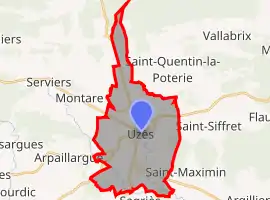
| |
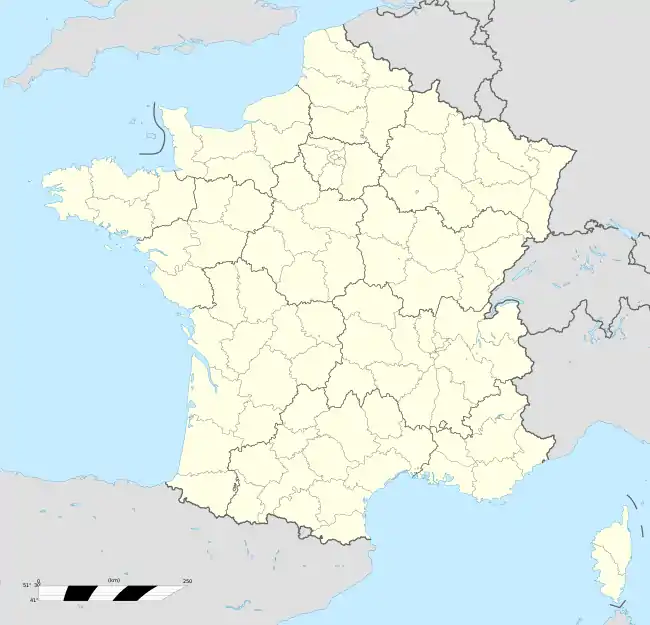  Uzès 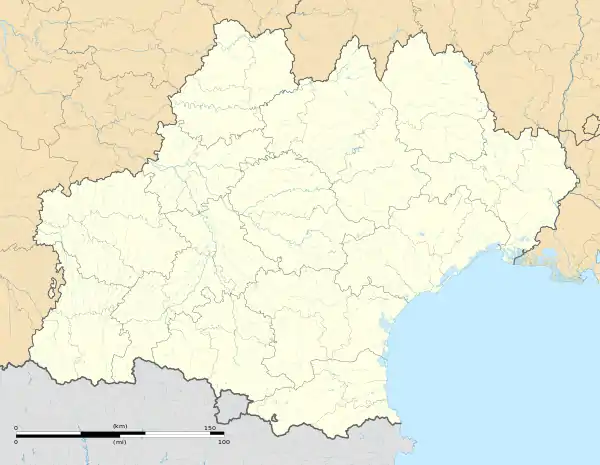 Uzès | |
| Coordinates: 44°00′47″N 4°25′14″E | |
| Country | France |
| Region | Occitanie |
| Department | Gard |
| Arrondissement | Nîmes |
| Canton | Uzès |
| Government | |
| • Mayor (2020–2026) | Jean-Luc Chapon |
| Area 1 | 25.41 km2 (9.81 sq mi) |
| Population | 8,420 |
| • Density | 330/km2 (860/sq mi) |
| Time zone | UTC+01:00 (CET) |
| • Summer (DST) | UTC+02:00 (CEST) |
| INSEE/Postal code | 30334 /30700 |
| Elevation | 49–274 m (161–899 ft) (avg. 167 m or 548 ft) |
| 1 French Land Register data, which excludes lakes, ponds, glaciers > 1 km2 (0.386 sq mi or 247 acres) and river estuaries. | |
History
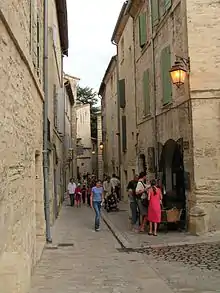
Originally Ucetia or Eutica in Latin, Uzès was a small Gallo-Roman oppidum, or administrative settlement. The town lies at the source of the Alzon river, at Fontaine d'Eure, from where a Roman aqueduct was built in the first century BC, to supply water to the local city of Nîmes, 50 kilometres (31 miles) away. The most famous stretch of the aqueduct is the Pont du Gard, now a World Heritage site,[2] which carried fresh water over splendid arches across the river Gardon.
The civilized and tolerant urban life of 5th-century Uzès contrasted with the Frankish north. Jews were apparently settled there as early as the 5th century. Saint Ferréol, Bishop of Uzès, allegedly admitted them to his table; on this account complaint was made of him to King Childebert I, whereupon the bishop was obliged to change his attitude toward the Jews, compelling all those who would not become Christians to leave Uzès. After his death (581) many who had received baptism returned to Judaism.[3] Jews were expelled from the region in 614.
In early 8th century, Uzès was a fortified civitas and bishopric under the Archbishop of Narbonne. During the Umayyad conquest of Gothic Septimania, Uzès became the northernmost stronghold of Muslim Spain circa 725. Charles Martel went on to lay siege to the stronghold in 736, but it remained in Gothic-Andalusian hands up to 752, when counts loyal to Ansemund of Nîmes handed over a large number of strongholds to the Frankish Pepin the Short. In 753 the stronghold rebelled against the Franks after Ansemund's assassination, but the uprising was suppressed and a Frankish trustee of Pepin imposed.
In the 13th century, Uzès hosted a small community of Jewish scholars, as well as a community of Cathars.
Like many cloth-manufacturing centers (Uzès was known for its serges), the city and the surrounding countryside were strongly Protestant during the Wars of Religion in the 16th century, which wreaked havoc in Languedoc. Numerous of the city's churches were trashed and burned by furious Protestants: only two remain today. One such destroyed and rebuilt church is Saint-Étienne.
Ucetia
Located in the Occitanie region of France, two of the most recent clues about the city of Ucetia came from when archaeologists found a stela in Nîmes, along with about 11 other Roman towns,[4] with Ucetia's name written in Latin as "VCETIAE".[5] This city was under the territory of Nemausus (Nîmes).[6] Ucetia also went by another name of Castrum Uceciense, which is in the Notitia of the Provinces of Gallia.[5]
Later on, archaeologists had also recently found mosaics in 2017 on accident while doing construction at a local high school that further proved Ucetia's ancient existence.[4] The mosaics were shown to have depictions of animals such as: a deer, an owl, an eagle, and bulls.[4] These animals on the mosaics were said to be an "honor to the Roman gods".[7] Many of these animals were also seen as important animals during that time. For many European cultures, deer represent deities of the woodlands[8] and owls were seen as harbingers of death for the Romans.[9] Amongst the animals were also decorations that included water, geometric shapes, colours, and patterns. The mosaics are being preserved in the area that they were originally found.
Ancient Population of Ucetia
The exact population of Ucetia is not known. There were people that inhabited the city in the 1st century B.C. until the 7th century A.D.[10] There was a gap of time where there were no people that inhabited the city between the 3rd and 4th centuries B.C.
Ucetia and Pont du Gard
Ucetia was known to have been a place where ancient Romans could get water, and while the population of Ucetia isn't known, the population in Nîmes had grown to 30,000 people[11] because of the water supply due to the connections with the Pont du Gard aqueduct. Given the water was now plentiful, this led to a "classic Roman tragedy" of greed in the nearby cities and towns.[12]
Dukes of Uzès
The title of Duke of Uzès, in the family de Crussol d'Uzès, is the premier title in the peerage of France, coming right after the princes of the blood. The title of seigneur d'Uzès is attested in a charter of 1088. After part of Languedoc was attached to royal demesne (1229), the lords' (and later dukes') military skill and fealty to the Crown propelled their rise through the nobility, until, after the treason of the last Duke of Montmorency, beheaded in 1632, the title of First Duke of France fell to Uzès, who retain their stronghold in the center of town today, which has expanded round the 11th century Tour Bermond. If France were a kingdom, it would be the job of the duke of Uzès to cry out, "Le Roi est mort. Vive le Roi!" at each state funeral, and defend the honour of the queen mother. Twenty-one dukes have been wounded or killed as hereditary Champion of France over the centuries.
Sights
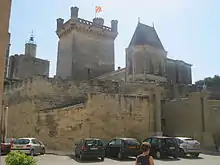
The present-day city retains the trace of its walls as a circuit of boulevards. A Capuchin chapel, built in 1635 to house the mortal remains of the dukes, occupies the site of a 1st-century AD temple dedicated to the first Roman Emperor, Augustus. There are monuments of the prestige of the former bishopric, once one of the most extensive of Languedoc, but extinguished at the Revolution, and private houses that witness the wealth that the textile trade brought in the 16th century. The town is also homes to three feudal towers, the Bermonde Tower (part of the château du Duché), the Bishop Tower and the Royal Tower.
Uzès Cathedral was destroyed in the Albigensian Crusade, rebuilt, and destroyed again in the 16th century Wars of Religion. Rebuilt again in the 17th century, it was stripped out during the French Revolution. The 11th century Romanesque Tour Fenestrelle ("Window Tower"), with its paired windows, is probably the most famous icon of the city. It was listed as a French Historical Monument in 1862.[13]
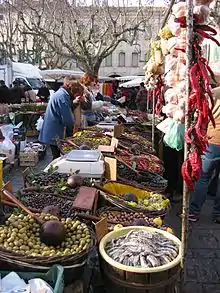
Uzès is famous in the area for its Saturday market. Not only does the market offer local produce, but it also boasts textiles made in the region and many tourist delights.[14]
Economy
Tourism is one of the key industrial sectors, alongside the local arts scene and wine making.
The region has a long history in the production of licorice. The German company Haribo maintains a factory and museum in Uzès, which traces its roots back to the licorice factory Henri Lefont opened there in 1862. His company later merged with Ricqlès, and was then taken over by Haribo.[15]
Population
| Year | Pop. | ±% |
|---|---|---|
| 1793 | 6,150 | — |
| 1800 | 6,350 | +3.3% |
| 1806 | 6,287 | −1.0% |
| 1821 | 5,684 | −9.6% |
| 1831 | 6,162 | +8.4% |
| 1836 | 6,856 | +11.3% |
| 1841 | 7,274 | +6.1% |
| 1846 | 7,215 | −0.8% |
| 1851 | 6,934 | −3.9% |
| 1856 | 6,333 | −8.7% |
| 1861 | 6,242 | −1.4% |
| 1866 | 5,895 | −5.6% |
| 1872 | 5,574 | −5.4% |
| 1876 | 5,585 | +0.2% |
| 1881 | 5,449 | −2.4% |
| 1886 | 5,146 | −5.6% |
| 1891 | 4,989 | −3.1% |
| 1896 | 4,819 | −3.4% |
| 1901 | 4,889 | +1.5% |
| 1906 | 5,182 | +6.0% |
| 1911 | 4,804 | −7.3% |
| 1921 | 4,098 | −14.7% |
| 1926 | 4,456 | +8.7% |
| 1931 | 4,212 | −5.5% |
| 1936 | 4,033 | −4.2% |
| 1946 | 4,667 | +15.7% |
| 1954 | 5,222 | +11.9% |
| 1962 | 5,649 | +8.2% |
| 1968 | 6,851 | +21.3% |
| 1975 | 7,078 | +3.3% |
| 1982 | 7,525 | +6.3% |
| 1990 | 7,649 | +1.6% |
| 1999 | 8,007 | +4.7% |
| 2008 | 8,213 | +2.6% |
Notable people
- Firmin Abauzit (1679–1767), scholar who worked on physics, theology and philosophy
- Vice-Admiral François-Paul Brueys D'Aigalliers, Count de Brueys, (1753–1798), the French commander in the Battle of the Nile.
- Bernard Plantapilosa, later Count of Auvergne and second son of Dhuoda who was famous for her medieval literature Liber Manualis.
- David Redfern (1936–2014) English music photographer
- Leon Krier, urbanist[16]
- Suzanne Verdier (1745–1813), writer
- Oliver Bevan (2001-) English artist
See also
References
- "Populations légales 2018". The National Institute of Statistics and Economic Studies. 28 December 2020.
- "Pont du Gard (Roman Aqueduct)". UNESCO.
- Gallia Christiana, vi. 613; Dom Vaissète, Histoire Générale de Languedoc, i. 274, 545
- "Stunning mosaics shed light on enigmatic past of Roman city in southern France". International Business Times UK. 2017-03-29. Retrieved 2021-12-03.
- "Dictionary of Greek and Roman Geography (1854), UCETIA". www.perseus.tufts.edu. Retrieved 2021-12-03.
- Winkle, Christian (2006-10-01), "Ucetia", Brill’s New Pauly, Brill, retrieved 2021-12-03
- "Uzès, City of Art and History | World Heritage Journeys of Europe". visitworldheritage.comhttps. Retrieved 2021-12-03.
- "Deer mythology and folklore". Trees for Life. Retrieved 2021-12-03.
- "Owl myths to keep you up at night | Chesapeake Bay Program". www.chesapeakebay.net. Retrieved 2021-12-03.
- Carlos, Naia (2017-04-04). "Lost Ancient City of Ucetia Finally Found With Iconic Roman Mosaics". Nature World News. Retrieved 2021-12-03.
- Rasmussen, Clare Kathleen (2017). "A Comparative Analysis of Roman Water Systems in Pompeii and Nîmes". The University of Arizona: 50.
- Courtice, Paul (1997-04-01). "Water-Worshipers of Nemausus". Journal of Professional Issues in Engineering Education and Practice. 123 (2): 78–81. doi:10.1061/(ASCE)1052-3928(1997)123:2(78). ISSN 1052-3928.
- Base Mérimée: Ancienne cathédrale Saint-Théodorit, Ministère français de la Culture. (in French)
- - Delights of Uzes Market
- "Ses espaces - Le Musée du Bonbon Haribo sur Uzès dans le Gard". www.museeharibo.fr. Retrieved 2016-12-05.
- https://shannonchance.net/2013/06/27/discovering-uzes-france/
 This article incorporates text from a publication now in the public domain: Herbermann, Charles, ed. (1913). Catholic Encyclopedia. New York: Robert Appleton Company. Missing or empty
 |title=(help)
Further reading
- d'Albiousse, Lionel (1881). Guide de l'étranger à Uzès (in French). Uzès: H. Malige.
- d'Albiousse, Lionel (1887). Histoire des ducs d'Uzès : suivie d'une notice sur leur château ducal (in French). Paris: H. Champion.
External links
 |
Wikimedia Commons has media related to Uzès. |
- Official website (in French)
- Tourist office website

Authority control  | |
|---|---|
| General | |
| National libraries | |
| Other | |